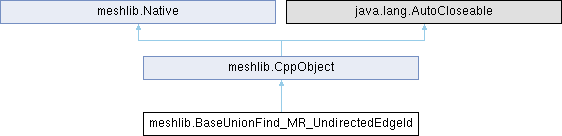
|
MeshLib Java Docs
|
|
MeshLib Java Docs
|
base of union-find data structures: stores only the parent forest and the operations that depend on it alone, so it is shared by the sequential UnionFind and the ParallelUnionFind More...
Additional Inherited Members | |
| Protected Member Functions inherited from meshlib.CppObject | |
| CppObject (java.lang.foreign.MemorySegment ptr, java.util.function.Consumer< java.lang.foreign.MemorySegment > destroy, java.lang.Object owner) | |
base of union-find data structures: stores only the parent forest and the operations that depend on it alone, so it is shared by the sequential UnionFind and the ParallelUnionFind
| I | is the identifier of a set's element, e.g. FaceId |
Generated from class MR::BaseUnionFind<MR::UndirectedEdgeId>. Derived classes: Direct: (non-virtual) MR::UnionFind<MR::UndirectedEdgeId>
Instances created here own their C++ objects, see CppObject.
| meshlib.BaseUnionFind_MR_UndirectedEdgeId.BaseUnionFind_MR_UndirectedEdgeId | ( | java.lang.foreign.MemorySegment | ptr, |
| boolean | owned, | ||
| java.lang.Object | owner ) |
Wraps a pointer from the C bindings. If owned, the object is destroyed when the wrapper dies. owner is kept alive as long as this wrapper is. Not for normal use.
| meshlib.BaseUnionFind_MR_UndirectedEdgeId.BaseUnionFind_MR_UndirectedEdgeId | ( | ) |
Constructs an empty (default-constructed) instance.
Calls MR_BaseUnionFind_MR_UndirectedEdgeId_DefaultConstruct().
| meshlib.BaseUnionFind_MR_UndirectedEdgeId.BaseUnionFind_MR_UndirectedEdgeId | ( | meshlib.BaseUnionFind_MR_UndirectedEdgeId | _other | ) |
Generated from constructor MR::BaseUnionFind<MR::UndirectedEdgeId>::BaseUnionFind. The reference to things referred to by the parameter _other (if any) might be preserved in the constructed object.
Calls MR_BaseUnionFind_MR_UndirectedEdgeId_ConstructFromAnother().
| meshlib.UndirectedEdgeId meshlib.BaseUnionFind_MR_UndirectedEdgeId.add | ( | ) |
adds new element in its own disjoint set, returns its identifier Generated from method MR::BaseUnionFind<MR::UndirectedEdgeId>::add.
Calls MR_BaseUnionFind_MR_UndirectedEdgeId_add().
| meshlib.BaseUnionFind_MR_UndirectedEdgeId meshlib.BaseUnionFind_MR_UndirectedEdgeId.assignFromAnother | ( | meshlib.BaseUnionFind_MR_UndirectedEdgeId | _other | ) |
Generated from method MR::BaseUnionFind<MR::UndirectedEdgeId>::operator=. The reference to things referred to by the parameter _other (if any) might be preserved in this object. The reference to this object might be preserved in the return value.
Calls MR_BaseUnionFind_MR_UndirectedEdgeId_AssignFromAnother().
| meshlib.UndirectedEdgeId meshlib.BaseUnionFind_MR_UndirectedEdgeId.find | ( | meshlib.UndirectedEdgeId | a | ) |
finds the root of the set containing given element with optimizing data structure updates Generated from method MR::BaseUnionFind<MR::UndirectedEdgeId>::find.
Calls MR_BaseUnionFind_MR_UndirectedEdgeId_find().
| meshlib.UndirectedEdgeId meshlib.BaseUnionFind_MR_UndirectedEdgeId.findUpdateRange | ( | meshlib.UndirectedEdgeId | a, |
| meshlib.UndirectedEdgeId | begin, | ||
| meshlib.UndirectedEdgeId | end ) |
finds the root of the set containing given element with optimizing data structure in the range [begin, end) Generated from method MR::BaseUnionFind<MR::UndirectedEdgeId>::findUpdateRange.
Calls MR_BaseUnionFind_MR_UndirectedEdgeId_findUpdateRange().
| boolean meshlib.BaseUnionFind_MR_UndirectedEdgeId.isRoot | ( | meshlib.UndirectedEdgeId | a | ) |
returns true if given element is the root of some set Generated from method MR::BaseUnionFind<MR::UndirectedEdgeId>::isRoot.
Calls MR_BaseUnionFind_MR_UndirectedEdgeId_isRoot().
| meshlib.UndirectedEdgeId meshlib.BaseUnionFind_MR_UndirectedEdgeId.parent | ( | meshlib.UndirectedEdgeId | a | ) |
return parent element of this element, which is equal to given element only for set's root Generated from method MR::BaseUnionFind<MR::UndirectedEdgeId>::parent.
Calls MR_BaseUnionFind_MR_UndirectedEdgeId_parent().
| meshlib.UndirectedEdgeMap meshlib.BaseUnionFind_MR_UndirectedEdgeId.parents | ( | ) |
gets the parents of all elements as is Generated from method MR::BaseUnionFind<MR::UndirectedEdgeId>::parents.
Calls MR_BaseUnionFind_MR_UndirectedEdgeId_parents().
| void meshlib.BaseUnionFind_MR_UndirectedEdgeId.reset | ( | long | size | ) |
resets union-find to represent given number of elements, each element is the only one in its disjoint set Generated from method MR::BaseUnionFind<MR::UndirectedEdgeId>::reset.
Calls MR_BaseUnionFind_MR_UndirectedEdgeId_reset().
| meshlib.UndirectedEdgeMap meshlib.BaseUnionFind_MR_UndirectedEdgeId.roots | ( | ) |
sets the root of corresponding set as the parent of each element, then returns the vector Generated from method MR::BaseUnionFind<MR::UndirectedEdgeId>::roots.
Calls MR_BaseUnionFind_MR_UndirectedEdgeId_roots().
| long meshlib.BaseUnionFind_MR_UndirectedEdgeId.size | ( | ) |
returns the number of elements in union-find Generated from method MR::BaseUnionFind<MR::UndirectedEdgeId>::size.
Calls MR_BaseUnionFind_MR_UndirectedEdgeId_size().
| boolean meshlib.BaseUnionFind_MR_UndirectedEdgeId.united | ( | meshlib.UndirectedEdgeId | first, |
| meshlib.UndirectedEdgeId | second ) |
returns true if given two elements are from one set Generated from method MR::BaseUnionFind<MR::UndirectedEdgeId>::united.
Calls MR_BaseUnionFind_MR_UndirectedEdgeId_united().
| meshlib.std_pair_MR_UndirectedEdgeId_bool meshlib.BaseUnionFind_MR_UndirectedEdgeId.uniteUnbalanced | ( | meshlib.UndirectedEdgeId | first, |
| meshlib.UndirectedEdgeId | second ) |
unites the two sets containing given elements WITHOUT balancing by set size (BaseUnionFind keeps no sizes): it simply attaches one set's root under the other's, so chained calls can build taller trees. Prefer UnionFind::unite, which selects the new root by set size, when many unions follow one another.
Calls MR_BaseUnionFind_MR_UndirectedEdgeId_uniteUnbalanced().
 1.14.0