|
MeshLib Java Docs
|
|
MeshLib Java Docs
|
Additional Inherited Members | |
| Protected Member Functions inherited from meshlib.CppObject | |
| CppObject (java.lang.foreign.MemorySegment ptr, java.util.function.Consumer< java.lang.foreign.MemorySegment > destroy, java.lang.Object owner) | |
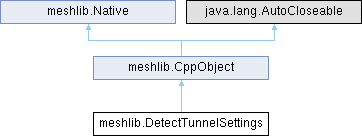
Generated from class MR::DetectTunnelSettings.
Instances created here own their C++ objects, see CppObject.
| meshlib.DetectTunnelSettings.DetectTunnelSettings | ( | java.lang.foreign.MemorySegment | ptr, |
| boolean | owned, | ||
| java.lang.Object | owner ) |
Wraps a pointer from the C bindings. If owned, the object is destroyed when the wrapper dies. owner is kept alive as long as this wrapper is. Not for normal use.
| meshlib.DetectTunnelSettings.DetectTunnelSettings | ( | ) |
Constructs an empty (default-constructed) instance.
Calls MR_DetectTunnelSettings_DefaultConstruct().
| meshlib.DetectTunnelSettings.DetectTunnelSettings | ( | float | maxTunnelLength, |
| int | maxIters, | ||
| meshlib.std_function_float_from_MR_EdgeId | metric, | ||
| boolean | buildCoLoops, | ||
| boolean | filterEquivalentCoLoops, | ||
| meshlib.TunnelLoopType | loopType, | ||
| meshlib.std_function_bool_from_float | progress ) |
Constructs MR::DetectTunnelSettings elementwise. The reference to the parameter metric might be preserved in the constructed object. The reference to the parameter loopType might be preserved in the constructed object. The reference to the parameter progress might be preserved in the constructed object.
Calls MR_DetectTunnelSettings_ConstructFrom().
| meshlib.DetectTunnelSettings.DetectTunnelSettings | ( | meshlib.DetectTunnelSettings | _other | ) |
Generated from constructor MR::DetectTunnelSettings::DetectTunnelSettings. The reference to things referred to by the parameter _other (if any) might be preserved in the constructed object.
Calls MR_DetectTunnelSettings_ConstructFromAnother().
| meshlib.DetectTunnelSettings meshlib.DetectTunnelSettings.assignFromAnother | ( | meshlib.DetectTunnelSettings | _other | ) |
Generated from method MR::DetectTunnelSettings::operator=. The reference to things referred to by the parameter _other (if any) might be preserved in this object.
Calls MR_DetectTunnelSettings_AssignFromAnother().
| boolean meshlib.DetectTunnelSettings.buildCoLoops | ( | ) |
if true then for every basis loop, findSmallestMetricCoLoop will be called; it typically results in shorter tunnels found, but requires more time per iteration, and more iterations to find all tunnels Returns a pointer to a member variable of class MR::DetectTunnelSettings named buildCoLoops. The reference to this object might be preserved as the return value.
Calls MR_DetectTunnelSettings_Get_buildCoLoops().
| boolean meshlib.DetectTunnelSettings.filterEquivalentCoLoops | ( | ) |
if ( buildCoLoops ) then some tunnel loops can be equivalent (e.g. they cut the same handle twice), this option activates their filtering out, but it is very slow Returns a pointer to a member variable of class MR::DetectTunnelSettings named filterEquivalentCoLoops. The reference to this object might be preserved as the return value.
Calls MR_DetectTunnelSettings_Get_filterEquivalentCoLoops().
| meshlib.TunnelLoopType meshlib.DetectTunnelSettings.loopType | ( | ) |
selects what kind of loops to return Returns a pointer to a member variable of class MR::DetectTunnelSettings named loopType. The reference to this object might be preserved as the return value.
Calls MR_DetectTunnelSettings_Get_loopType().
| int meshlib.DetectTunnelSettings.maxIters | ( | ) |
maximal number of iterations to detect all tunnels; on a big mesh with many tunnels even one iteration can take a while Returns a pointer to a member variable of class MR::DetectTunnelSettings named maxIters. The reference to this object might be preserved as the return value.
Calls MR_DetectTunnelSettings_Get_maxIters().
| float meshlib.DetectTunnelSettings.maxTunnelLength | ( | ) |
maximal euclidean length of tunnel loops to detect Returns a pointer to a member variable of class MR::DetectTunnelSettings named maxTunnelLength. The reference to this object might be preserved as the return value.
Calls MR_DetectTunnelSettings_Get_maxTunnelLength().
| meshlib.std_function_float_from_MR_EdgeId meshlib.DetectTunnelSettings.metric | ( | ) |
edge metric that will be used in optimizations, if co-loops are enabled then this metric must be not-negative, if no metric is given then either discreteMinusAbsMeanCurvatureMetric (if buildCoLoops = false) or edgeLengthMetric (if buildCoLoops = true) will be used, using caching via edgeTableSymMetric function can improve the performance, especially in buildCoLoops = true mode Returns a pointer to a member variable of class MR::DetectTunnelSettings named metric. The reference to this object might be preserved as the return value.
Calls MR_DetectTunnelSettings_Get_metric().
| meshlib.std_function_bool_from_float meshlib.DetectTunnelSettings.progress | ( | ) |
to report algorithm progress and cancel from outside Returns a pointer to a member variable of class MR::DetectTunnelSettings named progress. The reference to this object might be preserved as the return value.
Calls MR_DetectTunnelSettings_Get_progress().
| void meshlib.DetectTunnelSettings.setBuildCoLoops | ( | boolean | value | ) |
if true then for every basis loop, findSmallestMetricCoLoop will be called; it typically results in shorter tunnels found, but requires more time per iteration, and more iterations to find all tunnels Modifies a member variable of class MR::DetectTunnelSettings named buildCoLoops.
Calls MR_DetectTunnelSettings_Set_buildCoLoops().
| void meshlib.DetectTunnelSettings.setFilterEquivalentCoLoops | ( | boolean | value | ) |
if ( buildCoLoops ) then some tunnel loops can be equivalent (e.g. they cut the same handle twice), this option activates their filtering out, but it is very slow Modifies a member variable of class MR::DetectTunnelSettings named filterEquivalentCoLoops.
Calls MR_DetectTunnelSettings_Set_filterEquivalentCoLoops().
| void meshlib.DetectTunnelSettings.setLoopType | ( | meshlib.TunnelLoopType | value | ) |
selects what kind of loops to return Modifies a member variable of class MR::DetectTunnelSettings named loopType. The reference to the parameter value might be preserved in this object in element loopType.
Calls MR_DetectTunnelSettings_Set_loopType().
| void meshlib.DetectTunnelSettings.setMaxIters | ( | int | value | ) |
maximal number of iterations to detect all tunnels; on a big mesh with many tunnels even one iteration can take a while Modifies a member variable of class MR::DetectTunnelSettings named maxIters.
Calls MR_DetectTunnelSettings_Set_maxIters().
| void meshlib.DetectTunnelSettings.setMaxTunnelLength | ( | float | value | ) |
maximal euclidean length of tunnel loops to detect Modifies a member variable of class MR::DetectTunnelSettings named maxTunnelLength.
Calls MR_DetectTunnelSettings_Set_maxTunnelLength().
| void meshlib.DetectTunnelSettings.setMetric | ( | meshlib.std_function_float_from_MR_EdgeId | value | ) |
edge metric that will be used in optimizations, if co-loops are enabled then this metric must be not-negative, if no metric is given then either discreteMinusAbsMeanCurvatureMetric (if buildCoLoops = false) or edgeLengthMetric (if buildCoLoops = true) will be used, using caching via edgeTableSymMetric function can improve the performance, especially in buildCoLoops = true mode Modifies a member variable of class MR::DetectTunnelSettings named metric. The reference to the parameter value might be preserved in this object in element metric.
Calls MR_DetectTunnelSettings_Set_metric().
| void meshlib.DetectTunnelSettings.setProgress | ( | meshlib.std_function_bool_from_float | value | ) |
to report algorithm progress and cancel from outside Modifies a member variable of class MR::DetectTunnelSettings named progress. The reference to the parameter value might be preserved in this object in element progress.
Calls MR_DetectTunnelSettings_Set_progress().
 1.14.0