|
MeshLib Java Docs
|
|
MeshLib Java Docs
|
Additional Inherited Members | |
| Protected Member Functions inherited from meshlib.CppObject | |
| CppObject (java.lang.foreign.MemorySegment ptr, java.util.function.Consumer< java.lang.foreign.MemorySegment > destroy, java.lang.Object owner) | |
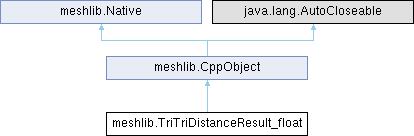
Generated from class MR::TriTriDistanceResult<float>.
Instances created here own their C++ objects, see CppObject.
| meshlib.TriTriDistanceResult_float.TriTriDistanceResult_float | ( | java.lang.foreign.MemorySegment | ptr, |
| boolean | owned, | ||
| java.lang.Object | owner ) |
Wraps a pointer from the C bindings. If owned, the object is destroyed when the wrapper dies. owner is kept alive as long as this wrapper is. Not for normal use.
| meshlib.TriTriDistanceResult_float.TriTriDistanceResult_float | ( | ) |
Constructs an empty (default-constructed) instance.
Calls MR_TriTriDistanceResult_float_DefaultConstruct().
| meshlib.TriTriDistanceResult_float.TriTriDistanceResult_float | ( | meshlib.Vector3f | a, |
| meshlib.Vector3f | b, | ||
| float | distSq, | ||
| boolean | overlap, | ||
| byte | aEdge, | ||
| byte | bEdge ) |
Constructs MR::TriTriDistanceResult<float> elementwise. The reference to the parameter a might be preserved in the constructed object. The reference to the parameter b might be preserved in the constructed object. The reference to the parameter aEdge might be preserved in the constructed object. The reference to the parameter bEdge might be preserved in the constructed object.
Calls MR_TriTriDistanceResult_float_ConstructFrom().
| meshlib.TriTriDistanceResult_float.TriTriDistanceResult_float | ( | meshlib.TriTriDistanceResult_float | _other | ) |
Generated from constructor MR::TriTriDistanceResult<float>::TriTriDistanceResult. The reference to things referred to by the parameter _other (if any) might be preserved in the constructed object.
Calls MR_TriTriDistanceResult_float_ConstructFromAnother().
| meshlib.Vector3f meshlib.TriTriDistanceResult_float.a | ( | ) |
If the triangles are disjoint, these points are the closest points of the corresponding triangles. However, if the triangles overlap, these are basically a random pair of points from the triangles, not coincident points on the intersection of the triangles, as might be expected. Returns a pointer to a member variable of class MR::TriTriDistanceResult<float> named a. The reference to this object might be preserved as the return value.
Calls MR_TriTriDistanceResult_float_Get_a().
| meshlib.TriPointf meshlib.TriTriDistanceResult_float.aBary | ( | meshlib.std_array_MR_Vector3f_3 | ta | ) |
barycentric coordinates of point a in triangle ta, given to findTriTriDistance as the first one; unlike the ones computed from the position of the point, they place a point found on an edge or in a vertex there Generated from method MR::TriTriDistanceResult<float>::aBary.
Calls MR_TriTriDistanceResult_float_aBary().
| byte meshlib.TriTriDistanceResult_float.aEdge | ( | ) |
the edges of the triangles with points a and b, numbered as in TriPoint::onEdge() (which also contain a point found in a vertex), or -1 if the point is inside its triangle Returns a pointer to a member variable of class MR::TriTriDistanceResult<float> named aEdge. The reference to this object might be preserved as the return value.
Calls MR_TriTriDistanceResult_float_Get_aEdge().
| meshlib.TriTriDistanceResult_float meshlib.TriTriDistanceResult_float.assignFromAnother | ( | meshlib.TriTriDistanceResult_float | _other | ) |
Generated from method MR::TriTriDistanceResult<float>::operator=. The reference to things referred to by the parameter _other (if any) might be preserved in this object.
Calls MR_TriTriDistanceResult_float_AssignFromAnother().
| meshlib.Vector3f meshlib.TriTriDistanceResult_float.b | ( | ) |
If the triangles are disjoint, these points are the closest points of the corresponding triangles. However, if the triangles overlap, these are basically a random pair of points from the triangles, not coincident points on the intersection of the triangles, as might be expected. Returns a pointer to a member variable of class MR::TriTriDistanceResult<float> named b. The reference to this object might be preserved as the return value.
Calls MR_TriTriDistanceResult_float_Get_b().
| meshlib.TriPointf meshlib.TriTriDistanceResult_float.bBary | ( | meshlib.std_array_MR_Vector3f_3 | tb | ) |
barycentric coordinates of point b in triangle tb, given to findTriTriDistance as the second one Generated from method MR::TriTriDistanceResult<float>::bBary.
Calls MR_TriTriDistanceResult_float_bBary().
| byte meshlib.TriTriDistanceResult_float.bEdge | ( | ) |
the edges of the triangles with points a and b, numbered as in TriPoint::onEdge() (which also contain a point found in a vertex), or -1 if the point is inside its triangle Returns a pointer to a member variable of class MR::TriTriDistanceResult<float> named bEdge. The reference to this object might be preserved as the return value.
Calls MR_TriTriDistanceResult_float_Get_bEdge().
| float meshlib.TriTriDistanceResult_float.distSq | ( | ) |
If the triangles are disjoint, it is the squared distance them (equal to the squared distance between a and b points). If the triangles overlap, it is zero. Returns a pointer to a member variable of class MR::TriTriDistanceResult<float> named distSq. The reference to this object might be preserved as the return value.
Calls MR_TriTriDistanceResult_float_Get_distSq().
| boolean meshlib.TriTriDistanceResult_float.overlap | ( | ) |
overlap==true means that the triangles are intersecting and not just touch one another => distSq == 0 if distSq == 0 and overlap == false, then the triangles just touch one another Returns a pointer to a member variable of class MR::TriTriDistanceResult<float> named overlap. The reference to this object might be preserved as the return value.
Calls MR_TriTriDistanceResult_float_Get_overlap().
| void meshlib.TriTriDistanceResult_float.setA | ( | meshlib.Vector3f | value | ) |
If the triangles are disjoint, these points are the closest points of the corresponding triangles. However, if the triangles overlap, these are basically a random pair of points from the triangles, not coincident points on the intersection of the triangles, as might be expected. Modifies a member variable of class MR::TriTriDistanceResult<float> named a. The reference to the parameter value might be preserved in this object in element a.
Calls MR_TriTriDistanceResult_float_Set_a().
| void meshlib.TriTriDistanceResult_float.setAEdge | ( | byte | value | ) |
the edges of the triangles with points a and b, numbered as in TriPoint::onEdge() (which also contain a point found in a vertex), or -1 if the point is inside its triangle Modifies a member variable of class MR::TriTriDistanceResult<float> named aEdge. The reference to the parameter value might be preserved in this object in element aEdge.
Calls MR_TriTriDistanceResult_float_Set_aEdge().
| void meshlib.TriTriDistanceResult_float.setB | ( | meshlib.Vector3f | value | ) |
If the triangles are disjoint, these points are the closest points of the corresponding triangles. However, if the triangles overlap, these are basically a random pair of points from the triangles, not coincident points on the intersection of the triangles, as might be expected. Modifies a member variable of class MR::TriTriDistanceResult<float> named b. The reference to the parameter value might be preserved in this object in element b.
Calls MR_TriTriDistanceResult_float_Set_b().
| void meshlib.TriTriDistanceResult_float.setBEdge | ( | byte | value | ) |
the edges of the triangles with points a and b, numbered as in TriPoint::onEdge() (which also contain a point found in a vertex), or -1 if the point is inside its triangle Modifies a member variable of class MR::TriTriDistanceResult<float> named bEdge. The reference to the parameter value might be preserved in this object in element bEdge.
Calls MR_TriTriDistanceResult_float_Set_bEdge().
| void meshlib.TriTriDistanceResult_float.setDistSq | ( | float | value | ) |
If the triangles are disjoint, it is the squared distance them (equal to the squared distance between a and b points). If the triangles overlap, it is zero. Modifies a member variable of class MR::TriTriDistanceResult<float> named distSq.
Calls MR_TriTriDistanceResult_float_Set_distSq().
| void meshlib.TriTriDistanceResult_float.setOverlap | ( | boolean | value | ) |
overlap==true means that the triangles are intersecting and not just touch one another => distSq == 0 if distSq == 0 and overlap == false, then the triangles just touch one another Modifies a member variable of class MR::TriTriDistanceResult<float> named overlap.
Calls MR_TriTriDistanceResult_float_Set_overlap().
 1.14.0