|
MeshLib Java Docs
|
|
MeshLib Java Docs
|
Additional Inherited Members | |
| Protected Member Functions inherited from meshlib.CppObject | |
| CppObject (java.lang.foreign.MemorySegment ptr, java.util.function.Consumer< java.lang.foreign.MemorySegment > destroy, java.lang.Object owner) | |
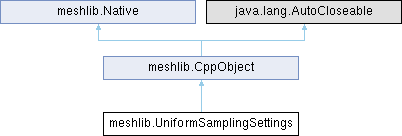
Generated from class MR::UniformSamplingSettings.
Instances created here own their C++ objects, see CppObject.
| meshlib.UniformSamplingSettings.UniformSamplingSettings | ( | java.lang.foreign.MemorySegment | ptr, |
| boolean | owned, | ||
| java.lang.Object | owner ) |
Wraps a pointer from the C bindings. If owned, the object is destroyed when the wrapper dies. owner is kept alive as long as this wrapper is. Not for normal use.
| meshlib.UniformSamplingSettings.UniformSamplingSettings | ( | ) |
Constructs an empty (default-constructed) instance.
Calls MR_UniformSamplingSettings_DefaultConstruct().
| meshlib.UniformSamplingSettings.UniformSamplingSettings | ( | float | distance, |
| float | minNormalDot, | ||
| boolean | lexicographicalOrder, | ||
| meshlib.VertCoords | pNormals, | ||
| meshlib.std_function_bool_from_float | progress ) |
Constructs MR::UniformSamplingSettings elementwise. The reference to the parameter pNormals might be preserved in the constructed object. The reference to the parameter progress might be preserved in the constructed object.
Calls MR_UniformSamplingSettings_ConstructFrom().
| meshlib.UniformSamplingSettings.UniformSamplingSettings | ( | meshlib.UniformSamplingSettings | _other | ) |
Generated from constructor MR::UniformSamplingSettings::UniformSamplingSettings. The reference to things referred to by the parameter _other (if any) might be preserved in the constructed object.
Calls MR_UniformSamplingSettings_ConstructFromAnother().
| meshlib.UniformSamplingSettings meshlib.UniformSamplingSettings.assignFromAnother | ( | meshlib.UniformSamplingSettings | _other | ) |
Generated from method MR::UniformSamplingSettings::operator=. The reference to things referred to by the parameter _other (if any) might be preserved in this object.
Calls MR_UniformSamplingSettings_AssignFromAnother().
| float meshlib.UniformSamplingSettings.distance | ( | ) |
minimal distance between samples Returns a pointer to a member variable of class MR::UniformSamplingSettings named distance. The reference to this object might be preserved as the return value.
Calls MR_UniformSamplingSettings_Get_distance().
| boolean meshlib.UniformSamplingSettings.lexicographicalOrder | ( | ) |
if true process the points in lexicographical order, which gives tighter and more uniform samples; if false process the points according to their ids, which is faster Returns a pointer to a member variable of class MR::UniformSamplingSettings named lexicographicalOrder. The reference to this object might be preserved as the return value.
Calls MR_UniformSamplingSettings_Get_lexicographicalOrder().
| float meshlib.UniformSamplingSettings.minNormalDot | ( | ) |
if point cloud has normals then automatically decreases local distance to make sure that all points inside have absolute normal dot product not less than this value; this is to make sampling denser in the regions of high curvature; value <=0 means ignore normals; value >=1 means select all points (practically useless) Returns a pointer to a member variable of class MR::UniformSamplingSettings named minNormalDot. The reference to this object might be preserved as the return value.
Calls MR_UniformSamplingSettings_Get_minNormalDot().
| java.lang.foreign.MemorySegment meshlib.UniformSamplingSettings.pNormals | ( | ) |
if not nullptr then these normals will be used during sampling instead of normals in the cloud itself Returns a pointer to a member variable of class MR::UniformSamplingSettings named pNormals. The reference to this object might be preserved as the return value.
Calls MR_UniformSamplingSettings_Get_pNormals(). Some types are raw C types, see the C bindings for the details.
| meshlib.std_function_bool_from_float meshlib.UniformSamplingSettings.progress | ( | ) |
to report progress and cancel processing Returns a pointer to a member variable of class MR::UniformSamplingSettings named progress. The reference to this object might be preserved as the return value.
Calls MR_UniformSamplingSettings_Get_progress().
| void meshlib.UniformSamplingSettings.setDistance | ( | float | value | ) |
minimal distance between samples Modifies a member variable of class MR::UniformSamplingSettings named distance.
Calls MR_UniformSamplingSettings_Set_distance().
| void meshlib.UniformSamplingSettings.setLexicographicalOrder | ( | boolean | value | ) |
if true process the points in lexicographical order, which gives tighter and more uniform samples; if false process the points according to their ids, which is faster Modifies a member variable of class MR::UniformSamplingSettings named lexicographicalOrder.
Calls MR_UniformSamplingSettings_Set_lexicographicalOrder().
| void meshlib.UniformSamplingSettings.setMinNormalDot | ( | float | value | ) |
if point cloud has normals then automatically decreases local distance to make sure that all points inside have absolute normal dot product not less than this value; this is to make sampling denser in the regions of high curvature; value <=0 means ignore normals; value >=1 means select all points (practically useless) Modifies a member variable of class MR::UniformSamplingSettings named minNormalDot.
Calls MR_UniformSamplingSettings_Set_minNormalDot().
| void meshlib.UniformSamplingSettings.setPNormals | ( | meshlib.VertCoords | value | ) |
if not nullptr then these normals will be used during sampling instead of normals in the cloud itself Modifies a member variable of class MR::UniformSamplingSettings named pNormals. The reference to the parameter value might be preserved in this object in element pNormals.
Calls MR_UniformSamplingSettings_Set_pNormals().
| void meshlib.UniformSamplingSettings.setProgress | ( | meshlib.std_function_bool_from_float | value | ) |
to report progress and cancel processing Modifies a member variable of class MR::UniformSamplingSettings named progress. The reference to the parameter value might be preserved in this object in element progress.
Calls MR_UniformSamplingSettings_Set_progress().
 1.14.0