|
MeshLib Java Docs
|
|
MeshLib Java Docs
|
Additional Inherited Members | |
| Protected Member Functions inherited from meshlib.CppObject | |
| CppObject (java.lang.foreign.MemorySegment ptr, java.util.function.Consumer< java.lang.foreign.MemorySegment > destroy, java.lang.Object owner) | |
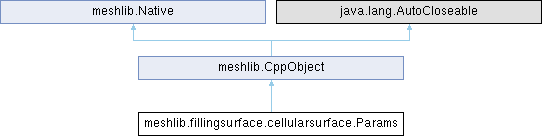
Generated from class MR::FillingSurface::CellularSurface::Params.
Instances created here own their C++ objects, see CppObject.
| meshlib.fillingsurface.cellularsurface.Params.Params | ( | java.lang.foreign.MemorySegment | ptr, |
| boolean | owned, | ||
| java.lang.Object | owner ) |
Wraps a pointer from the C bindings. If owned, the object is destroyed when the wrapper dies. owner is kept alive as long as this wrapper is. Not for normal use.
| meshlib.fillingsurface.cellularsurface.Params.Params | ( | ) |
Constructs an empty (default-constructed) instance.
Calls MR_FillingSurface_CellularSurface_Params_DefaultConstruct().
| meshlib.fillingsurface.cellularsurface.Params.Params | ( | meshlib.fillingsurface.cellularsurface.Type | type, |
| meshlib.Vector3f | period, | ||
| meshlib.Vector3f | width, | ||
| float | r, | ||
| boolean | highRes, | ||
| boolean | preserveTips ) |
Constructs MR::FillingSurface::CellularSurface::Params elementwise. The reference to the parameter type might be preserved in the constructed object. The reference to the parameter period might be preserved in the constructed object. The reference to the parameter width might be preserved in the constructed object.
Calls MR_FillingSurface_CellularSurface_Params_ConstructFrom().
| meshlib.fillingsurface.cellularsurface.Params.Params | ( | meshlib.fillingsurface.cellularsurface.Params | _other | ) |
Generated from constructor MR::FillingSurface::CellularSurface::Params::Params. The reference to things referred to by the parameter _other (if any) might be preserved in the constructed object.
Calls MR_FillingSurface_CellularSurface_Params_ConstructFromAnother().
| meshlib.fillingsurface.cellularsurface.Params meshlib.fillingsurface.cellularsurface.Params.assignFromAnother | ( | meshlib.fillingsurface.cellularsurface.Params | _other | ) |
Generated from method MR::FillingSurface::CellularSurface::Params::operator=. The reference to things referred to by the parameter _other (if any) might be preserved in this object.
Calls MR_FillingSurface_CellularSurface_Params_AssignFromAnother().
| boolean meshlib.fillingsurface.cellularsurface.Params.highRes | ( | ) |
used in tests in order to make surfaces close to their analytical expression recommended to be false for real usage for better performance Returns a pointer to a member variable of class MR::FillingSurface::CellularSurface::Params named highRes. The reference to this object might be preserved as the return value.
Calls MR_FillingSurface_CellularSurface_Params_Get_highRes().
| meshlib.Vector3f meshlib.fillingsurface.cellularsurface.Params.period | ( | ) |
< the distance between consecutive cylinders in each direction Returns a pointer to a member variable of class MR::FillingSurface::CellularSurface::Params named period. The reference to this object might be preserved as the return value.
Calls MR_FillingSurface_CellularSurface_Params_Get_period().
| boolean meshlib.fillingsurface.cellularsurface.Params.preserveTips | ( | ) |
Used in tests for roughly the same purpose: the computations of density estimation are made under the assumption of an infinite surface. Thus, we must impose "boundary conditions" that inflict the "tips" of the bars (cylinders or cubes) to be preserved on the boundary of the generated filling surface. However, for the aesthetic reasons, it was requested that the tips must be cut in the UI. And here comes this flag. Note that for the estimation of density in UI the influence of "tips" is not significant (it tends to zero with growing size), however we cannot afford to run tests on too big surfaces as it takes too long. Returns a pointer to a member variable of class MR::FillingSurface::CellularSurface::Params named preserveTips. The reference to this object might be preserved as the return value.
Calls MR_FillingSurface_CellularSurface_Params_Get_preserveTips().
| float meshlib.fillingsurface.cellularsurface.Params.r | ( | ) |
< the radius of uniting spheres Returns a pointer to a member variable of class MR::FillingSurface::CellularSurface::Params named r. The reference to this object might be preserved as the return value.
Calls MR_FillingSurface_CellularSurface_Params_Get_r().
| void meshlib.fillingsurface.cellularsurface.Params.setHighRes | ( | boolean | value | ) |
used in tests in order to make surfaces close to their analytical expression recommended to be false for real usage for better performance Modifies a member variable of class MR::FillingSurface::CellularSurface::Params named highRes.
Calls MR_FillingSurface_CellularSurface_Params_Set_highRes().
| void meshlib.fillingsurface.cellularsurface.Params.setPeriod | ( | meshlib.Vector3f | value | ) |
< the distance between consecutive cylinders in each direction Modifies a member variable of class MR::FillingSurface::CellularSurface::Params named period. The reference to the parameter value might be preserved in this object in element period.
Calls MR_FillingSurface_CellularSurface_Params_Set_period().
| void meshlib.fillingsurface.cellularsurface.Params.setPreserveTips | ( | boolean | value | ) |
Used in tests for roughly the same purpose: the computations of density estimation are made under the assumption of an infinite surface. Thus, we must impose "boundary conditions" that inflict the "tips" of the bars (cylinders or cubes) to be preserved on the boundary of the generated filling surface. However, for the aesthetic reasons, it was requested that the tips must be cut in the UI. And here comes this flag. Note that for the estimation of density in UI the influence of "tips" is not significant (it tends to zero with growing size), however we cannot afford to run tests on too big surfaces as it takes too long. Modifies a member variable of class MR::FillingSurface::CellularSurface::Params named preserveTips.
Calls MR_FillingSurface_CellularSurface_Params_Set_preserveTips().
| void meshlib.fillingsurface.cellularsurface.Params.setR | ( | float | value | ) |
< the radius of uniting spheres Modifies a member variable of class MR::FillingSurface::CellularSurface::Params named r.
Calls MR_FillingSurface_CellularSurface_Params_Set_r().
| void meshlib.fillingsurface.cellularsurface.Params.setType | ( | meshlib.fillingsurface.cellularsurface.Type | value | ) |
< the type of the base element Modifies a member variable of class MR::FillingSurface::CellularSurface::Params named type. The reference to the parameter value might be preserved in this object in element type.
Calls MR_FillingSurface_CellularSurface_Params_Set_type().
| void meshlib.fillingsurface.cellularsurface.Params.setWidth | ( | meshlib.Vector3f | value | ) |
< the width of cylinders in each direction Modifies a member variable of class MR::FillingSurface::CellularSurface::Params named width. The reference to the parameter value might be preserved in this object in element width.
Calls MR_FillingSurface_CellularSurface_Params_Set_width().
| meshlib.fillingsurface.cellularsurface.Type meshlib.fillingsurface.cellularsurface.Params.type | ( | ) |
< the type of the base element Returns a pointer to a member variable of class MR::FillingSurface::CellularSurface::Params named type. The reference to this object might be preserved as the return value.
Calls MR_FillingSurface_CellularSurface_Params_Get_type().
| meshlib.Vector3f meshlib.fillingsurface.cellularsurface.Params.width | ( | ) |
< the width of cylinders in each direction Returns a pointer to a member variable of class MR::FillingSurface::CellularSurface::Params named width. The reference to this object might be preserved as the return value.
Calls MR_FillingSurface_CellularSurface_Params_Get_width().
 1.14.0