|
MeshLib Java Docs
|
|
MeshLib Java Docs
|
Additional Inherited Members | |
| Protected Member Functions inherited from meshlib.CppObject | |
| CppObject (java.lang.foreign.MemorySegment ptr, java.util.function.Consumer< java.lang.foreign.MemorySegment > destroy, java.lang.Object owner) | |
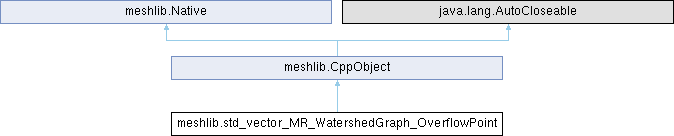
Generated from C++ container std::vector<MR::WatershedGraph::OverflowPoint>.
Instances created here own their C++ objects, see CppObject.
| meshlib.std_vector_MR_WatershedGraph_OverflowPoint.std_vector_MR_WatershedGraph_OverflowPoint | ( | java.lang.foreign.MemorySegment | ptr, |
| boolean | owned, | ||
| java.lang.Object | owner ) |
Wraps a pointer from the C bindings. If owned, the object is destroyed when the wrapper dies. owner is kept alive as long as this wrapper is. Not for normal use.
| meshlib.std_vector_MR_WatershedGraph_OverflowPoint.std_vector_MR_WatershedGraph_OverflowPoint | ( | ) |
Constructs an empty (default-constructed) instance.
Calls MR_std_vector_MR_WatershedGraph_OverflowPoint_DefaultConstruct().
| meshlib.std_vector_MR_WatershedGraph_OverflowPoint.std_vector_MR_WatershedGraph_OverflowPoint | ( | meshlib.std_vector_MR_WatershedGraph_OverflowPoint | other | ) |
Constructs a copy of another instance. The source remains alive. The reference to the parameter other might be preserved in the constructed object.
Calls MR_std_vector_MR_WatershedGraph_OverflowPoint_ConstructFromAnother().
| void meshlib.std_vector_MR_WatershedGraph_OverflowPoint.assignFromAnother | ( | meshlib.std_vector_MR_WatershedGraph_OverflowPoint | other | ) |
Assigns the contents from another instance. Both objects remain alive after the call. The reference to the parameter other might be preserved in this object.
Calls MR_std_vector_MR_WatershedGraph_OverflowPoint_AssignFromAnother().
| meshlib.WatershedGraph_OverflowPoint meshlib.std_vector_MR_WatershedGraph_OverflowPoint.at | ( | long | i | ) |
The element at a specific index, read-only. The reference to this object might be preserved as the return value.
Calls MR_std_vector_MR_WatershedGraph_OverflowPoint_at().
| meshlib.WatershedGraph_OverflowPoint meshlib.std_vector_MR_WatershedGraph_OverflowPoint.at_mut | ( | long | i | ) |
The element at a specific index, mutable. The reference to this object might be preserved as the return value.
Calls MR_std_vector_MR_WatershedGraph_OverflowPoint_at_mut().
| meshlib.WatershedGraph_OverflowPoint meshlib.std_vector_MR_WatershedGraph_OverflowPoint.back | ( | ) |
The last element or null if empty, read-only. The reference to this object might be preserved as the return value.
Calls MR_std_vector_MR_WatershedGraph_OverflowPoint_back().
| meshlib.WatershedGraph_OverflowPoint meshlib.std_vector_MR_WatershedGraph_OverflowPoint.back_mut | ( | ) |
The last element or null if empty, mutable. The reference to this object might be preserved as the return value.
Calls MR_std_vector_MR_WatershedGraph_OverflowPoint_back_mut().
| void meshlib.std_vector_MR_WatershedGraph_OverflowPoint.clear | ( | ) |
Removes all elements from the container.
Calls MR_std_vector_MR_WatershedGraph_OverflowPoint_clear().
| boolean meshlib.std_vector_MR_WatershedGraph_OverflowPoint.empty | ( | ) |
Returns true if the size is zero.
Calls MR_std_vector_MR_WatershedGraph_OverflowPoint_empty().
| void meshlib.std_vector_MR_WatershedGraph_OverflowPoint.erase | ( | long | position | ) |
Erases the element at the specified position.
Calls MR_std_vector_MR_WatershedGraph_OverflowPoint_erase().
| meshlib.WatershedGraph_OverflowPoint meshlib.std_vector_MR_WatershedGraph_OverflowPoint.front | ( | ) |
The first element or null if empty, read-only. The reference to this object might be preserved as the return value.
Calls MR_std_vector_MR_WatershedGraph_OverflowPoint_front().
| meshlib.WatershedGraph_OverflowPoint meshlib.std_vector_MR_WatershedGraph_OverflowPoint.front_mut | ( | ) |
The first element or null if empty, mutable. The reference to this object might be preserved as the return value.
Calls MR_std_vector_MR_WatershedGraph_OverflowPoint_front_mut().
| void meshlib.std_vector_MR_WatershedGraph_OverflowPoint.insert | ( | long | position, |
| meshlib.WatershedGraph_OverflowPoint | new_elem ) |
Inserts a new element right before the specified position. The reference to the parameter new_elem might be preserved in this object.
Calls MR_std_vector_MR_WatershedGraph_OverflowPoint_insert().
| void meshlib.std_vector_MR_WatershedGraph_OverflowPoint.pop_back | ( | ) |
Removes one element from the end.
Calls MR_std_vector_MR_WatershedGraph_OverflowPoint_pop_back().
| void meshlib.std_vector_MR_WatershedGraph_OverflowPoint.push_back | ( | meshlib.WatershedGraph_OverflowPoint | new_elem | ) |
Inserts a new element at the end. The reference to the parameter new_elem might be preserved in this object.
Calls MR_std_vector_MR_WatershedGraph_OverflowPoint_push_back().
| void meshlib.std_vector_MR_WatershedGraph_OverflowPoint.reserve | ( | long | new_capacity | ) |
Reserves memory for a certain number of elements. Never shrinks the memory.
Calls MR_std_vector_MR_WatershedGraph_OverflowPoint_reserve().
| void meshlib.std_vector_MR_WatershedGraph_OverflowPoint.resize | ( | long | new_size | ) |
Resizes the container. The new elements if any are zeroed.
Calls MR_std_vector_MR_WatershedGraph_OverflowPoint_resize().
| long meshlib.std_vector_MR_WatershedGraph_OverflowPoint.size | ( | ) |
The number of elements.
Calls MR_std_vector_MR_WatershedGraph_OverflowPoint_size().
 1.14.0