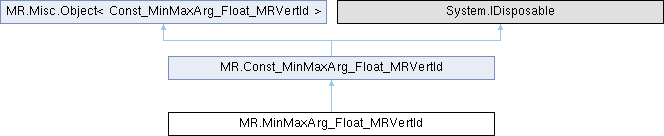
minimum and maximum of some elements of type T, and the indices of where minimum and maximum are reached of type I Generated from class MR::MinMaxArg<float, MR.VertId>. This is the non-const half of the class.
More...
|
| unsafe | MinMaxArg_Float_MRVertId () |
| | Constructs an empty (default-constructed) instance.
|
| unsafe | MinMaxArg_Float_MRVertId (float min, float max, MR.VertId minArg, MR.VertId maxArg) |
| | Constructs MR::MinMaxArg<float, MR.VertId> elementwise.
|
| unsafe | MinMaxArg_Float_MRVertId (MR.Const_MinMaxArg_Float_MRVertId _other) |
| | Generated from constructor MR::MinMaxArg<float, MR.VertId>::MinMaxArg.
|
| | MinMaxArg_Float_MRVertId (MinMaxArg_Float_MRVertId _other) |
| | Generated from constructor MR::MinMaxArg<float, MR.VertId>::MinMaxArg.
|
| unsafe MR.MinMaxArg_Float_MRVertId | assign (MR.Const_MinMaxArg_Float_MRVertId _other) |
| | Generated from method MR::MinMaxArg<float, MR.VertId>::operator=.
|
| unsafe void | include (MR.Std.Const_Pair_Float_MRVertId p) |
| | changes min(Arg) and max(Arg) if necessary to include given point Generated from method MR::MinMaxArg<float, MR.VertId>include.
|
| unsafe void | include (float v, MR.VertId arg) |
| | changes min(Arg) and max(Arg) if necessary to include given point Generated from method MR::MinMaxArg<float, MR.VertId>include.
|
| unsafe void | include (MR.Const_MinMaxArg_Float_MRVertId s) |
| | changes min(Arg) and max(Arg) if necessary to include given segment Generated from method MR::MinMaxArg<float, MR.VertId>include.
|
| virtual void | Dispose () |
| unsafe | Const_MinMaxArg_Float_MRVertId () |
| | Constructs an empty (default-constructed) instance.
|
| unsafe | Const_MinMaxArg_Float_MRVertId (float min, float max, MR.VertId minArg, MR.VertId maxArg) |
| | Constructs MR::MinMaxArg<float, MR.VertId> elementwise.
|
| unsafe | Const_MinMaxArg_Float_MRVertId (MR.Const_MinMaxArg_Float_MRVertId _other) |
| | Generated from constructor MR::MinMaxArg<float, MR.VertId>::MinMaxArg.
|
| | Const_MinMaxArg_Float_MRVertId (MinMaxArg_Float_MRVertId _other) |
| | Generated from constructor MR::MinMaxArg<float, MR.VertId>::MinMaxArg.
|
| unsafe MR.Std.Pair_Float_MRVertId | minPair () |
| | Generated from method MR::MinMaxArg<float, MR.VertId>minPair.
|
| unsafe MR.Std.Pair_Float_MRVertId | maxPair () |
| | Generated from method MR::MinMaxArg<float, MR.VertId>maxPair.
|
minimum and maximum of some elements of type T, and the indices of where minimum and maximum are reached of type I Generated from class MR::MinMaxArg<float, MR.VertId>. This is the non-const half of the class.
 1.14.0