|
MeshLib Python Docs
|
Public Member Functions | |
| None | __init__ (self) |
| None | __init__ (self, ConstComputeSteepestDescentPathSettings arg0) |
| None | __init__ (self, ConstMeshTriPoint end, VertId outVertexReached, EdgePoint outBdReached) |
| ComputeSteepestDescentPathSettings | assign (self, ConstComputeSteepestDescentPathSettings other) |
| MeshTriPoint | end (self) |
| None | end (self, ConstMeshTriPoint arg1) |
| EdgePoint | outBdReached (self) |
| None | outBdReached (self, EdgePoint arg1) |
| VertId | outVertexReached (self) |
| None | outVertexReached (self, VertId arg1) |
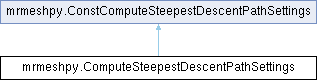
| Public Member Functions inherited from mrmeshpy.ConstComputeSteepestDescentPathSettings | |
| __init__ (self, *args, **kwargs) | |
Static Public Member Functions | |
| None | __init__ (*args, **kwargs) |
Additional Inherited Members | |
| Static Protected Attributes inherited from mrmeshpy.ConstComputeSteepestDescentPathSettings | |
| typing | _offsetof_end = 0 |
| typing | _offsetof_outBdReached = 24 |
| typing | _offsetof_outVertexReached = 16 |
Generated from: MR::ComputeSteepestDescentPathSettings
|
static |
| None mrmeshpy.ComputeSteepestDescentPathSettings.__init__ | ( | self | ) |
| None mrmeshpy.ComputeSteepestDescentPathSettings.__init__ | ( | self, | |
| ConstComputeSteepestDescentPathSettings | arg0 ) |
Implicit copy constructor.
| None mrmeshpy.ComputeSteepestDescentPathSettings.__init__ | ( | self, | |
| ConstMeshTriPoint | end, | ||
| VertId | outVertexReached, | ||
| EdgePoint | outBdReached ) |
Implicit aggregate constructor.
| ComputeSteepestDescentPathSettings mrmeshpy.ComputeSteepestDescentPathSettings.assign | ( | self, | |
| ConstComputeSteepestDescentPathSettings | other ) |
| MeshTriPoint mrmeshpy.ComputeSteepestDescentPathSettings.end | ( | self | ) |
if valid, then the descent is stopped as soon as same triangle with (end) is reached
Reimplemented from mrmeshpy.ConstComputeSteepestDescentPathSettings.
| None mrmeshpy.ComputeSteepestDescentPathSettings.end | ( | self, | |
| ConstMeshTriPoint | arg1 ) |
if valid, then the descent is stopped as soon as same triangle with (end) is reached
Reimplemented from mrmeshpy.ConstComputeSteepestDescentPathSettings.
| EdgePoint mrmeshpy.ComputeSteepestDescentPathSettings.outBdReached | ( | self | ) |
if not nullptr, then the descent is stopped as soon as any boundary point is reached, which is written in *outBdReached
Reimplemented from mrmeshpy.ConstComputeSteepestDescentPathSettings.
| None mrmeshpy.ComputeSteepestDescentPathSettings.outBdReached | ( | self, | |
| EdgePoint | arg1 ) |
if not nullptr, then the descent is stopped as soon as any boundary point is reached, which is written in *outBdReached
Reimplemented from mrmeshpy.ConstComputeSteepestDescentPathSettings.
| VertId mrmeshpy.ComputeSteepestDescentPathSettings.outVertexReached | ( | self | ) |
if not nullptr, then the descent is stopped as soon as any vertex is reached, which is written in *outVertexReached
Reimplemented from mrmeshpy.ConstComputeSteepestDescentPathSettings.
| None mrmeshpy.ComputeSteepestDescentPathSettings.outVertexReached | ( | self, | |
| VertId | arg1 ) |
if not nullptr, then the descent is stopped as soon as any vertex is reached, which is written in *outVertexReached
Reimplemented from mrmeshpy.ConstComputeSteepestDescentPathSettings.
 1.14.0