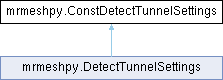
|
MeshLib Python Docs
|
Public Member Functions | |
| __init__ (self, *args, **kwargs) | |
| bool | buildCoLoops (self) |
| bool | filterEquivalentCoLoops (self) |
| TunnelLoopType | loopType (self) |
| int | maxIters (self) |
| float | maxTunnelLength (self) |
| Const_func_float_from_Id_EdgeTag | metric (self) |
| Const_func_bool_from_float | progress (self) |
Static Protected Attributes | |
| typing | _offsetof_buildCoLoops = 40 |
| typing | _offsetof_filterEquivalentCoLoops = 41 |
| typing | _offsetof_loopType = 44 |
| typing | _offsetof_maxIters = 4 |
| typing | _offsetof_maxTunnelLength = 0 |
| typing | _offsetof_metric = 8 |
| typing | _offsetof_progress = 48 |
Generated from: MR::DetectTunnelSettings
| mrmeshpy.ConstDetectTunnelSettings.__init__ | ( | self, | |
| * | args, | ||
| ** | kwargs ) |
__init__(*args, **kwargs)
Overloaded function.

1. __init__(self: meshlib.mrmeshpy.ConstDetectTunnelSettings) -> None

2. __init__(self: meshlib.mrmeshpy.ConstDetectTunnelSettings, arg0: meshlib.mrmeshpy.ConstDetectTunnelSettings) -> None

Implicit copy constructor.

3. __init__(self: meshlib.mrmeshpy.ConstDetectTunnelSettings, maxTunnelLength: float, maxIters: int, metric: meshlib.mrmeshpy.Const_func_float_from_Id_EdgeTag, buildCoLoops: bool, filterEquivalentCoLoops: bool, loopType: meshlib.mrmeshpy.TunnelLoopType, progress: meshlib.mrmeshpy.Const_func_bool_from_float) -> None

Implicit aggregate constructor.

4. __init__(self: meshlib.mrmeshpy.ConstDetectTunnelSettings, : meshlib.mrmeshpy.ConstDetectTunnelSettings) -> None
| bool mrmeshpy.ConstDetectTunnelSettings.buildCoLoops | ( | self | ) |
if true then for every basis loop, findSmallestMetricCoLoop will be called;
it typically results in shorter tunnels found, but requires more time per iteration, and more iterations to find all tunnels
Reimplemented in mrmeshpy.DetectTunnelSettings, and mrmeshpy.DetectTunnelSettings.
| bool mrmeshpy.ConstDetectTunnelSettings.filterEquivalentCoLoops | ( | self | ) |
if ( buildCoLoops ) then some tunnel loops can be equivalent (e.g. they cut the same handle twice),
this option activates their filtering out, but it is very slow
Reimplemented in mrmeshpy.DetectTunnelSettings, and mrmeshpy.DetectTunnelSettings.
| TunnelLoopType mrmeshpy.ConstDetectTunnelSettings.loopType | ( | self | ) |
selects what kind of loops to return
Reimplemented in mrmeshpy.DetectTunnelSettings, and mrmeshpy.DetectTunnelSettings.
| int mrmeshpy.ConstDetectTunnelSettings.maxIters | ( | self | ) |
maximal number of iterations to detect all tunnels;
on a big mesh with many tunnels even one iteration can take a while
Reimplemented in mrmeshpy.DetectTunnelSettings, and mrmeshpy.DetectTunnelSettings.
| float mrmeshpy.ConstDetectTunnelSettings.maxTunnelLength | ( | self | ) |
maximal euclidean length of tunnel loops to detect
Reimplemented in mrmeshpy.DetectTunnelSettings, and mrmeshpy.DetectTunnelSettings.
| Const_func_float_from_Id_EdgeTag mrmeshpy.ConstDetectTunnelSettings.metric | ( | self | ) |
edge metric that will be used in optimizations,
if co-loops are enabled then this metric must be not-negative,
if no metric is given then either discreteMinusAbsMeanCurvatureMetric (if buildCoLoops = false) or edgeLengthMetric (if buildCoLoops = true) will be used,
using caching via edgeTableSymMetric function can improve the performance, especially in buildCoLoops = true mode
Reimplemented in mrmeshpy.DetectTunnelSettings, and mrmeshpy.DetectTunnelSettings.
| Const_func_bool_from_float mrmeshpy.ConstDetectTunnelSettings.progress | ( | self | ) |
to report algorithm progress and cancel from outside
Reimplemented in mrmeshpy.DetectTunnelSettings, and mrmeshpy.DetectTunnelSettings.
|
staticprotected |
|
staticprotected |
|
staticprotected |
|
staticprotected |
|
staticprotected |
|
staticprotected |
|
staticprotected |
 1.14.0