|
MeshLib Python Docs
|
|
MeshLib Python Docs
|
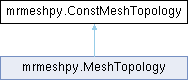
Generated from:  MR::MeshTopology

Mesh Topology
| mrmeshpy.ConstMeshTopology.__init__ | ( | self, | |
| * | args, | ||
| ** | kwargs ) |
__init__(*args, **kwargs)
Overloaded function.

1. __init__(self: meshlib.mrmeshpy.ConstMeshTopology) -> None

2. __init__(self: meshlib.mrmeshpy.ConstMeshTopology, arg0: meshlib.mrmeshpy.ConstMeshTopology) -> None

Implicit copy constructor.

3. __init__(self: meshlib.mrmeshpy.ConstMeshTopology, : meshlib.mrmeshpy.ConstMeshTopology) -> None
| bool mrmeshpy.ConstMeshTopology.__eq__ | ( | self, | |
| ConstMeshTopology | b ) |
compare that two topologies are exactly the same
| bool mrmeshpy.ConstMeshTopology.__ne__ | ( | self, | |
| ConstMeshTopology | b ) |
compare that two topologies are exactly the same
| EdgeId mrmeshpy.ConstMeshTopology.bdEdgeSameLeft | ( | self, | |
| ConstEdgeId | e, | ||
| ConstFaceBitSet | region = None ) |
returns the first boundary edge (for given region or for whole mesh if region is nullptr) in counter-clockwise order starting from given edge with the same left face or hole;
returns invalid edge if no boundary edge is found
| EdgeId mrmeshpy.ConstMeshTopology.bdEdgeSameOrigin | ( | self, | |
| ConstEdgeId | e, | ||
| ConstFaceBitSet | region = None ) |
returns the first boundary edge (for given region or for whole mesh if region is nullptr) in counter-clockwise order starting from given edge with the same origin;
returns invalid edge if no boundary edge is found
| EdgeId mrmeshpy.ConstMeshTopology.bdEdgeWithLeft | ( | self, | |
| ConstFaceId | f, | ||
| ConstFaceBitSet | region = None ) |
returns a boundary edge with given left face considering boundary of given region (or for whole mesh if region is nullptr);
returns invalid edge if no boundary edge is found
| EdgeId mrmeshpy.ConstMeshTopology.bdEdgeWithOrigin | ( | self, | |
| ConstVertId | v, | ||
| ConstFaceBitSet | region = None ) |
returns a boundary edge with given vertex in origin considering boundary of given region (or for whole mesh if region is nullptr);
returns invalid edge if no boundary edge is found
| bool mrmeshpy.ConstMeshTopology.checkValidity | ( | self, | |
| Const_func_bool_from_float | cb = '{}', | ||
| bool | allVerts = True ) |
verifies that all internal data structures are valid;
if allVerts=true then checks in addition that all not-lone edges have valid vertices on both ends
| int mrmeshpy.ConstMeshTopology.computeNotLoneUndirectedEdges | ( | self | ) |
computes the number of not-lone (valid) undirected edges
| VertId mrmeshpy.ConstMeshTopology.dest | ( | self, | |
| ConstEdgeId | he ) |
returns destination vertex of half-edge
| int mrmeshpy.ConstMeshTopology.edgeCapacity | ( | self | ) |
returns the number of allocated edge records
| ConstVector_EdgeId_FaceId mrmeshpy.ConstMeshTopology.edgePerFace | ( | self | ) |
for all valid faces this vector contains an edge with that face at left
| ConstVector_EdgeId_VertId mrmeshpy.ConstMeshTopology.edgePerVertex | ( | self | ) |
for all valid vertices this vector contains an edge with the origin there
| int mrmeshpy.ConstMeshTopology.edgeSize | ( | self | ) |
returns the number of half-edge records including lone ones
| EdgeId mrmeshpy.ConstMeshTopology.edgeWithLeft | ( | self, | |
| ConstFaceId | a ) |
returns valid edge if given vertex is present in the mesh
| EdgeId mrmeshpy.ConstMeshTopology.edgeWithOrg | ( | self, | |
| ConstVertId | a ) |
returns valid edge if given vertex is present in the mesh
| None mrmeshpy.ConstMeshTopology.excludeLoneEdges | ( | self, | |
| UndirectedEdgeBitSet | edges ) |
remove all lone edges from given set
| int mrmeshpy.ConstMeshTopology.faceCapacity | ( | self | ) |
returns the number of allocated face records
| int mrmeshpy.ConstMeshTopology.faceSize | ( | self | ) |
returns the number of face records including invalid ones
| FaceBitSet mrmeshpy.ConstMeshTopology.findBdFaces | ( | self, | |
| ConstFaceBitSet | region = None ) |
returns all faces for which isBdFace(f, region) is true
| VertBitSet mrmeshpy.ConstMeshTopology.findBdVerts | ( | self, | |
| ConstFaceBitSet | region = None, | ||
| ConstVertBitSet | test = None ) |
returns all (test) vertices for which isBdVertex(v, region) is true
| EdgeId mrmeshpy.ConstMeshTopology.findEdge | ( | self, | |
| ConstVertId | o, | ||
| ConstVertId | d ) |
finds and returns edge from o to d in the mesh; returns invalid edge otherwise
| std_vector_Id_EdgeTag mrmeshpy.ConstMeshTopology.findHoleRepresentiveEdges | ( | self, | |
| ConstFaceBitSet | region = None ) |
returns one edge with no valid left face for every boundary in the mesh;
if region is given, then returned edges must have valid right faces from the region
| EdgeBitSet mrmeshpy.ConstMeshTopology.findLeftBdEdges | ( | self, | |
| ConstFaceBitSet | region = None, | ||
| ConstEdgeBitSet | test = None ) |
returns all (test) edges for which left(e) does not belong to the region and isBdEdge(e, region) is true
| UndirectedEdgeBitSet mrmeshpy.ConstMeshTopology.findNotLoneUndirectedEdges | ( | self | ) |
finds and returns all not-lone (valid) undirected edges
| int mrmeshpy.ConstMeshTopology.findNumHoles | ( | self, | |
| EdgeBitSet | holeRepresentativeEdges = None ) |
returns the number of hole loops in the mesh;
\\param holeRepresentativeEdges optional output of the smallest edge id with no valid left face in every hole
| None mrmeshpy.ConstMeshTopology.flip | ( | self, | |
| FaceBitSet | fs ) |
sets in (fs) all valid faces that were not selected before the call, and resets other bits
| None mrmeshpy.ConstMeshTopology.flip | ( | self, | |
| VertBitSet | vs ) |
sets in (vs) all valid vertices that were not selected before the call, and resets other bits
| bool mrmeshpy.ConstMeshTopology.fromSameLeftRing | ( | self, | |
| ConstEdgeId | a, | ||
| ConstEdgeId | b ) |
returns true if a and b are both from the same left face ring
| bool mrmeshpy.ConstMeshTopology.fromSameOriginRing | ( | self, | |
| ConstEdgeId | a, | ||
| ConstEdgeId | b ) |
returns true if a and b are both from the same origin ring
| std_vector_std_array_Id_VertTag_3ul mrmeshpy.ConstMeshTopology.getAllTriVerts | ( | self | ) |
returns three vertex ids for valid triangles, invalid triangles are skipped
| int mrmeshpy.ConstMeshTopology.getFaceDegree | ( | self, | |
| ConstFaceId | f ) |
returns the number of edges around the given face: 3 for triangular faces, ...
| ConstFaceBitSet mrmeshpy.ConstMeshTopology.getFaceIds | ( | self, | |
| ConstFaceBitSet | region ) |
if region pointer is not null then converts it in reference, otherwise returns all valid faces in the mesh
| int mrmeshpy.ConstMeshTopology.getLeftDegree | ( | self, | |
| ConstEdgeId | a ) |
returns the number of edges around the left face: 3 for triangular faces, ...
| std_vector_Id_EdgeTag mrmeshpy.ConstMeshTopology.getLeftRing | ( | self, | |
| ConstEdgeId | e ) |
returns full edge-loop of left face from (e) starting from (e) itself
| std_vector_std_vector_Id_EdgeTag mrmeshpy.ConstMeshTopology.getLeftRings | ( | self, | |
| Const_std_vector_Id_EdgeTag | es ) |
returns full edge-loops of left faces from every edge in (es);
each edge-loop will be returned only once even if some faces are represented by more than one edge in (es)
| None mrmeshpy.ConstMeshTopology.getLeftTriEdges | ( | self, | |
| ConstEdgeId | e0, | ||
| EdgeId | e1, | ||
| EdgeId | e2 ) |
given one edge with triangular face on the left;
returns two other edges of the same face, oriented to have this face on the left;
the edges are returned in counter-clockwise order if look from mesh outside
| std_array_Id_VertTag_3 mrmeshpy.ConstMeshTopology.getLeftTriVerts | ( | self, | |
| ConstEdgeId | a ) |
| None mrmeshpy.ConstMeshTopology.getLeftTriVerts | ( | self, | |
| ConstEdgeId | a, | ||
| std_array_Id_VertTag_3 | v ) |
| None mrmeshpy.ConstMeshTopology.getLeftTriVerts | ( | self, | |
| ConstEdgeId | a, | ||
| VertId | v0, | ||
| VertId | v1, | ||
| VertId | v2 ) |
gets 3 vertices of the left face ( face-id may not exist, but the shape must be triangular)
the vertices are returned in counter-clockwise order if look from mesh outside: v0 = org( a ), v1 = dest( a )
| int mrmeshpy.ConstMeshTopology.getOrgDegree | ( | self, | |
| ConstEdgeId | a ) |
returns the number of edges around the origin vertex, returns 1 for lone edges
| FaceBitSet mrmeshpy.ConstMeshTopology.getPathLeftFaces | ( | self, | |
| Const_std_vector_Id_EdgeTag | path ) |
returns all valid left faces of path edges
| FaceBitSet mrmeshpy.ConstMeshTopology.getPathRightFaces | ( | self, | |
| Const_std_vector_Id_EdgeTag | path ) |
returns all valid right faces of path edges
| VertBitSet mrmeshpy.ConstMeshTopology.getPathVertices | ( | self, | |
| Const_std_vector_Id_EdgeTag | path ) |
returns all vertices incident to path edges
| Triangulation mrmeshpy.ConstMeshTopology.getTriangulation | ( | self | ) |
returns three vertex ids for valid triangles (which can be accessed by FaceId),
vertex ids for invalid triangles are undefined, and shall not be read
| None mrmeshpy.ConstMeshTopology.getTriEdges | ( | self, | |
| ConstFaceId | f, | ||
| EdgeId | e0, | ||
| EdgeId | e1, | ||
| EdgeId | e2 ) |
gets 3 edges of given triangular face, oriented to have it on the left;
the edges are returned in counter-clockwise order if look from mesh outside
| std_array_Id_VertTag_3 mrmeshpy.ConstMeshTopology.getTriVerts | ( | self, | |
| ConstFaceId | f ) |
| None mrmeshpy.ConstMeshTopology.getTriVerts | ( | self, | |
| ConstFaceId | f, | ||
| std_array_Id_VertTag_3 | v ) |
| None mrmeshpy.ConstMeshTopology.getTriVerts | ( | self, | |
| ConstFaceId | f, | ||
| VertId | v0, | ||
| VertId | v1, | ||
| VertId | v2 ) |
gets 3 vertices of given triangular face;
the vertices are returned in counter-clockwise order if look from mesh outside
| ConstFaceBitSet mrmeshpy.ConstMeshTopology.getValidFaces | ( | self | ) |
returns cached set of all valid faces
| ConstVertBitSet mrmeshpy.ConstMeshTopology.getValidVerts | ( | self | ) |
returns cached set of all valid vertices
| int mrmeshpy.ConstMeshTopology.getVertDegree | ( | self, | |
| ConstVertId | v ) |
returns the number of edges around the given vertex
| ConstVertBitSet mrmeshpy.ConstMeshTopology.getVertIds | ( | self, | |
| ConstVertBitSet | region ) |
if region pointer is not null then converts it in reference, otherwise returns all valid vertices in the mesh
| bool mrmeshpy.ConstMeshTopology.hasEdge | ( | self, | |
| ConstEdgeId | e ) |
returns true if given edge is within valid range and not-lone
| bool mrmeshpy.ConstMeshTopology.hasFace | ( | self, | |
| ConstFaceId | a ) |
returns true if given face is present in the mesh
| bool mrmeshpy.ConstMeshTopology.hasVert | ( | self, | |
| ConstVertId | a ) |
returns true if given vertex is present in the mesh
| int mrmeshpy.ConstMeshTopology.heapBytes | ( | self | ) |
returns the amount of memory this object occupies on heap
| bool mrmeshpy.ConstMeshTopology.isBdEdge | ( | self, | |
| ConstEdgeId | e, | ||
| ConstFaceBitSet | region = None ) |
isBdEdge(e) returns true, if the edge (e) is a boundary edge of the mesh:
    (e) has a hole from one or both sides.
isBdEdge(e, region) returns true, if the edge (e) is a boundary edge of the given region:
    (e) has a region's face from one side (region.test(f0)==true) and a hole or not-region face from the other side (!f1 || region.test(f1)==false).
If the region contains all faces of the mesh then isBdEdge(e) is the union of isBdEdge(e, region) and not-lone edges without both left and right faces.
| bool mrmeshpy.ConstMeshTopology.isBdFace | ( | self, | |
| ConstFaceId | f, | ||
| ConstFaceBitSet | region = None ) |
returns true if given face belongs to the region and it has a boundary edge (isBdEdge(e,region) == true)
| bool mrmeshpy.ConstMeshTopology.isBdVertex | ( | self, | |
| ConstVertId | v, | ||
| ConstFaceBitSet | region = None ) |
returns true if given vertex is on (region) boundary
| bool mrmeshpy.ConstMeshTopology.isBdVertexInOrg | ( | self, | |
| ConstEdgeId | e, | ||
| ConstFaceBitSet | region = None ) |
returns true if edge's origin is on (region) boundary
| bool mrmeshpy.ConstMeshTopology.isClosed | ( | self, | |
| ConstFaceBitSet | region = None ) |
returns true if the mesh (region) does not have any neighboring holes
| bool mrmeshpy.ConstMeshTopology.isInnerEdge | ( | self, | |
| ConstEdgeId | e, | ||
| ConstFaceBitSet | region = None ) |
return true if given edge is inner for given region (or for whole mesh if region is nullptr)
| bool mrmeshpy.ConstMeshTopology.isInnerOrBdEdge | ( | self, | |
| ConstEdgeId | e, | ||
| ConstFaceBitSet | region = None ) |
return true if given edge is inner or boundary for given region (or for whole mesh if region is nullptr), returns false for lone edges
| bool mrmeshpy.ConstMeshTopology.isInnerOrBdVertex | ( | self, | |
| ConstVertId | v, | ||
| ConstFaceBitSet | region = None ) |
returns true if one of incident faces of given vertex pertain to given region (or any such face exists if region is nullptr)
| bool mrmeshpy.ConstMeshTopology.isLeftBdEdge | ( | self, | |
| ConstEdgeId | e, | ||
| ConstFaceBitSet | region = None ) |
returns true if left face of given edge belongs to given region (if provided) and right face either does not exist or does not belong
| bool mrmeshpy.ConstMeshTopology.isLeftBdFace | ( | self, | |
| ConstEdgeId | e, | ||
| ConstFaceBitSet | region = None ) |
returns true if left(e) is a valid (region) face,
and it has a boundary edge (isBdEdge(e,region) == true)
| bool mrmeshpy.ConstMeshTopology.isLeftInRegion | ( | self, | |
| ConstEdgeId | e, | ||
| ConstFaceBitSet | region = None ) |
return true if left face of given edge belongs to region (or just have valid id if region is nullptr)
| bool mrmeshpy.ConstMeshTopology.isLeftQuad | ( | self, | |
| ConstEdgeId | a ) |
returns true if the cell to the left of a is quadrangular
| bool mrmeshpy.ConstMeshTopology.isLeftTri | ( | self, | |
| ConstEdgeId | a ) |
returns true if the cell to the left of a is triangular
| bool mrmeshpy.ConstMeshTopology.isLoneEdge | ( | self, | |
| ConstEdgeId | a ) |
checks whether the edge is disconnected from all other edges and disassociated from all vertices and faces (as if after makeEdge)
| bool mrmeshpy.ConstMeshTopology.isOrgInnerAndHasDegree | ( | self, | |
| ConstEdgeId | a, | ||
| int | d ) |
returns true if the origin of given edge is inner to the mesh (no boundary passes via it), and has the given number of incident edges (including input one)
| bool mrmeshpy.ConstMeshTopology.isTriVert | ( | self, | |
| ConstFaceId | f, | ||
| ConstVertId | v ) |
return true if triangular face (f) has (v) as one of its vertices
| bool mrmeshpy.ConstMeshTopology.isVertInnerAndHasDegree | ( | self, | |
| ConstVertId | v, | ||
| int | d ) |
returns true if the given vertex is inner to the mesh (no boundary passes via it), and has the given number of incident edges
| EdgeId mrmeshpy.ConstMeshTopology.lastNotLoneEdge | ( | self | ) |
returns last not lone edge id, or invalid id if no such edge exists
| UndirectedEdgeId mrmeshpy.ConstMeshTopology.lastNotLoneUndirectedEdge | ( | self | ) |
returns last not lone undirected edge id, or invalid id if no such edge exists
| FaceId mrmeshpy.ConstMeshTopology.lastValidFace | ( | self | ) |
returns last valid face id, or invalid id if no single valid face exists
| VertId mrmeshpy.ConstMeshTopology.lastValidVert | ( | self | ) |
returns last valid vertex id, or invalid id if no single valid vertex exists
| FaceId mrmeshpy.ConstMeshTopology.left | ( | self, | |
| ConstEdgeId | he ) |
returns left face of half-edge
| EdgeId mrmeshpy.ConstMeshTopology.next | ( | self, | |
| ConstEdgeId | he ) |
next (counter clock wise) half-edge in the origin ring
| EdgeId mrmeshpy.ConstMeshTopology.nextLeftBd | ( | self, | |
| ConstEdgeId | e, | ||
| ConstFaceBitSet | region = None, | ||
| Turn | turn = 'MR::Turn::Rightmost' ) |
given a (region) boundary edge with no right face in given region, returns next boundary edge for the same region: dest(e)==org(res);
\\param turn determines the selection of next boundary edge in case of several alternatives
| int mrmeshpy.ConstMeshTopology.numValidFaces | ( | self | ) |
returns the number of valid faces
| int mrmeshpy.ConstMeshTopology.numValidVerts | ( | self | ) |
returns the number of valid vertices
| VertId mrmeshpy.ConstMeshTopology.org | ( | self, | |
| ConstEdgeId | he ) |
returns origin vertex of half-edge
| EdgeId mrmeshpy.ConstMeshTopology.prev | ( | self, | |
| ConstEdgeId | he ) |
previous (clock wise) half-edge in the origin ring
| EdgeId mrmeshpy.ConstMeshTopology.prevLeftBd | ( | self, | |
| ConstEdgeId | e, | ||
| ConstFaceBitSet | region = None, | ||
| Turn | turn = 'MR::Turn::Rightmost' ) |
given a (region) boundary edge with no right face in given region, returns previous boundary edge for the same region; dest(res)==org(e);
\\param turn determines the selection of previous boundary edge in case of several alternatives, note the turn is from previous (returned) edge to the current edge
| FaceId mrmeshpy.ConstMeshTopology.right | ( | self, | |
| ConstEdgeId | he ) |
returns right face of half-edge
| EdgeId mrmeshpy.ConstMeshTopology.sharedEdge | ( | self, | |
| ConstFaceId | l, | ||
| ConstFaceId | r ) |
if two valid faces share the same edge then it is found and returned
| FaceId mrmeshpy.ConstMeshTopology.sharedFace | ( | self, | |
| ConstEdgeId | a, | ||
| ConstEdgeId | b ) |
if two valid edges belong to same valid face then it is found and returned
| EdgeId mrmeshpy.ConstMeshTopology.sharedVertInOrg | ( | self, | |
| ConstEdgeId | a, | ||
| ConstEdgeId | b ) |
if two valid edges share the same vertex then it is found and returned as Edge with this vertex in origin
| EdgeId mrmeshpy.ConstMeshTopology.sharedVertInOrg | ( | self, | |
| ConstFaceId | l, | ||
| ConstFaceId | r ) |
if two valid faces share the same vertex then it is found and returned as Edge with this vertex in origin
| int mrmeshpy.ConstMeshTopology.undirectedEdgeCapacity | ( | self | ) |
returns the number of allocated undirected edges (pairs of half-edges)
| int mrmeshpy.ConstMeshTopology.undirectedEdgeSize | ( | self | ) |
returns the number of undirected edges (pairs of half-edges) including lone ones
| bool mrmeshpy.ConstMeshTopology.updatingValids | ( | self | ) |
returns whether the methods validVerts(), validFaces(), numValidVerts(), numValidFaces() can be called
| int mrmeshpy.ConstMeshTopology.vertCapacity | ( | self | ) |
returns the number of allocated vert records
| int mrmeshpy.ConstMeshTopology.vertSize | ( | self | ) |
returns the number of vertex records including invalid ones
| None mrmeshpy.ConstMeshTopology.write | ( | self, | |
| typing.Any | s ) |
saves in binary stream
 1.14.0