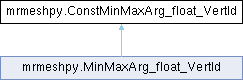
|
MeshLib Python Docs
|
Public Member Functions | |
| __init__ (self, *args, **kwargs) | |
| tuple[float, VertId] | maxPair (self) |
| tuple[float, VertId] | minPair (self) |
| float | max (self) |
| ConstVertId | maxArg (self) |
| float | min (self) |
| ConstVertId | minArg (self) |
Static Protected Attributes | |
| typing | _offsetof_max = 4 |
| typing | _offsetof_maxArg = 12 |
| typing | _offsetof_min = 0 |
| typing | _offsetof_minArg = 8 |
Generated from:  MR::MinMaxArg<float, MR::VertId>

minimum and maximum of some elements of type T,
and the indices of where minimum and maximum are reached of type I
| mrmeshpy.ConstMinMaxArg_float_VertId.__init__ | ( | self, | |
| * | args, | ||
| ** | kwargs ) |
__init__(*args, **kwargs)
Overloaded function.

1. __init__(self: meshlib.mrmeshpy.ConstMinMaxArg_float_VertId) -> None

2. __init__(self: meshlib.mrmeshpy.ConstMinMaxArg_float_VertId, arg0: meshlib.mrmeshpy.ConstMinMaxArg_float_VertId) -> None

Implicit copy constructor.

3. __init__(self: meshlib.mrmeshpy.ConstMinMaxArg_float_VertId, min: float, max: float, minArg: meshlib.mrmeshpy.ConstVertId, maxArg: meshlib.mrmeshpy.ConstVertId) -> None

Implicit aggregate constructor.

4. __init__(self: meshlib.mrmeshpy.ConstMinMaxArg_float_VertId, : meshlib.mrmeshpy.ConstMinMaxArg_float_VertId) -> None
| float mrmeshpy.ConstMinMaxArg_float_VertId.max | ( | self | ) |
| ConstVertId mrmeshpy.ConstMinMaxArg_float_VertId.maxArg | ( | self | ) |
Reimplemented in mrmeshpy.MinMaxArg_float_VertId, and mrmeshpy.MinMaxArg_float_VertId.
| tuple[float, VertId] mrmeshpy.ConstMinMaxArg_float_VertId.maxPair | ( | self | ) |
| float mrmeshpy.ConstMinMaxArg_float_VertId.min | ( | self | ) |
| ConstVertId mrmeshpy.ConstMinMaxArg_float_VertId.minArg | ( | self | ) |
Reimplemented in mrmeshpy.MinMaxArg_float_VertId, and mrmeshpy.MinMaxArg_float_VertId.
| tuple[float, VertId] mrmeshpy.ConstMinMaxArg_float_VertId.minPair | ( | self | ) |
|
staticprotected |
|
staticprotected |
|
staticprotected |
|
staticprotected |
 1.14.0