|
MeshLib Python Docs
|
Public Member Functions | |
| WatershedGraph.ConstBdInfo | __getitem__ (self, ConstGraphEdgeId i) |
| __init__ (self, *args, **kwargs) | |
| typing.Iterator[WatershedGraph.BdInfo] | __iter__ (self) |
| int | __len__ (self) |
| WatershedGraph.ConstBdInfo | back (self) |
| GraphEdgeId | backId (self) |
| GraphEdgeId | beginId (self) |
| int | capacity (self) |
| WatershedGraph.ConstBdInfo | data (self) |
| bool | empty (self) |
| GraphEdgeId | endId (self) |
| WatershedGraph.ConstBdInfo | front (self) |
| int | heapBytes (self) |
| int | max_size (self) |
| int | size (self) |
| Const_std_vector_WatershedGraph_BdInfo_Allocator_WatershedGraph_BdInfo | vec (self) |
Static Protected Attributes | |
| typing | _offsetof_vec = 0 |
Generated from:  MR::Vector<MR::WatershedGraph::BdInfo, MR::GraphEdgeId>

Vector<T> is indexed by size_t
| mrmeshpy.ConstVector_WatershedGraph_BdInfo_GraphEdgeId.__init__ | ( | self, | |
| * | args, | ||
| ** | kwargs ) |
__init__(*args, **kwargs)
Overloaded function.

1. __init__(self: meshlib.mrmeshpy.ConstVector_WatershedGraph_BdInfo_GraphEdgeId) -> None

creates empty vector

2. __init__(self: meshlib.mrmeshpy.ConstVector_WatershedGraph_BdInfo_GraphEdgeId, size: int) -> None

creates a vector with \\p size elements with default value

3. __init__(self: meshlib.mrmeshpy.ConstVector_WatershedGraph_BdInfo_GraphEdgeId, size: int, val: meshlib.mrmeshpy.WatershedGraph.ConstBdInfo) -> None

creates a vector with \\p size elements with the given value

4. __init__(self: meshlib.mrmeshpy.ConstVector_WatershedGraph_BdInfo_GraphEdgeId, arg0: list) -> None

5. __init__(self: meshlib.mrmeshpy.ConstVector_WatershedGraph_BdInfo_GraphEdgeId, arg0: meshlib.mrmeshpy.ConstVector_WatershedGraph_BdInfo_GraphEdgeId) -> None

Implicit copy constructor.

6. __init__(self: meshlib.mrmeshpy.ConstVector_WatershedGraph_BdInfo_GraphEdgeId, : meshlib.mrmeshpy.ConstVector_WatershedGraph_BdInfo_GraphEdgeId) -> None
| WatershedGraph.ConstBdInfo mrmeshpy.ConstVector_WatershedGraph_BdInfo_GraphEdgeId.__getitem__ | ( | self, | |
| ConstGraphEdgeId | i ) |
| typing.Iterator[WatershedGraph.BdInfo] mrmeshpy.ConstVector_WatershedGraph_BdInfo_GraphEdgeId.__iter__ | ( | self | ) |
| int mrmeshpy.ConstVector_WatershedGraph_BdInfo_GraphEdgeId.__len__ | ( | self | ) |
| WatershedGraph.ConstBdInfo mrmeshpy.ConstVector_WatershedGraph_BdInfo_GraphEdgeId.back | ( | self | ) |
| GraphEdgeId mrmeshpy.ConstVector_WatershedGraph_BdInfo_GraphEdgeId.backId | ( | self | ) |
returns the identifier of the back() element
| GraphEdgeId mrmeshpy.ConstVector_WatershedGraph_BdInfo_GraphEdgeId.beginId | ( | self | ) |
returns the identifier of the first element
| int mrmeshpy.ConstVector_WatershedGraph_BdInfo_GraphEdgeId.capacity | ( | self | ) |
| WatershedGraph.ConstBdInfo mrmeshpy.ConstVector_WatershedGraph_BdInfo_GraphEdgeId.data | ( | self | ) |
| bool mrmeshpy.ConstVector_WatershedGraph_BdInfo_GraphEdgeId.empty | ( | self | ) |
| GraphEdgeId mrmeshpy.ConstVector_WatershedGraph_BdInfo_GraphEdgeId.endId | ( | self | ) |
returns backId() + 1
| WatershedGraph.ConstBdInfo mrmeshpy.ConstVector_WatershedGraph_BdInfo_GraphEdgeId.front | ( | self | ) |
| int mrmeshpy.ConstVector_WatershedGraph_BdInfo_GraphEdgeId.heapBytes | ( | self | ) |
returns the amount of memory this object occupies on heap
| int mrmeshpy.ConstVector_WatershedGraph_BdInfo_GraphEdgeId.max_size | ( | self | ) |
| int mrmeshpy.ConstVector_WatershedGraph_BdInfo_GraphEdgeId.size | ( | self | ) |
| Const_std_vector_WatershedGraph_BdInfo_Allocator_WatershedGraph_BdInfo mrmeshpy.ConstVector_WatershedGraph_BdInfo_GraphEdgeId.vec | ( | self | ) |
The user can directly manipulate the vector, they can't break anything anyway.
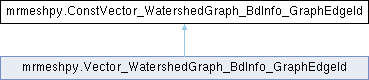
Reimplemented in mrmeshpy.Vector_WatershedGraph_BdInfo_GraphEdgeId, and mrmeshpy.Vector_WatershedGraph_BdInfo_GraphEdgeId.
|
staticprotected |
|
static |
|
static |
|
static |
|
static |
|
static |
|
static |
|
static |
|
static |
|
static |
|
static |
|
static |
|
static |
 1.14.0