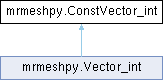
|
MeshLib Python Docs
|
Public Member Functions | |
| bool | __eq__ (self, ConstVector_int b) |
| int | __getitem__ (self, int i) |
| __init__ (self, *args, **kwargs) | |
| typing.Iterator[int] | __iter__ (self) |
| int | __len__ (self) |
| bool | __ne__ (self, ConstVector_int b) |
| int | back (self) |
| int | backId (self) |
| int | beginId (self) |
| int | capacity (self) |
| int | data (self) |
| bool | empty (self) |
| int | endId (self) |
| int | front (self) |
| int | heapBytes (self) |
| int | max_size (self) |
| int | size (self) |
| Const_std_vector_int_Allocator_int | vec (self) |
Static Public Attributes | |
| ConstStdVector = Const_std_vector_int_Allocator_int | |
| StdVector = std_vector_int_Allocator_int | |
Static Protected Attributes | |
| typing | _offsetof_vec = 0 |
Generated from:  MR::Vector<int>
Aliases:  Vector_int_unsigned_long

Vector<T> is indexed by size_t
| mrmeshpy.ConstVector_int.__init__ | ( | self, | |
| * | args, | ||
| ** | kwargs ) |
__init__(*args, **kwargs)
Overloaded function.

1. __init__(self: meshlib.mrmeshpy.ConstVector_int) -> None

creates empty vector

2. __init__(self: meshlib.mrmeshpy.ConstVector_int, size: int) -> None

creates a vector with \\p size elements with default value

3. __init__(self: meshlib.mrmeshpy.ConstVector_int, size: int, val: int) -> None

creates a vector with \\p size elements with the given value

4. __init__(self: meshlib.mrmeshpy.ConstVector_int, arg0: list) -> None

5. __init__(self: meshlib.mrmeshpy.ConstVector_int, arg0: meshlib.mrmeshpy.ConstVector_int) -> None

Implicit copy constructor.

6. __init__(self: meshlib.mrmeshpy.ConstVector_int, : meshlib.mrmeshpy.ConstVector_int) -> None
| bool mrmeshpy.ConstVector_int.__eq__ | ( | self, | |
| ConstVector_int | b ) |
| int mrmeshpy.ConstVector_int.__getitem__ | ( | self, | |
| int | i ) |
| typing.Iterator[int] mrmeshpy.ConstVector_int.__iter__ | ( | self | ) |
| int mrmeshpy.ConstVector_int.__len__ | ( | self | ) |
| bool mrmeshpy.ConstVector_int.__ne__ | ( | self, | |
| ConstVector_int | b ) |
| int mrmeshpy.ConstVector_int.back | ( | self | ) |
Reimplemented in mrmeshpy.Vector_int, and mrmeshpy.Vector_int.
| int mrmeshpy.ConstVector_int.backId | ( | self | ) |
returns the identifier of the back() element
| int mrmeshpy.ConstVector_int.beginId | ( | self | ) |
returns the identifier of the first element
| int mrmeshpy.ConstVector_int.capacity | ( | self | ) |
| int mrmeshpy.ConstVector_int.data | ( | self | ) |
Reimplemented in mrmeshpy.Vector_int, and mrmeshpy.Vector_int.
| bool mrmeshpy.ConstVector_int.empty | ( | self | ) |
| int mrmeshpy.ConstVector_int.endId | ( | self | ) |
returns backId() + 1
| int mrmeshpy.ConstVector_int.front | ( | self | ) |
Reimplemented in mrmeshpy.Vector_int, and mrmeshpy.Vector_int.
| int mrmeshpy.ConstVector_int.heapBytes | ( | self | ) |
returns the amount of memory this object occupies on heap
| int mrmeshpy.ConstVector_int.max_size | ( | self | ) |
| int mrmeshpy.ConstVector_int.size | ( | self | ) |
| Const_std_vector_int_Allocator_int mrmeshpy.ConstVector_int.vec | ( | self | ) |
The user can directly manipulate the vector, they can't break anything anyway.
Reimplemented in mrmeshpy.Vector_int, and mrmeshpy.Vector_int.
|
staticprotected |
|
static |
|
static |
 1.14.0