|
MeshLib Python Docs
|
|
MeshLib Python Docs
|
Public Member Functions | |
| bool | __eq__ (self, ConstVertCoords b) |
| ConstVector3f | __getitem__ (self, ConstVertId i) |
| __init__ (self, *args, **kwargs) | |
| typing.Iterator[ConstVector3f] | __iter__ (self) |
| int | __len__ (self) |
| bool | __ne__ (self, ConstVertCoords b) |
| ConstVector3f | back (self) |
| VertId | backId (self) |
| VertId | beginId (self) |
| int | capacity (self) |
| ConstVector3f | data (self) |
| bool | empty (self) |
| VertId | endId (self) |
| ConstVector3f | front (self) |
| int | heapBytes (self) |
| int | max_size (self) |
| int | size (self) |
| Const_std_vector_Vector3_float_Allocator_Vector3_float | vec (self) |
Static Protected Attributes | |
| typing | _offsetof_vec = 0 |
Generated from:  MR::VertCoords
Aliases:  VertNormals

Vector<T> is indexed by size_t
| mrmeshpy.ConstVertCoords.__init__ | ( | self, | |
| * | args, | ||
| ** | kwargs ) |
__init__(*args, **kwargs)
Overloaded function.

1. __init__(self: meshlib.mrmeshpy.ConstVertCoords) -> None

creates empty vector

2. __init__(self: meshlib.mrmeshpy.ConstVertCoords, size: int) -> None

creates a vector with \\p size elements with default value

3. __init__(self: meshlib.mrmeshpy.ConstVertCoords, size: int, val: meshlib.mrmeshpy.ConstVector3f) -> None

creates a vector with \\p size elements with the given value

4. __init__(self: meshlib.mrmeshpy.ConstVertCoords, arg0: list) -> None

5. __init__(self: meshlib.mrmeshpy.ConstVertCoords, arg0: meshlib.mrmeshpy.ConstVertCoords) -> None

Implicit copy constructor.

6. __init__(self: meshlib.mrmeshpy.ConstVertCoords, : meshlib.mrmeshpy.ConstVertCoords) -> None
| bool mrmeshpy.ConstVertCoords.__eq__ | ( | self, | |
| ConstVertCoords | b ) |
| ConstVector3f mrmeshpy.ConstVertCoords.__getitem__ | ( | self, | |
| ConstVertId | i ) |
| typing.Iterator[ConstVector3f] mrmeshpy.ConstVertCoords.__iter__ | ( | self | ) |
| int mrmeshpy.ConstVertCoords.__len__ | ( | self | ) |
| bool mrmeshpy.ConstVertCoords.__ne__ | ( | self, | |
| ConstVertCoords | b ) |
| ConstVector3f mrmeshpy.ConstVertCoords.back | ( | self | ) |
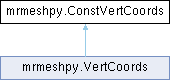
Reimplemented in mrmeshpy.VertCoords, and mrmeshpy.VertCoords.
| VertId mrmeshpy.ConstVertCoords.backId | ( | self | ) |
returns the identifier of the back() element
| VertId mrmeshpy.ConstVertCoords.beginId | ( | self | ) |
returns the identifier of the first element
| int mrmeshpy.ConstVertCoords.capacity | ( | self | ) |
| ConstVector3f mrmeshpy.ConstVertCoords.data | ( | self | ) |
Reimplemented in mrmeshpy.VertCoords, and mrmeshpy.VertCoords.
| bool mrmeshpy.ConstVertCoords.empty | ( | self | ) |
| VertId mrmeshpy.ConstVertCoords.endId | ( | self | ) |
returns backId() + 1
| ConstVector3f mrmeshpy.ConstVertCoords.front | ( | self | ) |
Reimplemented in mrmeshpy.VertCoords, and mrmeshpy.VertCoords.
| int mrmeshpy.ConstVertCoords.heapBytes | ( | self | ) |
returns the amount of memory this object occupies on heap
| int mrmeshpy.ConstVertCoords.max_size | ( | self | ) |
| int mrmeshpy.ConstVertCoords.size | ( | self | ) |
| Const_std_vector_Vector3_float_Allocator_Vector3_float mrmeshpy.ConstVertCoords.vec | ( | self | ) |
The user can directly manipulate the vector, they can't break anything anyway.
Reimplemented in mrmeshpy.VertCoords, and mrmeshpy.VertCoords.
|
staticprotected |
 1.14.0