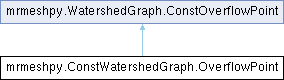
|
MeshLib Python Docs
|
Public Member Functions | |
| None | __init__ (WatershedGraph.OverflowPoint self) |
| None | __init__ (WatershedGraph.OverflowPoint self, WatershedGraph.ConstOverflowPoint arg0) |
| None | __init__ (WatershedGraph.OverflowPoint self, ConstVertId v, ConstGraphVertId fullBasin, ConstGraphVertId overflowTo) |
| WatershedGraph.OverflowPoint | assign (WatershedGraph.OverflowPoint self, WatershedGraph.ConstOverflowPoint other) |
| GraphVertId | fullBasin (self) |
| None | fullBasin (self, ConstGraphVertId arg1) |
| GraphVertId | overflowTo (self) |
| None | overflowTo (self, ConstGraphVertId arg1) |
| VertId | v (self) |
| None | v (self, ConstVertId arg1) |
| Public Member Functions inherited from mrmeshpy.WatershedGraph.ConstOverflowPoint | |
| __init__ (self, *args, **kwargs) | |
Static Public Member Functions | |
| None | __init__ (*args, **kwargs) |
Additional Inherited Members | |
| Static Protected Attributes inherited from mrmeshpy.WatershedGraph.ConstOverflowPoint | |
| typing | _offsetof_fullBasin = 4 |
| typing | _offsetof_overflowTo = 8 |
| typing | _offsetof_v = 0 |
Generated from:  MR::WatershedGraph::OverflowPoint

describes a point where a flow from one basin overflows into another basin
|
static |
| None mrmeshpy.ConstWatershedGraph.OverflowPoint.__init__ | ( | WatershedGraph.OverflowPoint | self | ) |
| None mrmeshpy.ConstWatershedGraph.OverflowPoint.__init__ | ( | WatershedGraph.OverflowPoint | self, |
| WatershedGraph.ConstOverflowPoint | arg0 ) |
Implicit copy constructor.
| None mrmeshpy.ConstWatershedGraph.OverflowPoint.__init__ | ( | WatershedGraph.OverflowPoint | self, |
| ConstVertId | v, | ||
| ConstGraphVertId | fullBasin, | ||
| ConstGraphVertId | overflowTo ) |
Implicit aggregate constructor.
| WatershedGraph.OverflowPoint mrmeshpy.ConstWatershedGraph.OverflowPoint.assign | ( | WatershedGraph.OverflowPoint | self, |
| WatershedGraph.ConstOverflowPoint | other ) |
| GraphVertId mrmeshpy.ConstWatershedGraph.OverflowPoint.fullBasin | ( | self | ) |
Reimplemented from mrmeshpy.WatershedGraph.ConstOverflowPoint.
| None mrmeshpy.ConstWatershedGraph.OverflowPoint.fullBasin | ( | self, | |
| ConstGraphVertId | arg1 ) |
Reimplemented from mrmeshpy.WatershedGraph.ConstOverflowPoint.
| GraphVertId mrmeshpy.ConstWatershedGraph.OverflowPoint.overflowTo | ( | self | ) |
basin where the flow from v goes
Reimplemented from mrmeshpy.WatershedGraph.ConstOverflowPoint.
| None mrmeshpy.ConstWatershedGraph.OverflowPoint.overflowTo | ( | self, | |
| ConstGraphVertId | arg1 ) |
basin where the flow from v goes
Reimplemented from mrmeshpy.WatershedGraph.ConstOverflowPoint.
| VertId mrmeshpy.ConstWatershedGraph.OverflowPoint.v | ( | self | ) |
mesh vertex on the boundary of full basin and the other where it overflows
Reimplemented from mrmeshpy.WatershedGraph.ConstOverflowPoint.
| None mrmeshpy.ConstWatershedGraph.OverflowPoint.v | ( | self, | |
| ConstVertId | arg1 ) |
mesh vertex on the boundary of full basin and the other where it overflows
Reimplemented from mrmeshpy.WatershedGraph.ConstOverflowPoint.
 1.14.0