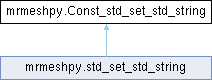
◆ __init__()
| mrmeshpy.Const_std_set_std_string.__init__ |
( |
| self, |
|
|
* | args, |
|
|
** | kwargs ) |
__init__(*args, **kwargs)
Overloaded function.

1. __init__(self: meshlib.mrmeshpy.Const_std_set_std_string) -> None

2. __init__(self: meshlib.mrmeshpy.Const_std_set_std_string, arg0: Iterable) -> None
◆ __contains__()
| mrmeshpy.Const_std_set_std_string.__contains__ |
( |
| self, |
|
|
| x ) |
__contains__(self: meshlib.mrmeshpy.Const_std_set_std_string, arg0: str) -> bool
◆ __iter__()
| typing.Iterator[str] mrmeshpy.Const_std_set_std_string.__iter__ |
( |
| self | ) |
|
◆ __len__()
| mrmeshpy.Const_std_set_std_string.__len__ |
( |
| self | ) |
|
__len__(self: meshlib.mrmeshpy.Const_std_set_std_string) -> int
◆ __repr__()
| mrmeshpy.Const_std_set_std_string.__repr__ |
( |
| self | ) |
|
__repr__(self: meshlib.mrmeshpy.Const_std_set_std_string) -> str

Return the canonical string representation of this set.
The documentation for this class was generated from the following file:
 1.14.0