|
MeshLib Python Docs
|
|
MeshLib Python Docs
|
Public Member Functions | |
| InSphereResult | __call__ (self, PreciseVertCoords d) |
| None | __init__ (self) |
| None | __init__ (self, FastInSphereTesterSoS arg0) |
| None | flip (self) |
| bool | outsideBothSpheres (self, Vector3i d) |
| bool | reset (self, PreciseVertCoords a, PreciseVertCoords b, PreciseVertCoords c, int rSq) |
| Public Member Functions inherited from mrmeshpy.InSphereTesterSoS | |
| InSphereResult | __call__ (self, PreciseVertCoords d) |
| None | __init__ (self) |
| None | __init__ (self, InSphereTesterSoS arg0) |
| bool | degenerateTriangle (self) |
| Public Member Functions inherited from mrmeshpy.InSphereTester_int | |
| InSphereResult | __call__ (self, Vector3i d) |
| None | __init__ (self) |
| None | __init__ (self, InSphereTester_int arg0) |
Static Public Member Functions | |
| None | __init__ (*args, **kwargs) |
| FastInSphereTesterSoS | operator (*args, **kwargs) |
| FastInSphereTesterSoS | operator (*args, **kwargs) |
| Static Public Member Functions inherited from mrmeshpy.InSphereTesterSoS | |
| None | __init__ (*args, **kwargs) |
| Static Public Member Functions inherited from mrmeshpy.InSphereTester_int | |
| None | __init__ (*args, **kwargs) |
Generated from:  MR::FastInSphereTesterSoS

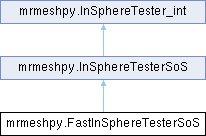
gives exactly the same answers as InSphereTesterSoS, only faster: the sphere's center is also
computed in floating point during reset(), and every query point far enough from the sphere's
surface is answered by it alone, leaving the exact predicates for the points close to it
|
static |
| None mrmeshpy.FastInSphereTesterSoS.__init__ | ( | self | ) |
| None mrmeshpy.FastInSphereTesterSoS.__init__ | ( | self, | |
| FastInSphereTesterSoS | arg0 ) |
Implicit copy constructor.
| InSphereResult mrmeshpy.FastInSphereTesterSoS.__call__ | ( | self, | |
| PreciseVertCoords | d ) |
returns the position of the point d.pt relative to the sphere, with the ties resolved by
simulation-of-simplicity exactly as InSphereTesterSoS does (never OnSphere or NoSphere);
shall be called only after reset() returned true, and all four ids must be distinct
| None mrmeshpy.FastInSphereTesterSoS.flip | ( | self | ) |
selects the mirror sphere as the base class does, moving the floating-point center as well;
this hides the flip of the base class, which would leave the center on the wrong side
Reimplemented from mrmeshpy.InSphereTesterSoS.
|
static |
Reimplemented from mrmeshpy.InSphereTesterSoS.
|
static |
Reimplemented from mrmeshpy.InSphereTesterSoS.
| bool mrmeshpy.FastInSphereTesterSoS.outsideBothSpheres | ( | self, | |
| Vector3i | d ) |
whether d is strictly outside both spheres of the given radius passing via the three points
of reset(): the selected one and its mirror in the plane of the triangle;
the answer is exact, and a point lying on either of them is not strictly outside, so no tie
arises and no simulation-of-simplicity is involved;
filtered in floating point as the query above, and equally exact;
for a degenerate triangle, where only the perturbed spheres exist and the answer would need
the id of d, returns false conservatively (never prunes)
| bool mrmeshpy.FastInSphereTesterSoS.reset | ( | self, | |
| PreciseVertCoords | a, | ||
| PreciseVertCoords | b, | ||
| PreciseVertCoords | c, | ||
| int | rSq ) |
prepares the tester as InSphereTesterSoS::reset does, and additionally computes the
floating-point center of the sphere and the tolerance of the tests below;
this hides the reset of the base class, which would leave the center stale
Reimplemented from mrmeshpy.InSphereTesterSoS.
 1.14.0