|
MeshLib Python Docs
|
Public Member Functions | |
| __init__ (self, *args, **kwargs) | |
| Features.Primitives.ConeSegment | axis (self) |
| Features.Primitives.ConeSegment | baseCircle (self, bool negative) |
| Features.Primitives.Plane | basePlane (self, bool negative) |
| Sphere3f | basePoint (self, bool negative) |
| Sphere3f | centerPoint (self) |
| Features.Primitives.ConeSegment | extendToInfinity (self, bool negative) |
| Features.Primitives.ConeSegment | extendToInfinity (self) |
| bool | isCircle (self) |
| bool | isZeroRadius (self) |
| float | length (self) |
| Features.Primitives.ConeSegment | untruncateCone (self) |
| ConstVector3f | dir (self) |
| bool | hollow (self) |
| float | negativeLength (self) |
| float | negativeSideRadius (self) |
| float | positiveLength (self) |
| float | positiveSideRadius (self) |
| ConstVector3f | referencePoint (self) |
Static Public Member Functions | |
| bool | __eq__ (*args, **kwargs) |
| bool | __ne__ (*args, **kwargs) |
Static Protected Attributes | |
| typing | _offsetof_dir = 12 |
| typing | _offsetof_hollow = 40 |
| typing | _offsetof_negativeLength = 36 |
| typing | _offsetof_negativeSideRadius = 28 |
| typing | _offsetof_positiveLength = 32 |
| typing | _offsetof_positiveSideRadius = 24 |
| typing | _offsetof_referencePoint = 0 |
Generated from:  MR::Features::Primitives::ConeSegment

Can have infinite length in one or two directions.
The top and/or bottom can be flat or pointy.
Doubles as a cylinder, line (finite or infinite), and a circle.
| mrmeshpy.Features.Primitives.ConstConeSegment.__init__ | ( | self, | |
| * | args, | ||
| ** | kwargs ) |
__init__(*args, **kwargs)
Overloaded function.

1. __init__(self: meshlib.mrmeshpy.Features.Primitives.ConstConeSegment) -> None

2. __init__(self: meshlib.mrmeshpy.Features.Primitives.ConstConeSegment, arg0: meshlib.mrmeshpy.Features.Primitives.ConstConeSegment) -> None

Implicit copy constructor.

3. __init__(self: meshlib.mrmeshpy.Features.Primitives.ConstConeSegment, referencePoint: meshlib.mrmeshpy.ConstVector3f, dir: meshlib.mrmeshpy.ConstVector3f, positiveSideRadius: float, negativeSideRadius: float, positiveLength: float, negativeLength: float, hollow: bool) -> None

Implicit aggregate constructor.

4. __init__(self: meshlib.mrmeshpy.Features.Primitives.ConstConeSegment, : meshlib.mrmeshpy.Features.Primitives.ConstConeSegment) -> None
|
static |
|
static |
| Features.Primitives.ConeSegment mrmeshpy.Features.Primitives.ConstConeSegment.axis | ( | self | ) |
Returns a finite axis. For circles, you might want to immediately `extendToInfinity()` it.
| Features.Primitives.ConeSegment mrmeshpy.Features.Primitives.ConstConeSegment.baseCircle | ( | self, | |
| bool | negative ) |
Returns one of the two base circles.
| Features.Primitives.Plane mrmeshpy.Features.Primitives.ConstConeSegment.basePlane | ( | self, | |
| bool | negative ) |
Returns one of the two base planes.
| Sphere3f mrmeshpy.Features.Primitives.ConstConeSegment.basePoint | ( | self, | |
| bool | negative ) |
Returns a center of one of the two base circles.
| Sphere3f mrmeshpy.Features.Primitives.ConstConeSegment.centerPoint | ( | self | ) |
Returns the center point (unlike `referencePoint`, which can actually be off-center).
For half-infinite objects, returns the finite end.
| ConstVector3f mrmeshpy.Features.Primitives.ConstConeSegment.dir | ( | self | ) |
The axis direction. Must be normalized.
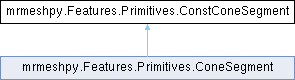
Reimplemented in mrmeshpy.Features.Primitives.ConeSegment, and mrmeshpy.Features.Primitives.ConeSegment.
| Features.Primitives.ConeSegment mrmeshpy.Features.Primitives.ConstConeSegment.extendToInfinity | ( | self | ) |
Extends the object to infinity in both directions. This is equivalent to `.extendToInfinity(false).extendToInfinity(true)`,
except that calling it with `positiveSideRadius != negativeSideRadius` is illegal and triggers an assertion.
| Features.Primitives.ConeSegment mrmeshpy.Features.Primitives.ConstConeSegment.extendToInfinity | ( | self, | |
| bool | negative ) |
Extends the object to infinity in one direction. The radius in the extended direction becomes equal to the radius in the opposite direction.
| bool mrmeshpy.Features.Primitives.ConstConeSegment.hollow | ( | self | ) |
If true, the cone has no caps and no volume, and all distances (to the conical surface, that is) are positive.
Reimplemented in mrmeshpy.Features.Primitives.ConeSegment, and mrmeshpy.Features.Primitives.ConeSegment.
| bool mrmeshpy.Features.Primitives.ConstConeSegment.isCircle | ( | self | ) |
| bool mrmeshpy.Features.Primitives.ConstConeSegment.isZeroRadius | ( | self | ) |
| float mrmeshpy.Features.Primitives.ConstConeSegment.length | ( | self | ) |
Returns the length. Can be infinite.
| float mrmeshpy.Features.Primitives.ConstConeSegment.negativeLength | ( | self | ) |
Distance from the `center` to the cap in the direction opposite to `dir`.
Reimplemented in mrmeshpy.Features.Primitives.ConeSegment, and mrmeshpy.Features.Primitives.ConeSegment.
| float mrmeshpy.Features.Primitives.ConstConeSegment.negativeSideRadius | ( | self | ) |
Cap radius in the direction opposite to `dir`.
Reimplemented in mrmeshpy.Features.Primitives.ConeSegment, and mrmeshpy.Features.Primitives.ConeSegment.
| float mrmeshpy.Features.Primitives.ConstConeSegment.positiveLength | ( | self | ) |
Distance from the `center` to the cap in the `dir` direction.
Reimplemented in mrmeshpy.Features.Primitives.ConeSegment, and mrmeshpy.Features.Primitives.ConeSegment.
| float mrmeshpy.Features.Primitives.ConstConeSegment.positiveSideRadius | ( | self | ) |
Cap radius in the `dir` direction.
Reimplemented in mrmeshpy.Features.Primitives.ConeSegment, and mrmeshpy.Features.Primitives.ConeSegment.
| ConstVector3f mrmeshpy.Features.Primitives.ConstConeSegment.referencePoint | ( | self | ) |
Some point on the axis, but not necessarily the true center point. Use `centerPoint()` for that.
Reimplemented in mrmeshpy.Features.Primitives.ConeSegment, and mrmeshpy.Features.Primitives.ConeSegment.
| Features.Primitives.ConeSegment mrmeshpy.Features.Primitives.ConstConeSegment.untruncateCone | ( | self | ) |
Untruncates a truncated cone. If it's not a cone at all, returns the object unchanged and triggers an assertion.
|
staticprotected |
|
staticprotected |
|
staticprotected |
|
staticprotected |
|
staticprotected |
|
staticprotected |
|
staticprotected |
 1.14.0