|
MeshLib Python Docs
|
Public Member Functions | |
| __new__ (cls, value) | |
| __format__ (self, format_spec) | |
| __str__ (self) | |
Static Public Attributes | |
| typing | Combined .ClassVar[ICPMethod] |
| typing | PointToPlane .ClassVar[ICPMethod] |
| typing | PointToPoint .ClassVar[ICPMethod] |
Protected Member Functions | |
| _missing_ (cls, value) | |
| _value_repr_ (self) | |
Static Protected Member Functions | |
| _generate_next_value_ (name, start, count, last_values) | |
| _new_member_ (type, *args, **kwargs) | |
Static Protected Attributes | |
| typing | _member_map_ .ClassVar[dict] |
| list | _member_names_ = ['Combined', 'PointToPoint', 'PointToPlane'] |
| typing | _unhashable_values_ = list() |
| typing | _use_args_ = True |
| typing | _value2member_map_ .ClassVar[dict] |
| _member_type_ = builtins.int | |
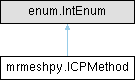
Members:

  Combined : PointToPoint for the first 2 iterations, and PointToPlane for the remaining iterations

  PointToPoint : select transformation that minimizes mean squared distance between two points in each pair,
it is the safest approach but can converge slowly

  PointToPlane : select transformation that minimizes mean squared distance between a point and a plane via the other point in each pair,
converge much faster than PointToPoint in case of many good (with not all points/normals in one plane) pairs
This mode only works correctly if the object that points are being projected onto has normals information (is not a point clouds without normals).
By default both objects are projected onto each other, so at least one of them must have normals, unless you change the settings
to only project one way (using `MR::ICP::setFltSamples()` or `MR::ICP::setRefSamples()`), in which case the object being projected onto
must have normals.
| mrmeshpy.ICPMethod.__format__ | ( | self, | |
| format_spec ) |
Convert to a string according to format_spec.
| mrmeshpy.ICPMethod.__new__ | ( | cls, | |
| value ) |
| mrmeshpy.ICPMethod.__str__ | ( | self | ) |
|
staticprotected |
        Generate the next value when not given.

        name: the name of the member
        start: the initial start value or None
        count: the number of existing members
        last_values: the list of values assigned
|
protected |
|
staticprotected |
Create and return a new object. See help(type) for accurate signature.
|
protected |
Return repr(self).
|
staticprotected |
|
staticprotected |
|
staticprotected |
|
staticprotected |
|
staticprotected |
|
staticprotected |
|
static |
|
static |
|
static |
 1.14.0