|
MeshLib Python Docs
|
Public Member Functions | |
| None | __init__ (self) |
| None | __init__ (self, ConstMoveMeshToVoxelMaxDerivSettings arg0) |
| None | __init__ (self, int iters, int samplePoints, int degree, float outlierThreshold, float intermediateSmoothForce, float preparationSmoothForce) |
| MoveMeshToVoxelMaxDerivSettings | assign (self, ConstMoveMeshToVoxelMaxDerivSettings other) |
| int | degree (self) |
| None | degree (self, int arg1) |
| float | intermediateSmoothForce (self) |
| None | intermediateSmoothForce (self, float arg1) |
| int | iters (self) |
| None | iters (self, int arg1) |
| float | outlierThreshold (self) |
| None | outlierThreshold (self, float arg1) |
| float | preparationSmoothForce (self) |
| None | preparationSmoothForce (self, float arg1) |
| int | samplePoints (self) |
| None | samplePoints (self, int arg1) |
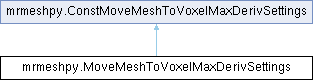
| Public Member Functions inherited from mrmeshpy.ConstMoveMeshToVoxelMaxDerivSettings | |
| __init__ (self, *args, **kwargs) | |
Static Public Member Functions | |
| None | __init__ (*args, **kwargs) |
Additional Inherited Members | |
| Static Protected Attributes inherited from mrmeshpy.ConstMoveMeshToVoxelMaxDerivSettings | |
| typing | _offsetof_degree = 8 |
| typing | _offsetof_intermediateSmoothForce = 16 |
| typing | _offsetof_iters = 0 |
| typing | _offsetof_outlierThreshold = 12 |
| typing | _offsetof_preparationSmoothForce = 20 |
| typing | _offsetof_samplePoints = 4 |
Generated from: MR::MoveMeshToVoxelMaxDerivSettings
|
static |
| None mrmeshpy.MoveMeshToVoxelMaxDerivSettings.__init__ | ( | self | ) |
| None mrmeshpy.MoveMeshToVoxelMaxDerivSettings.__init__ | ( | self, | |
| ConstMoveMeshToVoxelMaxDerivSettings | arg0 ) |
Implicit copy constructor.
| None mrmeshpy.MoveMeshToVoxelMaxDerivSettings.__init__ | ( | self, | |
| int | iters, | ||
| int | samplePoints, | ||
| int | degree, | ||
| float | outlierThreshold, | ||
| float | intermediateSmoothForce, | ||
| float | preparationSmoothForce ) |
Implicit aggregate constructor.
| MoveMeshToVoxelMaxDerivSettings mrmeshpy.MoveMeshToVoxelMaxDerivSettings.assign | ( | self, | |
| ConstMoveMeshToVoxelMaxDerivSettings | other ) |
| int mrmeshpy.MoveMeshToVoxelMaxDerivSettings.degree | ( | self | ) |
degree of the polynomial used to fit sampled points. Must be in range [3; 6]
Reimplemented from mrmeshpy.ConstMoveMeshToVoxelMaxDerivSettings.
| None mrmeshpy.MoveMeshToVoxelMaxDerivSettings.degree | ( | self, | |
| int | arg1 ) |
degree of the polynomial used to fit sampled points. Must be in range [3; 6]
Reimplemented from mrmeshpy.ConstMoveMeshToVoxelMaxDerivSettings.
| float mrmeshpy.MoveMeshToVoxelMaxDerivSettings.intermediateSmoothForce | ( | self | ) |
force of the smoothing (relaxation) of vector field of shifts on each iteration
Reimplemented from mrmeshpy.ConstMoveMeshToVoxelMaxDerivSettings.
| None mrmeshpy.MoveMeshToVoxelMaxDerivSettings.intermediateSmoothForce | ( | self, | |
| float | arg1 ) |
force of the smoothing (relaxation) of vector field of shifts on each iteration
Reimplemented from mrmeshpy.ConstMoveMeshToVoxelMaxDerivSettings.
| int mrmeshpy.MoveMeshToVoxelMaxDerivSettings.iters | ( | self | ) |
number of iterations. Each iteration moves vertex only slightly and smooths the vector field of shifts.
Reimplemented from mrmeshpy.ConstMoveMeshToVoxelMaxDerivSettings.
| None mrmeshpy.MoveMeshToVoxelMaxDerivSettings.iters | ( | self, | |
| int | arg1 ) |
number of iterations. Each iteration moves vertex only slightly and smooths the vector field of shifts.
Reimplemented from mrmeshpy.ConstMoveMeshToVoxelMaxDerivSettings.
| float mrmeshpy.MoveMeshToVoxelMaxDerivSettings.outlierThreshold | ( | self | ) |
for each iteration, if target position of the vertex is greater than this threshold, it is disregarded.
For small degrees, this value should be small, for large degrees it may be larger.
Measured in number of voxels.
Reimplemented from mrmeshpy.ConstMoveMeshToVoxelMaxDerivSettings.
| None mrmeshpy.MoveMeshToVoxelMaxDerivSettings.outlierThreshold | ( | self, | |
| float | arg1 ) |
for each iteration, if target position of the vertex is greater than this threshold, it is disregarded.
For small degrees, this value should be small, for large degrees it may be larger.
Measured in number of voxels.
Reimplemented from mrmeshpy.ConstMoveMeshToVoxelMaxDerivSettings.
| float mrmeshpy.MoveMeshToVoxelMaxDerivSettings.preparationSmoothForce | ( | self | ) |
force of initial smoothing of vertices, before applying the algorithm
Reimplemented from mrmeshpy.ConstMoveMeshToVoxelMaxDerivSettings.
| None mrmeshpy.MoveMeshToVoxelMaxDerivSettings.preparationSmoothForce | ( | self, | |
| float | arg1 ) |
force of initial smoothing of vertices, before applying the algorithm
Reimplemented from mrmeshpy.ConstMoveMeshToVoxelMaxDerivSettings.
| int mrmeshpy.MoveMeshToVoxelMaxDerivSettings.samplePoints | ( | self | ) |
number of points to sample for each vertex. Samples are used to get the picewice-linear function of density and
estimate the derivative based on it
Reimplemented from mrmeshpy.ConstMoveMeshToVoxelMaxDerivSettings.
| None mrmeshpy.MoveMeshToVoxelMaxDerivSettings.samplePoints | ( | self, | |
| int | arg1 ) |
number of points to sample for each vertex. Samples are used to get the picewice-linear function of density and
estimate the derivative based on it
Reimplemented from mrmeshpy.ConstMoveMeshToVoxelMaxDerivSettings.
 1.14.0