MeshLib Python Docs
Loading...
Searching...
No Matches
mrmeshpy.PointToPlaneAligningTransform Class Reference
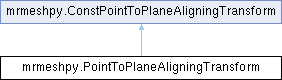
Inheritance diagram for mrmeshpy.PointToPlaneAligningTransform:

Public Member Functions

None __init__ (self)
None __init__ (self, ConstPointToPlaneAligningTransform arg0)
None add (self, ConstVector3d p1, ConstVector3d p2, ConstVector3d normal2, float w=1)
None add (self, ConstVector3f p1, ConstVector3f p2, ConstVector3f normal2, float w=1)
PointToPlaneAligningTransform assign (self, ConstPointToPlaneAligningTransform other)
None clear (self)
None prepare (self)
None setStabilizer (self, float stabilizer)
Public Member Functions inherited from mrmeshpy.ConstPointToPlaneAligningTransform
 __init__ (self, *args, **kwargs)
RigidScaleXf3d calculateAmendment (self)
RigidScaleXf3d calculateAmendmentWithScale (self)
RigidScaleXf3d calculateFixedAxisAmendment (self, ConstVector3d axis)
RigidScaleXf3d calculateOrthogonalAxisAmendment (self, ConstVector3d ort)
AffineXf3d findBestRigidScaleXf (self)
AffineXf3d findBestRigidXf (self)
AffineXf3d findBestRigidXfFixedRotationAxis (self, ConstVector3d axis)
AffineXf3d findBestRigidXfOrthogonalRotationAxis (self, ConstVector3d ort)
Vector3d findBestTranslation (self, ConstVector3d rotAngles=..., float scale=1)
float getStabilizer (self)

Static Public Member Functions

None __init__ (*args, **kwargs)

Detailed Description

Generated from:  MR::PointToPlaneAligningTransform

This class and its main method can be used to solve the problem of 3D shape alignment.
This algorithm uses a point-to-plane error metric in which the object of minimization is the sum of
the squared distance between a point and the tangent plane at its correspondence point.
To use this technique it's need to have small rotation angles. So there is an approximate solution.
The result of this algorithm is the transformation of first points (p1) which aligns it to the second ones (p2).

Constructor & Destructor Documentation

◆ __init__() [1/3]

None mrmeshpy.PointToPlaneAligningTransform.__init__ ( * args,
** kwargs )
static

◆ __init__() [2/3]

None mrmeshpy.PointToPlaneAligningTransform.__init__ ( self)

◆ __init__() [3/3]

None mrmeshpy.PointToPlaneAligningTransform.__init__ ( self,
ConstPointToPlaneAligningTransform arg0 )
Implicit copy constructor.

Member Function Documentation

◆ add() [1/2]

None mrmeshpy.PointToPlaneAligningTransform.add ( self,
ConstVector3d p1,
ConstVector3d p2,
ConstVector3d normal2,
float w = 1 )
Add a pair of corresponding points and the normal of the tangent plane at the second point

◆ add() [2/2]

None mrmeshpy.PointToPlaneAligningTransform.add ( self,
ConstVector3f p1,
ConstVector3f p2,
ConstVector3f normal2,
float w = 1 )
Add a pair of corresponding points and the normal of the tangent plane at the second point

◆ assign()

PointToPlaneAligningTransform mrmeshpy.PointToPlaneAligningTransform.assign ( self,
ConstPointToPlaneAligningTransform other )

◆ clear()

None mrmeshpy.PointToPlaneAligningTransform.clear ( self)
Clear points and normals data

◆ prepare()

None mrmeshpy.PointToPlaneAligningTransform.prepare ( self)
this method must be called after add() and before constant find...()/calculate...() to make the matrix symmetric

◆ setStabilizer()

None mrmeshpy.PointToPlaneAligningTransform.setStabilizer ( self,
float stabilizer )
sets relative regularization: this fraction of the mean diagonal element of the rotation block
and of the translation block of the linear system is added to the diagonal of the same block;
it suppresses huge motions along the directions poorly constrained by the planes (e.g. sliding along parallel planes)

The documentation for this class was generated from the following file: