|
MeshLib Python Docs
|
Static Public Member Functions | |
| None | __init__ (*args, **kwargs) |
Additional Inherited Members | |
| Static Public Attributes inherited from mrmeshpy.ConstVector_ObjFaceId_FaceId | |
| ConstStdVector = Const_std_vector_ObjFaceId_Allocator_ObjFaceId | |
| Const_const_pointer = ConstObjFaceId | |
| Const_const_reference = ConstObjFaceId | |
| Const_pointer = ConstObjFaceId | |
| Const_reference = ConstObjFaceId | |
| Const_value_type = ConstObjFaceId | |
| StdVector = std_vector_ObjFaceId_Allocator_ObjFaceId | |
| const_pointer = ObjFaceId | |
| const_reference = ObjFaceId | |
| pointer = ObjFaceId | |
| reference = ObjFaceId | |
| value_type = ObjFaceId | |
| Static Protected Attributes inherited from mrmeshpy.ConstVector_ObjFaceId_FaceId | |
| typing | _offsetof_vec = 0 |
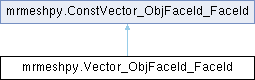
Generated from:  MR::Vector<MR::ObjFaceId, MR::FaceId>

Vector<T> is indexed by size_t
|
static |
| None mrmeshpy.Vector_ObjFaceId_FaceId.__init__ | ( | self | ) |
creates empty vector
| None mrmeshpy.Vector_ObjFaceId_FaceId.__init__ | ( | self, | |
| int | size ) |
creates a vector with \\p size elements with default value
| None mrmeshpy.Vector_ObjFaceId_FaceId.__init__ | ( | self, | |
| int | size, | ||
| ConstObjFaceId | val ) |
creates a vector with \\p size elements with the given value
| None mrmeshpy.Vector_ObjFaceId_FaceId.__init__ | ( | self, | |
| list | arg0 ) |
| None mrmeshpy.Vector_ObjFaceId_FaceId.__init__ | ( | self, | |
| ConstVector_ObjFaceId_FaceId | arg0 ) |
Implicit copy constructor.
| ConstObjFaceId mrmeshpy.Vector_ObjFaceId_FaceId.__getitem__ | ( | ConstVector_ObjFaceId_FaceId | self, |
| ConstFaceId | i ) |
| ObjFaceId mrmeshpy.Vector_ObjFaceId_FaceId.__getitem__ | ( | self, | |
| ConstFaceId | i ) |
| typing.Iterator[ObjFaceId] mrmeshpy.Vector_ObjFaceId_FaceId.__iter__ | ( | ConstVector_ObjFaceId_FaceId | self | ) |
| typing.Iterator[ObjFaceId] mrmeshpy.Vector_ObjFaceId_FaceId.__iter__ | ( | self | ) |
| None mrmeshpy.Vector_ObjFaceId_FaceId.__setitem__ | ( | self, | |
| ConstFaceId | arg0, | ||
| ConstObjFaceId | arg1 ) |
| Vector_ObjFaceId_FaceId mrmeshpy.Vector_ObjFaceId_FaceId.assign | ( | self, | |
| ConstVector_ObjFaceId_FaceId | other ) |
| None mrmeshpy.Vector_ObjFaceId_FaceId.assign | ( | self, | |
| int | count, | ||
| ConstObjFaceId | val ) |
replaces the contents with \\p count copies of \\p val
| ObjFaceId mrmeshpy.Vector_ObjFaceId_FaceId.autoResizeAt | ( | self, | |
| ConstFaceId | i ) |
this accessor automatically adjusts the size of the vector
| None mrmeshpy.Vector_ObjFaceId_FaceId.autoResizeSet | ( | self, | |
| ConstFaceId | i, | ||
| ConstObjFaceId | val ) |
sets the element i to the given value, adjusting the size of the vector to include new element
| None mrmeshpy.Vector_ObjFaceId_FaceId.autoResizeSet | ( | self, | |
| ConstFaceId | pos, | ||
| int | len, | ||
| ConstObjFaceId | val ) |
sets elements [pos, pos+len) to the given value, adjusting the size of the vector to include new elements;
the elements in between old size and \\p pos are also set to \\p val (for faster implementation)
| ConstObjFaceId mrmeshpy.Vector_ObjFaceId_FaceId.back | ( | ConstVector_ObjFaceId_FaceId | self | ) |
Reimplemented from mrmeshpy.ConstVector_ObjFaceId_FaceId.
| ObjFaceId mrmeshpy.Vector_ObjFaceId_FaceId.back | ( | self | ) |
Reimplemented from mrmeshpy.ConstVector_ObjFaceId_FaceId.
| None mrmeshpy.Vector_ObjFaceId_FaceId.clear | ( | self | ) |
| ConstObjFaceId mrmeshpy.Vector_ObjFaceId_FaceId.data | ( | ConstVector_ObjFaceId_FaceId | self | ) |
Reimplemented from mrmeshpy.ConstVector_ObjFaceId_FaceId.
| ObjFaceId mrmeshpy.Vector_ObjFaceId_FaceId.data | ( | self | ) |
Reimplemented from mrmeshpy.ConstVector_ObjFaceId_FaceId.
| ConstObjFaceId mrmeshpy.Vector_ObjFaceId_FaceId.front | ( | ConstVector_ObjFaceId_FaceId | self | ) |
Reimplemented from mrmeshpy.ConstVector_ObjFaceId_FaceId.
| ObjFaceId mrmeshpy.Vector_ObjFaceId_FaceId.front | ( | self | ) |
Reimplemented from mrmeshpy.ConstVector_ObjFaceId_FaceId.
| None mrmeshpy.Vector_ObjFaceId_FaceId.pop_back | ( | self | ) |
| None mrmeshpy.Vector_ObjFaceId_FaceId.push_back | ( | self, | |
| ConstObjFaceId | t ) |
| None mrmeshpy.Vector_ObjFaceId_FaceId.push_back | ( | self, | |
| ObjFaceId | t ) |
| None mrmeshpy.Vector_ObjFaceId_FaceId.reserve | ( | self, | |
| int | capacity ) |
| None mrmeshpy.Vector_ObjFaceId_FaceId.resize | ( | self, | |
| int | newSize ) |
| None mrmeshpy.Vector_ObjFaceId_FaceId.resize | ( | self, | |
| int | newSize, | ||
| ConstObjFaceId | t ) |
| None mrmeshpy.Vector_ObjFaceId_FaceId.resizeWithReserve | ( | self, | |
| int | newSize ) |
same as resize(newSize), which already grows the capacity geometrically
| None mrmeshpy.Vector_ObjFaceId_FaceId.resizeWithReserve | ( | self, | |
| int | newSize, | ||
| ConstObjFaceId | value ) |
same as resize(newSize, value), which already grows the capacity geometrically
| None mrmeshpy.Vector_ObjFaceId_FaceId.shrink_to_fit | ( | self | ) |
| None mrmeshpy.Vector_ObjFaceId_FaceId.swap | ( | self, | |
| Vector_ObjFaceId_FaceId | b ) |
| std_vector_ObjFaceId_Allocator_ObjFaceId mrmeshpy.Vector_ObjFaceId_FaceId.vec | ( | self | ) |
The user can directly manipulate the vector, they can't break anything anyway.
Reimplemented from mrmeshpy.ConstVector_ObjFaceId_FaceId.
| None mrmeshpy.Vector_ObjFaceId_FaceId.vec | ( | self, | |
| Const_std_vector_ObjFaceId_Allocator_ObjFaceId | arg1 ) |
The user can directly manipulate the vector, they can't break anything anyway.
Reimplemented from mrmeshpy.ConstVector_ObjFaceId_FaceId.
 1.14.0