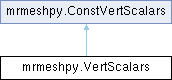
|
MeshLib Python Docs
|
Public Member Functions | |
| float | __getitem__ (self, ConstVertId i) |
| float | __getitem__ (ConstVertScalars self, ConstVertId i) |
| None | __init__ (self) |
| None | __init__ (self, int size) |
| None | __init__ (self, int size, float val) |
| None | __init__ (self, list arg0) |
| None | __init__ (self, ConstVertScalars arg0) |
| None | __setitem__ (self, ConstVertId arg0, float arg1) |
| VertScalars | assign (self, ConstVertScalars other) |
| None | assign (self, int count, float val) |
| float | autoResizeAt (self, ConstVertId i) |
| None | autoResizeSet (self, ConstVertId pos, int len, float val) |
| None | autoResizeSet (self, ConstVertId i, float val) |
| float | back (self) |
| float | back (ConstVertScalars self) |
| None | clear (self) |
| float | data (self) |
| float | data (ConstVertScalars self) |
| float | front (self) |
| float | front (ConstVertScalars self) |
| None | pop_back (self) |
| None | push_back (self, float t) |
| None | push_back (self, float t) |
| None | reserve (self, int capacity) |
| None | resize (self, int newSize) |
| None | resize (self, int newSize, float t) |
| None | resizeWithReserve (self, int newSize) |
| None | resizeWithReserve (self, int newSize, float value) |
| None | shrink_to_fit (self) |
| None | swap (self, VertScalars b) |
| std_vector_float_Allocator_float | vec (self) |
| None | vec (self, Const_std_vector_float_Allocator_float arg1) |
| Public Member Functions inherited from mrmeshpy.ConstVertScalars | |
| bool | __eq__ (self, ConstVertScalars b) |
| float | __getitem__ (self, ConstVertId i) |
| __init__ (self, *args, **kwargs) | |
| typing.Iterator[float] | __iter__ (self) |
| int | __len__ (self) |
| bool | __ne__ (self, ConstVertScalars b) |
| VertId | backId (self) |
| VertId | beginId (self) |
| int | capacity (self) |
| bool | empty (self) |
| VertId | endId (self) |
| int | heapBytes (self) |
| int | max_size (self) |
| int | size (self) |
Static Public Member Functions | |
| None | __init__ (*args, **kwargs) |
Additional Inherited Members | |
| Static Protected Attributes inherited from mrmeshpy.ConstVertScalars | |
| typing | _offsetof_vec = 0 |
Generated from:  MR::VertScalars

Vector<T> is indexed by size_t
|
static |
| None mrmeshpy.VertScalars.__init__ | ( | self | ) |
creates empty vector
| None mrmeshpy.VertScalars.__init__ | ( | self, | |
| int | size ) |
creates a vector with \\p size elements with default value
| None mrmeshpy.VertScalars.__init__ | ( | self, | |
| int | size, | ||
| float | val ) |
creates a vector with \\p size elements with the given value
| None mrmeshpy.VertScalars.__init__ | ( | self, | |
| list | arg0 ) |
| None mrmeshpy.VertScalars.__init__ | ( | self, | |
| ConstVertScalars | arg0 ) |
Implicit copy constructor.
| float mrmeshpy.VertScalars.__getitem__ | ( | ConstVertScalars | self, |
| ConstVertId | i ) |
| float mrmeshpy.VertScalars.__getitem__ | ( | self, | |
| ConstVertId | i ) |
| None mrmeshpy.VertScalars.__setitem__ | ( | self, | |
| ConstVertId | arg0, | ||
| float | arg1 ) |
| VertScalars mrmeshpy.VertScalars.assign | ( | self, | |
| ConstVertScalars | other ) |
| None mrmeshpy.VertScalars.assign | ( | self, | |
| int | count, | ||
| float | val ) |
replaces the contents with \\p count copies of \\p val
| float mrmeshpy.VertScalars.autoResizeAt | ( | self, | |
| ConstVertId | i ) |
this accessor automatically adjusts the size of the vector
| None mrmeshpy.VertScalars.autoResizeSet | ( | self, | |
| ConstVertId | i, | ||
| float | val ) |
sets the element i to the given value, adjusting the size of the vector to include new element
| None mrmeshpy.VertScalars.autoResizeSet | ( | self, | |
| ConstVertId | pos, | ||
| int | len, | ||
| float | val ) |
sets elements [pos, pos+len) to the given value, adjusting the size of the vector to include new elements;
the elements in between old size and \\p pos are also set to \\p val (for faster implementation)
| float mrmeshpy.VertScalars.back | ( | ConstVertScalars | self | ) |
Reimplemented from mrmeshpy.ConstVertScalars.
| float mrmeshpy.VertScalars.back | ( | self | ) |
Reimplemented from mrmeshpy.ConstVertScalars.
| None mrmeshpy.VertScalars.clear | ( | self | ) |
| float mrmeshpy.VertScalars.data | ( | ConstVertScalars | self | ) |
Reimplemented from mrmeshpy.ConstVertScalars.
| float mrmeshpy.VertScalars.data | ( | self | ) |
Reimplemented from mrmeshpy.ConstVertScalars.
| float mrmeshpy.VertScalars.front | ( | ConstVertScalars | self | ) |
Reimplemented from mrmeshpy.ConstVertScalars.
| float mrmeshpy.VertScalars.front | ( | self | ) |
Reimplemented from mrmeshpy.ConstVertScalars.
| None mrmeshpy.VertScalars.pop_back | ( | self | ) |
| None mrmeshpy.VertScalars.push_back | ( | self, | |
| float | t ) |
| None mrmeshpy.VertScalars.push_back | ( | self, | |
| float | t ) |
| None mrmeshpy.VertScalars.reserve | ( | self, | |
| int | capacity ) |
| None mrmeshpy.VertScalars.resize | ( | self, | |
| int | newSize ) |
| None mrmeshpy.VertScalars.resize | ( | self, | |
| int | newSize, | ||
| float | t ) |
| None mrmeshpy.VertScalars.resizeWithReserve | ( | self, | |
| int | newSize ) |
same as resize(newSize), which already grows the capacity geometrically
| None mrmeshpy.VertScalars.resizeWithReserve | ( | self, | |
| int | newSize, | ||
| float | value ) |
same as resize(newSize, value), which already grows the capacity geometrically
| None mrmeshpy.VertScalars.shrink_to_fit | ( | self | ) |
| None mrmeshpy.VertScalars.swap | ( | self, | |
| VertScalars | b ) |
| std_vector_float_Allocator_float mrmeshpy.VertScalars.vec | ( | self | ) |
The user can directly manipulate the vector, they can't break anything anyway.
Reimplemented from mrmeshpy.ConstVertScalars.
| None mrmeshpy.VertScalars.vec | ( | self, | |
| Const_std_vector_float_Allocator_float | arg1 ) |
The user can directly manipulate the vector, they can't break anything anyway.
Reimplemented from mrmeshpy.ConstVertScalars.
 1.14.0