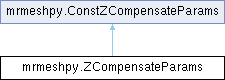
|
MeshLib Python Docs
|
Public Member Functions | |
| None | __init__ (self) |
| None | __init__ (self, ConstZCompensateParams arg0) |
| None | __init__ (self, float maxShift, bool reduceSelfIntersections, float minThickness, Const_func_bool_from_float progress) |
| ZCompensateParams | assign (self, ConstZCompensateParams other) |
| float | maxShift (self) |
| None | maxShift (self, float arg1) |
| float | minThickness (self) |
| None | minThickness (self, float arg1) |
| func_bool_from_float | progress (self) |
| None | progress (self, Const_func_bool_from_float arg1) |
| bool | reduceSelfIntersections (self) |
| None | reduceSelfIntersections (self, bool arg1) |
| Public Member Functions inherited from mrmeshpy.ConstZCompensateParams | |
| __init__ (self, *args, **kwargs) | |
Static Public Member Functions | |
| None | __init__ (*args, **kwargs) |
Additional Inherited Members | |
| Static Protected Attributes inherited from mrmeshpy.ConstZCompensateParams | |
| typing | _offsetof_maxShift = 0 |
| typing | _offsetof_minThickness = 8 |
| typing | _offsetof_progress = 16 |
| typing | _offsetof_reduceSelfIntersections = 4 |
Generated from: MR::ZCompensateParams
|
static |
| None mrmeshpy.ZCompensateParams.__init__ | ( | self | ) |
| None mrmeshpy.ZCompensateParams.__init__ | ( | self, | |
| ConstZCompensateParams | arg0 ) |
Implicit copy constructor.
| None mrmeshpy.ZCompensateParams.__init__ | ( | self, | |
| float | maxShift, | ||
| bool | reduceSelfIntersections, | ||
| float | minThickness, | ||
| Const_func_bool_from_float | progress ) |
Implicit aggregate constructor.
| ZCompensateParams mrmeshpy.ZCompensateParams.assign | ( | self, | |
| ConstZCompensateParams | other ) |
| float mrmeshpy.ZCompensateParams.maxShift | ( | self | ) |
shift of mesh parts orthogonal to Z-axis with normal against Z-axis;
for other mesh parts the shift will be less and will depend on the angle between point pseudo-normal and Z-axis
Reimplemented from mrmeshpy.ConstZCompensateParams.
| None mrmeshpy.ZCompensateParams.maxShift | ( | self, | |
| float | arg1 ) |
shift of mesh parts orthogonal to Z-axis with normal against Z-axis;
for other mesh parts the shift will be less and will depend on the angle between point pseudo-normal and Z-axis
Reimplemented from mrmeshpy.ConstZCompensateParams.
| float mrmeshpy.ZCompensateParams.minThickness | ( | self | ) |
only if (reduceSelfIntersections = true), avoids moving a vertex closer than this distance to another triangle
Reimplemented from mrmeshpy.ConstZCompensateParams.
| None mrmeshpy.ZCompensateParams.minThickness | ( | self, | |
| float | arg1 ) |
only if (reduceSelfIntersections = true), avoids moving a vertex closer than this distance to another triangle
Reimplemented from mrmeshpy.ConstZCompensateParams.
| func_bool_from_float mrmeshpy.ZCompensateParams.progress | ( | self | ) |
to report progress and cancel processing
Reimplemented from mrmeshpy.ConstZCompensateParams.
| None mrmeshpy.ZCompensateParams.progress | ( | self, | |
| Const_func_bool_from_float | arg1 ) |
to report progress and cancel processing
Reimplemented from mrmeshpy.ConstZCompensateParams.
| bool mrmeshpy.ZCompensateParams.reduceSelfIntersections | ( | self | ) |
if true, limits the movement of each vertex to reduce self-intersections in the mesh
Reimplemented from mrmeshpy.ConstZCompensateParams.
| None mrmeshpy.ZCompensateParams.reduceSelfIntersections | ( | self, | |
| bool | arg1 ) |
if true, limits the movement of each vertex to reduce self-intersections in the mesh
Reimplemented from mrmeshpy.ConstZCompensateParams.
 1.14.0