|
MeshLib Python Docs
|
|
MeshLib Python Docs
|
Public Member Functions | |
| bool | __bool__ (self) |
| bool | __eq__ (self, ConstEdgePoint rhs) |
| __init__ (self, *args, **kwargs) | |
| bool | __ne__ (self, ConstEdgePoint rhs) |
| VertId | getClosestVertex (self, ConstMeshTopology topology) |
| VertId | getClosestVertex (self, ConstPolylineTopology topology) |
| VertId | inVertex (self, ConstMeshTopology topology) |
| VertId | inVertex (self, ConstPolylineTopology topology) |
| bool | inVertex (self) |
| bool | isBd (self, ConstMeshTopology topology, ConstFaceBitSet region=None) |
| EdgePoint | sym (self) |
| bool | valid (self) |
| ConstSegmPointf | a (self) |
| ConstEdgeId | e (self) |
Static Protected Attributes | |
| typing | _offsetof_a = 4 |
| typing | _offsetof_e = 0 |
Generated from:  MR::EdgePoint
Aliases:  EdgePointf, MeshEdgePoint, MeshEdgePointf

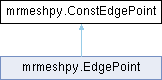
encodes a point on an edge of mesh or of polyline
| mrmeshpy.ConstEdgePoint.__init__ | ( | self, | |
| * | args, | ||
| ** | kwargs ) |
__init__(*args, **kwargs)
Overloaded function.

1. __init__(self: meshlib.mrmeshpy.ConstEdgePoint) -> None

2. __init__(self: meshlib.mrmeshpy.ConstEdgePoint, e: meshlib.mrmeshpy.ConstEdgeId, a: float) -> None

3. __init__(self: meshlib.mrmeshpy.ConstEdgePoint, topology: meshlib.mrmeshpy.ConstMeshTopology, v: meshlib.mrmeshpy.ConstVertId) -> None

4. __init__(self: meshlib.mrmeshpy.ConstEdgePoint, topology: meshlib.mrmeshpy.ConstPolylineTopology, v: meshlib.mrmeshpy.ConstVertId) -> None

5. __init__(self: meshlib.mrmeshpy.ConstEdgePoint, arg0: meshlib.mrmeshpy.ConstEdgePoint) -> None

Implicit copy constructor.

6. __init__(self: meshlib.mrmeshpy.ConstEdgePoint, : meshlib.mrmeshpy.ConstEdgePoint) -> None
| bool mrmeshpy.ConstEdgePoint.__bool__ | ( | self | ) |
| bool mrmeshpy.ConstEdgePoint.__eq__ | ( | self, | |
| ConstEdgePoint | rhs ) |
returns true if two edge-points are equal including equal not-unique representation
| bool mrmeshpy.ConstEdgePoint.__ne__ | ( | self, | |
| ConstEdgePoint | rhs ) |
returns true if two edge-points are equal including equal not-unique representation
| ConstSegmPointf mrmeshpy.ConstEdgePoint.a | ( | self | ) |
a in [0,1], a=0 => point is in org( e ), a=1 => point is in dest( e )
Reimplemented in mrmeshpy.EdgePoint, and mrmeshpy.EdgePoint.
| ConstEdgeId mrmeshpy.ConstEdgePoint.e | ( | self | ) |
Reimplemented in mrmeshpy.EdgePoint, and mrmeshpy.EdgePoint.
| VertId mrmeshpy.ConstEdgePoint.getClosestVertex | ( | self, | |
| ConstMeshTopology | topology ) |
returns one of two edge vertices, closest to this point
| VertId mrmeshpy.ConstEdgePoint.getClosestVertex | ( | self, | |
| ConstPolylineTopology | topology ) |
returns one of two edge vertices, closest to this point
| bool mrmeshpy.ConstEdgePoint.inVertex | ( | self | ) |
returns true if the point is in a vertex
| VertId mrmeshpy.ConstEdgePoint.inVertex | ( | self, | |
| ConstMeshTopology | topology ) |
returns valid vertex id if the point is in vertex, otherwise returns invalid id
| VertId mrmeshpy.ConstEdgePoint.inVertex | ( | self, | |
| ConstPolylineTopology | topology ) |
returns valid vertex id if the point is in vertex, otherwise returns invalid id
| bool mrmeshpy.ConstEdgePoint.isBd | ( | self, | |
| ConstMeshTopology | topology, | ||
| ConstFaceBitSet | region = None ) |
returns true if the point is on the boundary of the region (or for whole mesh if region is nullptr)
| EdgePoint mrmeshpy.ConstEdgePoint.sym | ( | self | ) |
represents the same point relative to sym edge in
| bool mrmeshpy.ConstEdgePoint.valid | ( | self | ) |
consider this valid if the edge ID is valid
|
staticprotected |
|
staticprotected |
 1.14.0