|
MeshLib Python Docs
|
Classes | |
| class | ConstProjectionResult |
| class | ProjectionResult |
Public Member Functions | |
| __init__ (self, *args, **kwargs) | |
| None | accumulate (self, PointAccumulator accum, ConstAffineXf3f xf=None) |
| ConstMeshPart | asMeshPart (self) |
| ConstPointCloudPart | asPointCloudPart (self) |
| None | cacheAABBTree (self) |
| Box3f | computeBoundingBox (self, ConstAffineXf3f toWorld=None) |
| Box3f | getObjBoundingBox (self) |
| func_bool_from_Vector3_float_MeshOrPoints_ProjectionResult | limitedProjector (self) |
| func_Vector3_float_from_Id_VertTag | normals (self) |
| ConstVertCoords | points (self) |
| VertBitSet | pointsGridSampling (self, float voxelSize, int maxVoxels=500000, Const_func_bool_from_float cb='{}') |
| func_MeshOrPoints_ProjectionResult_from_Vector3_float | projector (self) |
| VertBitSet | surfaceGridSampling (self, float voxelSize, PointCloud cloud) |
| ConstVertBitSet | validPoints (self) |
| func_float_from_Id_VertTag | weights (self) |
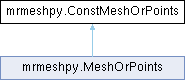
Generated from:  MR::MeshOrPoints

This class can hold either mesh part or point cloud.
It is used for generic algorithms operating with either of them
| mrmeshpy.ConstMeshOrPoints.__init__ | ( | self, | |
| * | args, | ||
| ** | kwargs ) |
__init__(*args, **kwargs)
Overloaded function.

1. __init__(self: meshlib.mrmeshpy.ConstMeshOrPoints, mp: meshlib.mrmeshpy.ConstMeshPart) -> None

2. __init__(self: meshlib.mrmeshpy.ConstMeshOrPoints, pcp: meshlib.mrmeshpy.ConstPointCloudPart) -> None

3. __init__(self: meshlib.mrmeshpy.ConstMeshOrPoints, mesh: meshlib.mrmeshpy.ConstMesh) -> None

these constructors are redundant for C++, but important for python bindings

4. __init__(self: meshlib.mrmeshpy.ConstMeshOrPoints, pc: meshlib.mrmeshpy.ConstPointCloud) -> None

5. __init__(self: meshlib.mrmeshpy.ConstMeshOrPoints, arg0: meshlib.mrmeshpy.ConstMeshOrPoints) -> None

Implicit copy constructor.

6. __init__(self: meshlib.mrmeshpy.ConstMeshOrPoints, : meshlib.mrmeshpy.ConstMeshOrPoints) -> None
| None mrmeshpy.ConstMeshOrPoints.accumulate | ( | self, | |
| PointAccumulator | accum, | ||
| ConstAffineXf3f | xf = None ) |
Adds in existing PointAccumulator the elements of the contained object
| ConstMeshPart mrmeshpy.ConstMeshOrPoints.asMeshPart | ( | self | ) |
if this object holds a mesh part then returns pointer on it, otherwise returns nullptr
| ConstPointCloudPart mrmeshpy.ConstMeshOrPoints.asPointCloudPart | ( | self | ) |
if this object holds a point cloud part then returns pointer on it, otherwise returns nullptr
| None mrmeshpy.ConstMeshOrPoints.cacheAABBTree | ( | self | ) |
if the tree used by projections (AABBTree of a mesh, AABBTreePoints of a cloud) is already built does nothing otherwise builds and caches it
| Box3f mrmeshpy.ConstMeshOrPoints.computeBoundingBox | ( | self, | |
| ConstAffineXf3f | toWorld = None ) |
passes through all valid vertices and finds the minimal bounding box containing all of them;
if toWorld transformation is given then returns minimal bounding box in world space
| Box3f mrmeshpy.ConstMeshOrPoints.getObjBoundingBox | ( | self | ) |
returns the minimal bounding box containing all valid vertices of the object (and not only part of mesh);
implemented via obj.getBoundingBox()
| func_bool_from_Vector3_float_MeshOrPoints_ProjectionResult mrmeshpy.ConstMeshOrPoints.limitedProjector | ( | self | ) |
returns a function that updates previously known projection (closest) points on this,
the update takes place only if newly found closest point is closer to p than sqrt(res.distSq) given on input
The function returns true if the update has taken place.
| func_Vector3_float_from_Id_VertTag mrmeshpy.ConstMeshOrPoints.normals | ( | self | ) |
returns normals generating function: VertId->normal (or empty for point cloud without normals)
| ConstVertCoords mrmeshpy.ConstMeshOrPoints.points | ( | self | ) |
gives access to points-vector (which can include invalid points as well)
| VertBitSet mrmeshpy.ConstMeshOrPoints.pointsGridSampling | ( | self, | |
| float | voxelSize, | ||
| int | maxVoxels = 500000, | ||
| Const_func_bool_from_float | cb = '{}' ) |
performs sampling of vertices or points;
subdivides bounding box of the object on voxels of approximately given size and returns at most one vertex per voxel;
voxelSize is automatically increased to avoid more voxels than \\param maxVoxels;
if voxelSize == 0 then all valid points are returned;
returns std::nullopt if it was terminated by the callback
| func_MeshOrPoints_ProjectionResult_from_Vector3_float mrmeshpy.ConstMeshOrPoints.projector | ( | self | ) |
returns a function that finds projection (closest) points on this: Vector3f->ProjectionResult
| VertBitSet mrmeshpy.ConstMeshOrPoints.surfaceGridSampling | ( | self, | |
| float | voxelSize, | ||
| PointCloud | cloud ) |
performs grid sampling as pointsGridSampling, but a mesh with triangles too big for the sampling is sampled from its dense point cloud
(see meshToDensePointCloud) returned in (cloud) with Mesh::pseudonormal in every point, and then the ids refer to the points of that cloud;
otherwise (cloud) is reset and the ids refer to the points of this object
| ConstVertBitSet mrmeshpy.ConstMeshOrPoints.validPoints | ( | self | ) |
gives access to bit set of valid points
| func_float_from_Id_VertTag mrmeshpy.ConstMeshOrPoints.weights | ( | self | ) |
returns weights generating function: VertId->float:
for mesh it is double area of surrounding triangles, and for point cloud - nothing
 1.14.0