|
| new unsafe ref MR.OffsetMode | mode [get] |
| new unsafe MR.? UndirectedEdgeBitSet | outSharpEdges [get, set] |
| | if non-null then created sharp edges will be saved here
|
| new unsafe MR.? Vector_MRVoxelId_MRFaceId | outVoxelPerFace [get, set] |
| | if non-null then for each output mesh face maps its voxel id
|
| new unsafe ref float | minNewVertDev [get] |
| | minimal surface deviation to introduce new vertex in a voxel, measured in voxelSize
|
| new unsafe ref float | maxNewRank2VertDev [get] |
| | maximal surface deviation to introduce new rank 2 vertex (on intersection of 2 planes), measured in voxelSize
|
| new unsafe ref float | maxNewRank3VertDev [get] |
| | maximal surface deviation to introduce new rank 3 vertex (on intersection of 3 planes), measured in voxelSize
|
| new unsafe ref float | maxOldVertPosCorrection [get] |
| | correct positions of the input vertices using reference mesh by not more than this distance, measured in voxelSize; big correction can be wrong and result from self-intersections in the reference mesh
|
| new unsafe ref bool | voxelClamp [get] |
| | if true, the displacement of a new vertex from the average point is shortened to keep the vertex within its voxel's box (so the geometry of a voxel can never reach another one), and the in-plane elevation check is skipped
|
| new unsafe ref MR.SignDetectionMode | signDetectionMode [get] |
| | determines the method to compute distance sign; offsetMesh implementing OffsetMode.Smooth supports only Unsigned, OpenVDB and HoleWindingRule here
|
| new unsafe ref bool | closeHolesInHoleWindingNumber [get] |
| | whether to construct closed mesh in signMode = SignDetectionModeShort.HoleWindingNumber
|
| new unsafe ref float | windingNumberThreshold [get] |
| | only for SignDetectionMode.HoleWindingRule: positive distance if winding number below or equal this threshold; ideal threshold: 0.5 for closed meshes; 0.0 for planar meshes
|
| new unsafe ref float | windingNumberBeta [get] |
| | only for SignDetectionMode.HoleWindingRule: determines the precision of fast approximation: the more the better, minimum value is 1
|
| new unsafe MR.Std.SharedPtr_MRIFastWindingNumber | fwn [get, protected set] |
| | defines particular implementation of IFastWindingNumber interface that will compute windings. If it is not specified, default FastWindingNumber is used this only used if signDetectionMode == SignDetectionMode.HoleWindingRule, otherwise it is ignored providing this will disable memoryEfficient (as if memoryEfficient == false)
|
| new unsafe ref bool | memoryEfficient [get] |
| | use FunctionVolume for voxel grid representation:
|
| new unsafe ref float | voxelSize [get] |
| | Size of voxel in grid conversions; The user is responsible for setting some positive value here.
|
| new unsafe MR.Std.Function_Bool_From_Float | callBack [get, protected set] |
| | Progress callback.
|
| unsafe MR.OffsetMode | mode [get] |
| unsafe MR.? UndirectedEdgeBitSet | outSharpEdges [get] |
| | if non-null then created sharp edges will be saved here
|
| unsafe MR.? Vector_MRVoxelId_MRFaceId | outVoxelPerFace [get] |
| | if non-null then for each output mesh face maps its voxel id
|
| unsafe float | minNewVertDev [get] |
| | minimal surface deviation to introduce new vertex in a voxel, measured in voxelSize
|
| unsafe float | maxNewRank2VertDev [get] |
| | maximal surface deviation to introduce new rank 2 vertex (on intersection of 2 planes), measured in voxelSize
|
| unsafe float | maxNewRank3VertDev [get] |
| | maximal surface deviation to introduce new rank 3 vertex (on intersection of 3 planes), measured in voxelSize
|
| unsafe float | maxOldVertPosCorrection [get] |
| | correct positions of the input vertices using reference mesh by not more than this distance, measured in voxelSize; big correction can be wrong and result from self-intersections in the reference mesh
|
| unsafe bool | voxelClamp [get] |
| | if true, the displacement of a new vertex from the average point is shortened to keep the vertex within its voxel's box (so the geometry of a voxel can never reach another one), and the in-plane elevation check is skipped
|
| unsafe MR.SignDetectionMode | signDetectionMode [get] |
| | determines the method to compute distance sign; offsetMesh implementing OffsetMode.Smooth supports only Unsigned, OpenVDB and HoleWindingRule here
|
| unsafe bool | closeHolesInHoleWindingNumber [get] |
| | whether to construct closed mesh in signMode = SignDetectionModeShort.HoleWindingNumber
|
| unsafe float | windingNumberThreshold [get] |
| | only for SignDetectionMode.HoleWindingRule: positive distance if winding number below or equal this threshold; ideal threshold: 0.5 for closed meshes; 0.0 for planar meshes
|
| unsafe float | windingNumberBeta [get] |
| | only for SignDetectionMode.HoleWindingRule: determines the precision of fast approximation: the more the better, minimum value is 1
|
| unsafe MR.Std.Const_SharedPtr_MRIFastWindingNumber | fwn [get, protected set] |
| | defines particular implementation of IFastWindingNumber interface that will compute windings. If it is not specified, default FastWindingNumber is used this only used if signDetectionMode == SignDetectionMode.HoleWindingRule, otherwise it is ignored providing this will disable memoryEfficient (as if memoryEfficient == false)
|
| unsafe bool | memoryEfficient [get] |
| | use FunctionVolume for voxel grid representation:
|
| unsafe float | voxelSize [get] |
| | Size of voxel in grid conversions; The user is responsible for setting some positive value here.
|
| unsafe MR.Std.Const_Function_Bool_From_Float | callBack [get, protected set] |
| | Progress callback.
|
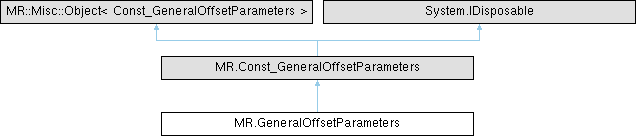
allows the user to select in the parameters which offset algorithm to call Generated from class MR.GeneralOffsetParameters. Base classes: Direct: (non-virtual) MR.SharpOffsetParameters Indirect: (non-virtual) MR.BaseShellParameters MR.OffsetParameters This is the non-const half of the class.
 1.14.0