Dental Software
Build high-performance dental software with MeshLib SDK — precise, fast 3D processing for crowns, bridges, aligners and implants.
Challenge
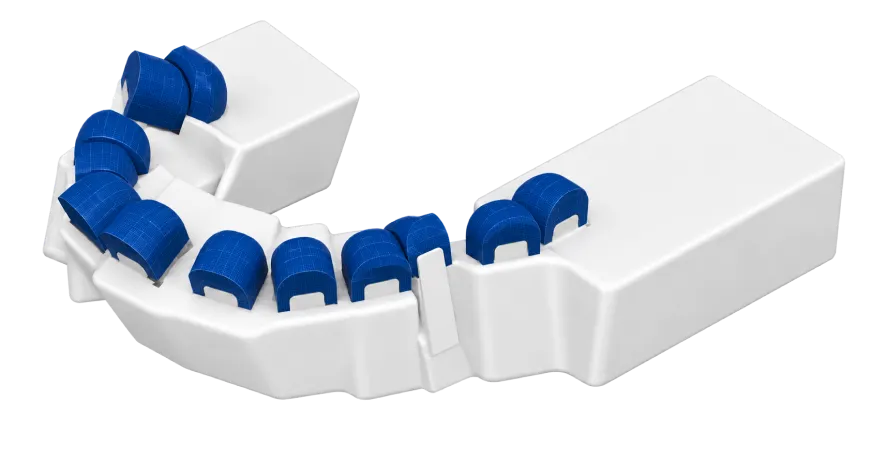
Every tooth is unique, and reverse-engineering each one to CAD is cost-prohibitive. Dental applications must handle intricate 3D models of teeth and prosthetics with precision, speed and reliability — producing custom crowns, bridges, aligners and implants while processing tens of thousands of intraoral scans per month without manual cleanup.
Solution

Boolean Operations
Instantly merge or subtract complex shapes with precision. MeshLib’s Boolean engine handles intricate geometry without delays, so implants and abutments integrate seamlessly with existing tooth models.

Offset
Create exact spacing and wall thickness — critical for aligner shells and prosthetic fit. Offsets are computed in milliseconds, enabling real-time feedback in interactive tools.

Mesh Healing
Automatically detect and repair holes, non-manifold edges and self-intersections in seconds, producing watertight models ready for 3D printing or CAD.

Hole Filling & Smoothing
Curvature-aware hole filling and denoising clean raw intraoral scans and close preparation margins without washing out fine anatomical detail.

Simplification
Reduce scan density for fast previews and lightweight web or CAD delivery while preserving surface accuracy.
Outcome
Developers using MeshLib can build dental software that produces custom-fit devices quickly and accurately — improving workflow efficiency, raising product quality and enhancing patient outcomes while reducing development and operational costs.
Real-World Industry Usage
Dental software teams already build on MeshLib. SmileInspector uses MeshLib to power fast, accurate processing of intraoral scans and prosthetic design. Other dental innovators — including 3Dons, TruAbutment, Relu, Brius and InSmile — rely on high-performance mesh processing to deliver custom-fit crowns, bridges, aligners and implants at scale.