Patient-Specific Software
Create patient-specific medical software with MeshLib SDK — accurate, watertight 3D models built from CT and MRI data.
Challenge
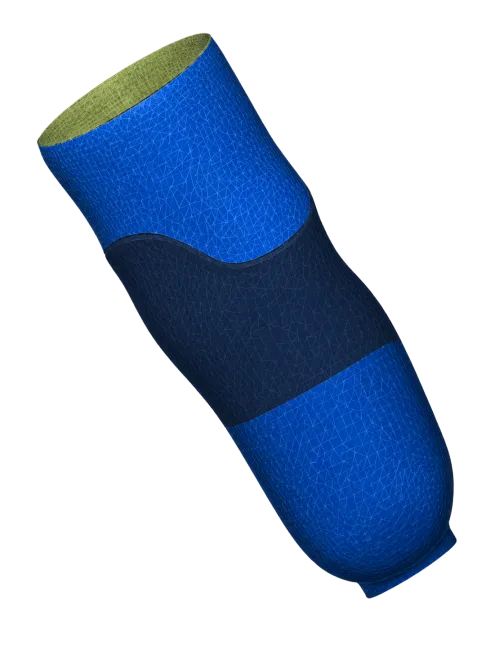
Patient-specific applications require highly precise 3D models generated from CT or MRI scans that faithfully reflect unique anatomy while staying free of holes and self-intersections. Designing implants, prosthetics and surgical guides — from craniomaxillofacial reconstruction to orthopedic devices — demands robust mesh processing that guarantees watertight geometry, preserves essential anatomical features and stays compatible with 3D printing and surgical-planning software.
Solution

Voxel-to-Mesh Conversion
Turn raw CT/MRI volumes into accurate 3D models that reflect each patient’s unique anatomy — the foundation for custom implants, guides and prosthetics.

Mesh Healing
Guarantee defect-free, watertight geometry so models are safe to manufacture, where even a minor defect can compromise a printed part.

Boolean Operations
Build shapes that fit existing anatomy precisely — essential for custom implants and cutting or drilling guides.

Offset & Decimation
Control implant wall thickness and reduce model size while preserving the anatomical features that matter.

Registration & Alignment (ICP)
Align planning data and mirror contralateral anatomy to reconstruct defects accurately.
Outcome
With MeshLib, developers deliver patient-specific software that converts scan data into manufacturable, anatomically faithful models — accelerating surgical planning, improving device fit and shortening time from scan to treatment.

Real-World Industry Usage
Patient-specific device makers build on MeshLib. Customed, Axial3D and Enhatch turn patient CT/MRI data into custom implants, anatomical models and surgical guides — where watertight, anatomically faithful meshes are essential for safe, manufacturable results.