|
MeshLib Python Docs
|
|
MeshLib Python Docs
|
Static Public Member Functions | |
| Mesh | fromFaceSoup (ConstVertCoords vertexCoordinates, Const_std_vector_Id_VertTag verts, ConstVector_MeshBuilder_VertSpan_FaceId faces, MeshBuilder.ConstBuildSettings settings=..., Const_func_bool_from_float cb='{}') |
| Mesh | fromPointTriples (Const_std_vector_std_array_Vector3_float_3ul posTriples, bool duplicateNonManifoldVertices) |
| Mesh | fromTriMesh (TriMesh triMesh, MeshBuilder.ConstBuildSettings settings=..., Const_func_bool_from_float cb='{}') |
| Mesh | fromTriangles (ConstVertCoords vertexCoordinates, ConstTriangulation t, MeshBuilder.ConstBuildSettings settings=..., Const_func_bool_from_float cb='{}') |
| Mesh | fromTrianglesDuplicatingNonManifoldVertices (ConstVertCoords vertexCoordinates, Triangulation t, std_vector_MeshBuilder_VertDuplication dups=None, MeshBuilder.ConstBuildSettings settings=..., Const_func_bool_from_Id_VertTag_Id_VertTag_Id_VertTag_Id_VertTag_Id_VertTag betterCont='{}') |
Static Protected Attributes | |
| typing | _offsetof_points = 152 |
| typing | _offsetof_topology = 0 |
Generated from:  MR::Mesh
Aliases:  std_shared_ptr_Mesh, std_shared_ptr_const_Mesh

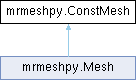
This class represents a mesh, including topology (connectivity) information and point coordinates,
as well as some caches to accelerate search algorithms
| mrmeshpy.ConstMesh.__init__ | ( | self, | |
| * | args, | ||
| ** | kwargs ) |
__init__(*args, **kwargs)
Overloaded function.

1. __init__(self: meshlib.mrmeshpy.ConstMesh) -> None

2. __init__(self: meshlib.mrmeshpy.ConstMesh, arg0: meshlib.mrmeshpy.ConstMesh) -> None

Implicit copy constructor.

3. __init__(self: meshlib.mrmeshpy.ConstMesh, : meshlib.mrmeshpy.ConstMesh) -> None
| bool mrmeshpy.ConstMesh.__eq__ | ( | self, | |
| ConstMesh | b ) |
compare that two meshes are exactly the same
| bool mrmeshpy.ConstMesh.__ne__ | ( | self, | |
| ConstMesh | b ) |
compare that two meshes are exactly the same
| float mrmeshpy.ConstMesh.area | ( | self, | |
| ConstFaceBitSet | fs = None ) |
computes the area of given face-region (or whole mesh)
| float mrmeshpy.ConstMesh.area | ( | self, | |
| ConstFaceId | f ) |
returns the area of given face
| float mrmeshpy.ConstMesh.averageEdgeLength | ( | self | ) |
computes average length of an edge in this mesh
| float mrmeshpy.ConstMesh.calcFastWindingNumber | ( | self, | |
| ConstVector3f | pt, | ||
| float | beta = 2 ) |
computes generalized winding number in a point (pt), which is
* for closed mesh with normals outside: 1 inside, 0 outside;
* for planar mesh: 0.5 inside, -0.5 outside;
and in general is equal to (portion of solid angle where inside part of mesh is observable) minus (portion of solid angle where outside part of mesh is observable)
\\param beta determines the precision of fast approximation: the more the better, recommended value 2 or more
| float mrmeshpy.ConstMesh.circumcircleDiameter | ( | self, | |
| ConstFaceId | f ) |
returns circumcircle diameter of given mesh triangle
| float mrmeshpy.ConstMesh.circumcircleDiameterSq | ( | self, | |
| ConstFaceId | f ) |
returns squared circumcircle diameter of given mesh triangle
| Mesh mrmeshpy.ConstMesh.cloneRegion | ( | self, | |
| ConstFaceBitSet | region, | ||
| bool | flipOrientation = False, | ||
| ConstPartMapping | map = ... ) |
creates new mesh from given triangles of this mesh
| Box3f mrmeshpy.ConstMesh.computeBoundingBox | ( | self, | |
| ConstAffineXf3f | toWorld = None ) |
passes through all valid vertices and finds the minimal bounding box containing all of them;
if toWorld transformation is given then returns minimal bounding box in world space
| Box3f mrmeshpy.ConstMesh.computeBoundingBox | ( | self, | |
| ConstFaceBitSet | region, | ||
| ConstAffineXf3f | toWorld = None ) |
passes through all given faces (or whole mesh if region == null) and finds the minimal bounding box containing all of them
if toWorld transformation is given then returns minimal bounding box in world space
| float mrmeshpy.ConstMesh.cotan | ( | self, | |
| ConstUndirectedEdgeId | ue ) |
computes sum of cotangents of the angle in the left and right triangles opposite to given edge,
consider cotangents zero for not existing triangles
| float mrmeshpy.ConstMesh.dblArea | ( | self, | |
| ConstFaceId | f ) |
returns twice the area of given face
| float mrmeshpy.ConstMesh.dblArea | ( | self, | |
| ConstVertId | v ) |
computes the length of summed directed double areas of all triangles around given vertex
| Vector3f mrmeshpy.ConstMesh.destPnt | ( | self, | |
| ConstEdgeId | e ) |
returns coordinates of the edge destination
| float mrmeshpy.ConstMesh.dihedralAngle | ( | self, | |
| ConstUndirectedEdgeId | e ) |
given an edge between two triangular faces, computes the dihedral angle between them:
0 if both faces are in the same plane,
positive if the faces form convex surface,
negative if the faces form concave surface;
please consider the usage of faster dihedralAngleSin(e) and dihedralAngleCos(e)
| float mrmeshpy.ConstMesh.dihedralAngleCos | ( | self, | |
| ConstUndirectedEdgeId | e ) |
given an edge between two triangular faces, computes cosine of dihedral angle between them:
1 if both faces are in the same plane,
0 if the surface makes right angle turn at the edge,
-1 if the faces overlap one another
| float mrmeshpy.ConstMesh.dihedralAngleSin | ( | self, | |
| ConstUndirectedEdgeId | e ) |
given an edge between two triangular faces, computes sine of dihedral angle between them:
0 if both faces are in the same plane,
positive if the faces form convex surface,
negative if the faces form concave surface
| Vector3d mrmeshpy.ConstMesh.dirArea | ( | self, | |
| ConstFaceBitSet | fs = None ) |
computes the sum of directed areas for faces from given region (or whole mesh)
| Vector3f mrmeshpy.ConstMesh.dirDblArea | ( | self, | |
| ConstFaceId | f ) |
computes directed double area for a triangular face from its vertices
| Vector3f mrmeshpy.ConstMesh.dirDblArea | ( | self, | |
| ConstVertId | v ) |
computes sum of directed double areas of all triangles around given vertex
| float mrmeshpy.ConstMesh.discreteGaussianCurvature | ( | self, | |
| ConstVertId | v, | ||
| bool_output | outBoundaryVert = None ) |
computes discrete Gaussian curvature (or angle defect) at given vertex,
which 0 in inner vertices on planar mesh parts and reaches 2*pi on needle's tip, see http://math.uchicago.edu/~may/REU2015/REUPapers/Upadhyay.pdf
optionally returns whether the vertex is on boundary
| VertScalars mrmeshpy.ConstMesh.discreteGaussianCurvatures | ( | self, | |
| ConstVertBitSet | region = None ) |
computes discrete Gaussian curvature (see discreteGaussianCurvature( v )) in the vertices of given region (or in all valid vertices if region is null),
and puts 0 in all other vertices
| float mrmeshpy.ConstMesh.discreteMeanCurvature | ( | self, | |
| ConstUndirectedEdgeId | e ) |
computes discrete mean curvature in given edge, measures in length^-1;
0 for planar regions, positive for convex surface, negative for concave surface
| float mrmeshpy.ConstMesh.discreteMeanCurvature | ( | self, | |
| ConstVertId | v ) |
computes discrete mean curvature in given vertex, measures in length^-1;
0 for planar regions, positive for convex surface, negative for concave surface
| VertScalars mrmeshpy.ConstMesh.discreteMeanCurvatures | ( | self, | |
| ConstVertBitSet | region = None ) |
computes discrete mean curvature (see discreteMeanCurvature( v )) in the vertices of given region (or in all valid vertices if region is null),
and puts 0 in all other vertices
| Vector3f mrmeshpy.ConstMesh.edgeCenter | ( | self, | |
| ConstUndirectedEdgeId | e ) |
computes the center of given edge
| float mrmeshpy.ConstMesh.edgeLength | ( | self, | |
| ConstUndirectedEdgeId | e ) |
returns Euclidean length of the edge
| UndirectedEdgeScalars mrmeshpy.ConstMesh.edgeLengths | ( | self | ) |
computes and returns the lengths of all edges in the mesh
| float mrmeshpy.ConstMesh.edgeLengthSq | ( | self, | |
| ConstUndirectedEdgeId | e ) |
returns squared Euclidean length of the edge (faster to compute than length)
| Vector3f mrmeshpy.ConstMesh.edgePoint | ( | self, | |
| ConstEdgeId | e, | ||
| float | f ) |
returns a point on the edge: origin point for f=0 and destination point for f=1
| Vector3f mrmeshpy.ConstMesh.edgePoint | ( | self, | |
| ConstEdgePoint | ep ) |
computes coordinates of point given as edge and relative position on it
| LineSegm3f mrmeshpy.ConstMesh.edgeSegment | ( | self, | |
| ConstEdgeId | e ) |
returns line segment of given edge
| Vector3f mrmeshpy.ConstMesh.edgeVector | ( | self, | |
| ConstEdgeId | e ) |
returns vector equal to edge destination point minus edge origin point
| Vector3f mrmeshpy.ConstMesh.findCenterFromBBox | ( | self | ) |
computes bounding box and returns its center
| Vector3f mrmeshpy.ConstMesh.findCenterFromFaces | ( | self | ) |
computes center of mass considering that density of all triangles is the same
| Vector3f mrmeshpy.ConstMesh.findCenterFromPoints | ( | self | ) |
computes average position of all valid mesh vertices
| MeshProjectionResult mrmeshpy.ConstMesh.findClosestPoint | ( | self, | |
| ConstVector3f | point, | ||
| float | maxDistSq = 3.4028234663852886e+38, | ||
| ConstFaceBitSet | region = None, | ||
| ConstAffineXf3f | xf = None ) |
| bool mrmeshpy.ConstMesh.findClosestPoint | ( | self, | |
| ConstVector3f | point, | ||
| MeshProjectionResult | res, | ||
| float | maxDistSq = 3.4028234663852886e+38, | ||
| ConstFaceBitSet | region = None, | ||
| ConstAffineXf3f | xf = None ) |
| UndirectedEdgeBitSet mrmeshpy.ConstMesh.findCreaseEdges | ( | self, | |
| float | angleFromPlanar ) |
finds all mesh edges where dihedral angle is distinct from planar PI angle on at least given value
| UndirectedEdgeBitSet mrmeshpy.ConstMesh.findSharpEdges | ( | self, | |
| float | minSharpCos, | ||
| float | maxSharpCos ) |
finds all mesh edges with the cosine of dihedral angle (see dihedralAngleCos) in [minSharpCos, maxSharpCos]
| VertBitSet mrmeshpy.ConstMesh.findSpikeVertices | ( | self, | |
| float | minSumAngle, | ||
| ConstVertBitSet | region = None, | ||
| Const_func_bool_from_float | cb = '{}' ) |
returns vertices where the sum of triangle angles is below given threshold
|
static |
construct mesh from vertex coordinates and construct mesh topology from face soup,
where each face can have arbitrary degree (not only triangles);
all non-triangular faces will be automatically subdivided on triangles
|
static |
construct mesh from point triples;
\\param duplicateNonManifoldVertices = false, all coinciding points are given the same VertId in the result;
       duplicateNonManifoldVertices = true, it tries to avoid non-manifold vertices by creating duplicate vertices with same coordinates
|
static |
construct mesh from vertex coordinates and a set of triangles with given ids
|
static |
construct mesh from vertex coordinates and a set of triangles with given ids;
unlike simple fromTriangles() it tries to resolve non-manifold vertices by creating duplicate vertices;
`betterCont` (if given) selects the best triangle among several possible continuations during the duplication
|
static |
construct mesh from TriMesh representation
| ConstAABBTree mrmeshpy.ConstMesh.getAABBTree | ( | self | ) |
returns cached aabb-tree of this mesh's triangles, creating it if it did not exist in a thread-safe manner
| ConstAABBTree mrmeshpy.ConstMesh.getAABBTreeNotCreate | ( | self | ) |
returns cached aabb-tree of this mesh's triangles, but does not create it if it did not exist
| ConstAABBTreePoints mrmeshpy.ConstMesh.getAABBTreePoints | ( | self | ) |
returns cached aabb-tree for points of this mesh, creating it if it did not exist in a thread-safe manner
| ConstAABBTreePoints mrmeshpy.ConstMesh.getAABBTreePointsNotCreate | ( | self | ) |
returns cached aabb-tree for points of this mesh, but does not create it if it did not exist
| Box3f mrmeshpy.ConstMesh.getBoundingBox | ( | self | ) |
returns the bounding box containing all valid vertices (the root box of AABBTree)
this bounding box is insignificantly bigger that minimal box due to AABB algorithms precision
| UndirectedEdgeId mrmeshpy.ConstMesh.getClosestEdge | ( | self, | |
| ConstMeshTriPoint | p ) |
returns one of three face edges, closest to given point
| UndirectedEdgeId mrmeshpy.ConstMesh.getClosestEdge | ( | self, | |
| ConstPointOnFace | p ) |
returns one of three face edges, closest to given point
| VertId mrmeshpy.ConstMesh.getClosestVertex | ( | self, | |
| ConstMeshTriPoint | p ) |
returns one of three face vertices, closest to given point
| VertId mrmeshpy.ConstMesh.getClosestVertex | ( | self, | |
| ConstPointOnFace | p ) |
returns one of three face vertices, closest to given point
| ConstDipoles mrmeshpy.ConstMesh.getDipoles | ( | self | ) |
returns cached dipoles of aabb-tree nodes for this mesh, creating it if it did not exist in a thread-safe manner
| ConstDipoles mrmeshpy.ConstMesh.getDipolesNotCreate | ( | self | ) |
returns cached dipoles of aabb-tree nodes for this mesh, but does not create it if it did not exist
| std_array_Vector3_float_3 mrmeshpy.ConstMesh.getLeftTriPoints | ( | self, | |
| ConstEdgeId | e ) |
returns three points of left face of e: res[0] = orgPnt( e ), res[1] = destPnt( e )
| None mrmeshpy.ConstMesh.getLeftTriPoints | ( | self, | |
| ConstEdgeId | e, | ||
| Vector3f | v0, | ||
| Vector3f | v1, | ||
| Vector3f | v2 ) |
returns three points of left face of e: v0 = orgPnt( e ), v1 = destPnt( e )
| Plane3d mrmeshpy.ConstMesh.getPlane3d | ( | self, | |
| ConstFaceId | f ) |
| Plane3f mrmeshpy.ConstMesh.getPlane3f | ( | self, | |
| ConstFaceId | f ) |
returns the plane containing given triangular face with normal looking outwards
| std_array_Vector3_float_3 mrmeshpy.ConstMesh.getTriPoints | ( | self, | |
| ConstFaceId | f ) |
returns three points of given face
| None mrmeshpy.ConstMesh.getTriPoints | ( | self, | |
| ConstFaceId | f, | ||
| Vector3f | v0, | ||
| Vector3f | v1, | ||
| Vector3f | v2 ) |
returns three points of given face
| int mrmeshpy.ConstMesh.heapBytes | ( | self | ) |
returns the amount of memory this object occupies on heap
| Vector3d mrmeshpy.ConstMesh.holeDirArea | ( | self, | |
| ConstEdgeId | e ) |
computes directed area of the hole specified by one of its edges with no valid left face (left is hole);
if the hole is planar then returned vector is orthogonal to the plane pointing outside and its magnitude is equal to hole area
| float mrmeshpy.ConstMesh.holePerimeter | ( | self, | |
| ConstEdgeId | e ) |
computes the perimeter of the hole specified by one of its edges with no valid left face (left is hole)
| bool mrmeshpy.ConstMesh.isOutside | ( | self, | |
| ConstVector3f | pt, | ||
| float | windingNumberThreshold = 0.5, | ||
| float | beta = 2 ) |
computes whether a point (pt) is located outside the object surrounded by this mesh using generalized winding number
\\param beta determines the precision of winding number computation: the more the better, recommended value 2 or more
| bool mrmeshpy.ConstMesh.isOutsideByProjNorm | ( | self, | |
| ConstVector3f | pt, | ||
| ConstMeshProjectionResult | proj, | ||
| ConstFaceBitSet | region = None ) |
computes whether a point (pt) is located outside the object surrounded by this mesh
using pseudonormal at the closest point to in on mesh (proj);
this method works much faster than \\ref isOutside but can return wrong sign if the closest point is located on self-intersecting part of the mesh
| float mrmeshpy.ConstMesh.leftCotan | ( | self, | |
| ConstEdgeId | e ) |
computes cotangent of the angle in the left( e ) triangle opposite to e,
and returns 0 if left face does not exist
| Vector3f mrmeshpy.ConstMesh.leftDirDblArea | ( | self, | |
| ConstEdgeId | e ) |
computes directed double area of left triangular face of given edge
| Vector3f mrmeshpy.ConstMesh.leftNormal | ( | self, | |
| ConstEdgeId | e ) |
computes triangular face normal from its vertices
| Vector3f mrmeshpy.ConstMesh.leftTangent | ( | self, | |
| ConstEdgeId | e ) |
computes unit vector that is both orthogonal to given edge and to the normal of its left triangle, the vector is directed inside left triangle
| Vector3f mrmeshpy.ConstMesh.normal | ( | self, | |
| ConstFaceId | f ) |
computes triangular face normal from its vertices
| Vector3f mrmeshpy.ConstMesh.normal | ( | self, | |
| ConstMeshTriPoint | p ) |
computes normal in three vertices of p's triangle, then interpolates them using barycentric coordinates and normalizes again;
this is the same normal as in rendering with smooth shading
| Vector3f mrmeshpy.ConstMesh.normal | ( | self, | |
| ConstVertId | v ) |
computes normal in a vertex using sum of directed areas of neighboring triangles
| Vector3f mrmeshpy.ConstMesh.orgPnt | ( | self, | |
| ConstEdgeId | e ) |
returns coordinates of the edge origin
| ConstVertCoords mrmeshpy.ConstMesh.points | ( | self | ) |
Reimplemented in mrmeshpy.Mesh, and mrmeshpy.Mesh.
| float mrmeshpy.ConstMesh.projArea | ( | self, | |
| ConstVector3f | dir, | ||
| ConstFaceBitSet | fs = None ) |
computes the sum of absolute projected area of faces from given region (or whole mesh) as visible if look from given direction
| MeshProjectionResult mrmeshpy.ConstMesh.projectPoint | ( | self, | |
| ConstVector3f | point, | ||
| float | maxDistSq = 3.4028234663852886e+38, | ||
| ConstFaceBitSet | region = None, | ||
| ConstAffineXf3f | xf = None ) |
finds the closest mesh point on this mesh (or its region) to given point;
\\param point source location to look the closest to
\\param maxDistSq search only in the ball with sqrt(maxDistSq) radius around given point, smaller value here increases performance
\\param xf is mesh-to-point transformation, if not specified then identity transformation is assumed and works much faster;
\\return found closest point including Euclidean coordinates, barycentric coordinates, FaceId and squared distance to point
        or std::nullopt if no mesh point is found in the ball with sqrt(maxDistSq) radius around given point
| bool mrmeshpy.ConstMesh.projectPoint | ( | self, | |
| ConstVector3f | point, | ||
| MeshProjectionResult | res, | ||
| float | maxDistSq = 3.4028234663852886e+38, | ||
| ConstFaceBitSet | region = None, | ||
| ConstAffineXf3f | xf = None ) |
finds the closest mesh point on this mesh (or its region) to given point;
\\param point source location to look the closest to
\\param res found closest point including Euclidean coordinates, barycentric coordinates, FaceId and squared distance to point
\\param maxDistSq search only in the ball with sqrt(maxDistSq) radius around given point, smaller value here increases performance
\\param xf is mesh-to-point transformation, if not specified then identity transformation is assumed and works much faster;
\\return false if no mesh point is found in the ball with sqrt(maxDistSq) radius around given point
| bool mrmeshpy.ConstMesh.projectPoint | ( | self, | |
| ConstVector3f | point, | ||
| PointOnFace | res, | ||
| float | maxDistSq = 3.4028234663852886e+38, | ||
| ConstFaceBitSet | region = None, | ||
| ConstAffineXf3f | xf = None ) |
finds the closest mesh point on this mesh (or its region) to given point;
\\param point source location to look the closest to
\\param res found closest point including Euclidean coordinates and FaceId
\\param maxDistSq search only in the ball with sqrt(maxDistSq) radius around given point, smaller value here increases performance
\\param xf is mesh-to-point transformation, if not specified then identity transformation is assumed and works much faster;
\\return false if no mesh point is found in the ball with sqrt(maxDistSq) radius around given point
| Vector3f mrmeshpy.ConstMesh.pseudonormal | ( | self, | |
| ConstMeshTriPoint | p, | ||
| ConstFaceBitSet | region = None ) |
returns pseudonormal in corresponding face/edge/vertex for signed distance calculation
as suggested in the article "Signed Distance Computation Using the Angle Weighted Pseudonormal" by J. Andreas Baerentzen and Henrik Aanaes,
https://backend.orbit.dtu.dk/ws/portalfiles/portal/3977815/B_rentzen.pdf
unlike normal( const MeshTriPoint & p ), this is not a smooth function
| Vector3f mrmeshpy.ConstMesh.pseudonormal | ( | self, | |
| ConstUndirectedEdgeId | e, | ||
| ConstFaceBitSet | region = None ) |
computes normalized half sum of face normals sharing given edge (only (region) faces will be considered);
| Vector3f mrmeshpy.ConstMesh.pseudonormal | ( | self, | |
| ConstVertId | v, | ||
| ConstFaceBitSet | region = None ) |
computes angle-weighted sum of normals of incident faces of given vertex (only (region) faces will be considered);
the sum is normalized before returning
| QuadraticForm3f mrmeshpy.ConstMesh.quadraticForm | ( | self, | |
| ConstVertId | v, | ||
| bool | angleWeigted, | ||
| ConstFaceBitSet | region = None, | ||
| ConstUndirectedEdgeBitSet | creases = None ) |
computes quadratic form in the vertex as the sum of squared distances from
1) planes of adjacent triangles, with the weight equal to the angle of adjacent triangle at this vertex divided on PI in case of angleWeigted=true;
2) lines of adjacent boundary and crease edges
| float mrmeshpy.ConstMesh.signedDistance | ( | self, | |
| ConstVector3f | pt ) |
given a point (pt) in 3D, computes the closest point on mesh, and
\\return signed distance from pt to mesh: positive value - outside mesh, negative - inside mesh;
this method can return wrong sign if the closest point is located on self-intersecting part of the mesh
| float mrmeshpy.ConstMesh.signedDistance | ( | self, | |
| ConstVector3f | pt, | ||
| ConstMeshProjectionResult | proj, | ||
| ConstFaceBitSet | region = None ) |
given a point (pt) in 3D and the closest point to in on mesh (proj),
\\return signed distance from pt to mesh: positive value - outside mesh, negative - inside mesh;
this method can return wrong sign if the closest point is located on self-intersecting part of the mesh
| float mrmeshpy.ConstMesh.signedDistance | ( | self, | |
| ConstVector3f | pt, | ||
| float | maxDistSq, | ||
| ConstFaceBitSet | region = None ) |
given a point (pt) in 3D, computes the closest point on mesh, and
\\return signed distance from pt to mesh: positive value - outside mesh, negative - inside mesh;
  or std::nullopt if the projection point is not within maxDist;
this method can return wrong sign if the closest point is located on self-intersecting part of the mesh
| float mrmeshpy.ConstMesh.sumAngles | ( | self, | |
| ConstVertId | v, | ||
| bool_output | outBoundaryVert = None ) |
computes the sum of triangle angles at given vertex; optionally returns whether the vertex is on boundary
| EdgePoint mrmeshpy.ConstMesh.toEdgePoint | ( | self, | |
| ConstEdgeId | e, | ||
| ConstVector3f | p ) |
converts edge and 3d point into edge-point representation
| EdgePoint mrmeshpy.ConstMesh.toEdgePoint | ( | self, | |
| ConstVertId | v ) |
converts vertex into edge-point representation
| ConstMeshTopology mrmeshpy.ConstMesh.topology | ( | self | ) |
Reimplemented in mrmeshpy.Mesh, and mrmeshpy.Mesh.
| MeshTriPoint mrmeshpy.ConstMesh.toTriPoint | ( | self, | |
| ConstFaceId | f, | ||
| ConstVector3f | p ) |
converts face id and 3d point into barycentric representation
| MeshTriPoint mrmeshpy.ConstMesh.toTriPoint | ( | self, | |
| ConstPointOnFace | p ) |
converts face id and 3d point into barycentric representation
| MeshTriPoint mrmeshpy.ConstMesh.toTriPoint | ( | self, | |
| ConstVertId | v ) |
converts vertex into barycentric representation
| float mrmeshpy.ConstMesh.triangleAspectRatio | ( | self, | |
| ConstFaceId | f ) |
returns aspect ratio of given mesh triangle equal to the ratio of the circum-radius to twice its in-radius
| Vector3f mrmeshpy.ConstMesh.triCenter | ( | self, | |
| ConstFaceId | f ) |
returns the centroid of given triangle
| Vector3f mrmeshpy.ConstMesh.triPoint | ( | self, | |
| ConstMeshTriPoint | p ) |
computes coordinates of point given as face and barycentric representation
| float mrmeshpy.ConstMesh.volume | ( | self, | |
| ConstFaceBitSet | region = None ) |
returns volume of the object surrounded by given region (or whole mesh if (region) is nullptr);
if the region has holes then each hole will be virtually filled by adding triangles for each edge and the hole's geometrical center
|
staticprotected |
|
staticprotected |
 1.14.0