Fast 1-Click Mesh Repair
Mesh Healing with MeshLib SDK
Mesh Healing is a vital process in the 3D processing pipeline. It ensures that digital models are free from errors and ready for various applications. MeshLib SDK offers cutting-edge tools to address common issues in 3D models, such as holes, non-manifold edges, and inconsistent normals. This powerful toolkit prepares mesh models for simulations, analyses, and 3D printing, making it an essential asset for professionals working with STL and OBJ files.
Key Mesh Healing Operations in MeshLib SDK
MeshLib provides a comprehensive suite of operations to transform imperfect 3D models into flawless digital assets. Let's look at the operations that make MeshLib SDK a game-changer in the processing of 3D models:
Unite Close Vertices
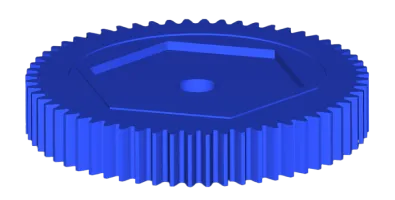
This operation merges vertices that are in close proximity, eliminating minor gaps and imperfections. It's particularly useful for models that have undergone extensive editing or format conversion, resulting in a more cohesive and stable mesh structure.
Component Unification
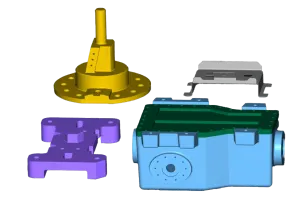
Mesh Healing in MeshLib SDK goes beyond just fixing imperfections — it plays a crucial role in unifying models with multiple components into a single, cohesive structure. This feature is particularly valuable when working with multipart assemblies or complex designs. By merging distinct components into one, Mesh Healing enhances the model’s structural integrity and simplifies further editing or analysis, ensuring a smoother workflow for intricate assemblies.
Advanced Hole Filling
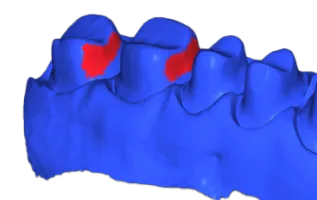
The SDK uses sophisticated algorithms to fill holes seamlessly, maintaining the original geometry's curvature and aesthetics. This operation is crucial for preparing watertight models, especially for 3D printing applications.
Precise Repositioning
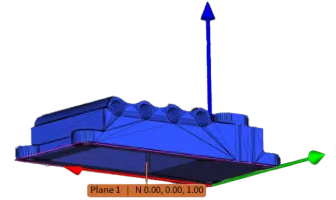
This function offers accurate adjustment of mesh vertices, enhancing both structural integrity and visual appeal. It's essential for fine-tuning details and aligning surfaces before further processing.
Tunnel Detection and Resolution

MeshLib SDK's algorithms identify and fix tunnels — unwanted pathways that penetrate a model. This ensures the model's integrity, particularly in simulation and manufacturing contexts where such anomalies could compromise functionality.
Self-Intersection Resolution
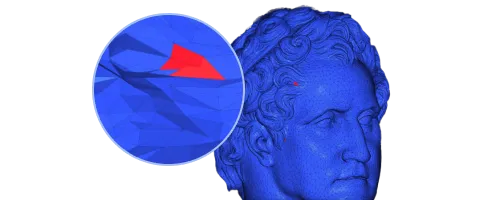
By detecting and resolving self-intersections, the SDK guarantees the production of error-free meshes. This capability is fundamental for creating models that are both visually appealing and functionally sound.
Efficient Noise Reduction
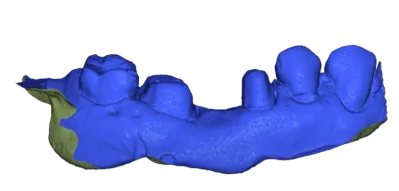
MeshLib efficiently smoothens mesh surfaces, eliminating noise and irregularities. This enhancement improves visual clarity and precision, making models ideal for high-resolution simulations and renderings.
Smart Decimation
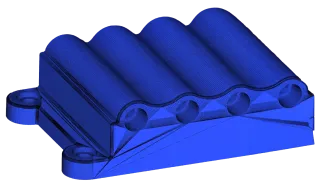
This powerful feature reduces mesh complexity without compromising quality. It enables faster processing and optimization for various applications, including online viewing and interactive gaming.
High-Quality Subdivision
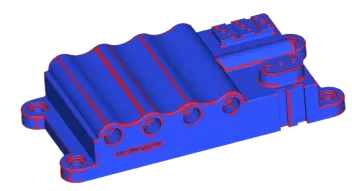
MeshLib SDK can increase the density of mesh elements, refining model details and smoothness. This is key for creating high-quality visuals and detailed simulations.
Offset Reconstruction
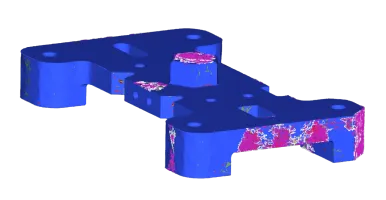
By rebuilding the mesh with an offset, this operation adds thickness to models — an essential step for many manufacturing processes and creating more robust designs.
Building Instant Mesh Repair with MeshLib SDK
MeshLib SDK empowers developers to seamlessly integrate advanced mesh healing functionality into their software. With MeshLib, developers can create tools like MeshHealer, offering users a 1-click solution to repair STL and OBJ files effortlessly. This SDK tackles complex issues such as self-intersections and non-manifold geometry, ensuring watertight models for 3D printing, simulations, or games. Its robust algorithms and developer-friendly design make it easy to build efficient, user-focused mesh repair tools with minimal effort, delivering powerful results in just a few clicks.
Why Choose MeshLib SDK for Mesh Healing?
Here's why MeshLib SDK is the top choice for Mesh Healing. It combines power, precision, and ease of use, making it essential for both professionals and beginners in 3D modeling.
Unmatched Robustness
MeshLib SDK offers comprehensive mesh healing operations, from simple fixes to complex issues. It efficiently handles everything from self-intersections to creating watertight models for 3D printing and simulations.
Precision
The toolkit maintains original model details while correcting errors, preserving intended geometry. This accuracy is crucial for high-fidelity applications in engineering and visualizations.
Efficiency
MeshLib leverages parallelization to handle large datasets effectively, making it a top pick within intensive modeling workflows.
Versatility
From 3D printing preparation to game asset optimization, MeshLib SDK adapts to diverse mesh healing needs across multiple industries.
Proven Performance
MeshInspector, powered by MeshLib SDK, processes models with millions of polygons quickly, consistently producing watertight, manifold models ready for immediate use.
MeshLib SDK is the ideal solution for building software with advanced mesh healing and repair functionalities. Its cutting-edge algorithms are designed to fix STL and OBJ files efficiently, ensuring models are perfectly prepared for 3D printing, simulation, or visualization. MeshLib’s precision, speed, and user-friendly interface make it a top choice for professionals and developers looking to integrate powerful mesh repair capabilities into their applications, delivering flawless results for both complex and simple 3D models.
Frequently Asked Questions
What is the primary purpose of Mesh Healing?
Mesh Healing prepares 3D models for various applications by fixing issues like holes, non-manifold edges, and inconsistent normals. It ensures models are watertight and error-free, making them suitable for simulation, analysis, and 3D printing.
Can MeshLib SDK handle large and complex meshes?
Yes, MeshLib SDK uses optimized algorithms and GPU acceleration to process large and complex meshes efficiently. It can handle models with millions of polygons, making it suitable for high-resolution scans and detailed CAD designs.
Why is MeshLib SDK good for preparing 3D printing models?
MeshLib SDK is a good solution for building software with mesh healing/repair functionality. It prepares models for 3D printing by making sure they're solid and printable. It also fills holes, fixes edge problems, and corrects model orientation, which is crucial for successful 3D printing.
Can MeshLib SDK work with other 3D modeling programs?
Yes, MeshLib SDK can easily connect with various 3D modeling software. It offers tools for developers to add its mesh healing abilities to their own programs. This makes MeshLib useful for both standalone work and as part of bigger 3D projects.
What sets MeshLib SDK apart from other mesh healing solutions?
MeshLib SDK offers a comprehensive set of healing algorithms and supports popular file formats. Its performance, accuracy, and ease of use make it a standout choice for professional 3D processing applications.
What our customers say
Massimo Ivani
CEO, Medialab

Read full review«Our application is a medical device, so we have to be able to trust the SDK behind it. We built a lot of internal tests before switching, and MeshLib gave us the precision we had before at twice the speed…»
Ruedger Rubbert
Chief Technology Officer, Brius Technologies Inc

Read full reviewWith MeshInspector MeshLib we were able to automate many of our workflow processes, thanks to its advanced, modern, and efficient dental and geometry oriented algorithms, covering many of our orthodontic-related tasks: CT and intraoral scan segmentation, voxel and Boolean operations, editing, aligning, visualization, inspection, and import/export of mesh objects. We use the versatile MeshInspector MeshLib API, both in production and R&D for fast prototyping and testing of our ideas.
Mariusz Hermansdorfer
Head of Computational Design at Henning Larsen Architechts

Read full reviewOver the past year, MeshLib has transformed my approach to design and analysis in landscape architecture and architecture projects. This powerful library excels in critical areas, such as geometry processing, interactive booleans, point cloud manipulation, and curve offsetting. These features enhance design workflows, allowing for dynamic modifications, efficient terrain modeling, stormwater flow analysis, and advanced wind flow visualiiza…
Gal Cohen
CTO, customed.ai

Read full reviewMeshLib has been a game-changer for our company, providing all the essential operations we need to handle meshes and create highly accurate personal surgical instruments (PSIs), which are our primary products. After extensive research and comparison, MeshLib stands out as the best solution on the market. Their team is exceptionally professional and knowledgeable. Collaborating with them has been an absolute pleasure—they respond to any issues we encounter promptly and always deliver effective solutions. Their commitment to customer support and technical excellence is truly unmatched.
HeonJae Cho, DDS, MSD, PhD
Chief Executive Officer, 3DONS INC

Read full reviewMeshLib SDK helped us achieve faster and more accurate calculation results and outperformed any other Mesh Processing library that we evaluated. For us in digital dentistry, it was a game-changer. Mesh processing operations, such as inspecting and editing the mesh to create dental devices for the treatment plan, are crucial. MeshInspector support liberated our team from technical constraints so we concentrated on creating exactly what we wanted. I highly recommend incorporating the MeshLib into your software arsenal.
Thomas Tong
Founder, Polyga

Read full reviewWhen we set out to develop our new PointKit scanning platform, we chose MeshInspector’s MeshLib as the foundation. That partnership let us accelerate development, ship new features faster, and get to market months sooner than we could have on our own. The MeshInspector team has been outstanding — quick answers, deep technical know-how, and genuine enthusiasm for our success. We simply wouldn’t be where we are today without their support.
Join companies switching to next-gen geometry algorithms.















Try MeshLib now
Booleans, mesh repair, decimation and ICP — in your browser, as JavaScript and WebAssembly. No install, no sign-up.
Open live demoOr install the SDK — free to evaluate