Published: 2025-04-10
Updated: 2026-09-16
Dmitry Lambin
Post rating: 0.0
3D Mesh Decimation Library
Comparison
Get the full 2026 benchmark report (PDF)
Key Takeaways
MeshLib (MT & ST)
Delivers the strongest combination of processing speed and mesh quality across both heavy and moderate simplification scenarios.
MeshLib (MT & ST)
Delivers the strongest combination of processing speed and mesh quality across both heavy and moderate simplification scenarios.
MeshLib (MT & ST)
Delivers the strongest combination of processing speed and mesh quality across both heavy and moderate simplification scenarios.
MeshLib (MT & ST)
Delivers the strongest combination of processing speed and mesh quality across both heavy and moderate simplification scenarios.
Introduction
The idea behind mesh simplification (also known as mesh decimation) is reducing the number of polygons in a given 3D mesh while preserving its overall shape and visual fidelity. Such a technique is understandably essential for optimizing 3D models. Namely, the goal here is to make meshes more suitable for real-world applications, which demand:
- Faster rendering and economical memory usage (especially in resource-constrained environments);
- Cost-efficiency which is to be secured thanks to minimized processing times and slightly reduced material consumption (say, like 3D printing);
- Compatibility based on adapting complex models for utilization on a variety of platforms.
Thus, from 3D printing and architectural visualization to medical imaging and geospatial modeling, mesh simplification underpins a wide range of use cases, making it an invaluable technique tool in computational geometry. To help you find an optimal library for mesh simplification tasks (in Python, C++, or both), our team conducted a practical search and will share some findings below.
Methodology
To ensure fair and reproducible results, every library was evaluated using the same benchmark methodology.
Evaluation scenarios
2M → 2K triangles
1000× or more reduction
- Maximum reduction
- Lower resource usage
- Stress-test scenario
2M → 200K triangles
10× reduction
- Better visual fidelity
- Balanced performance
- Practical production scenario
Heavy simplification risks
Holes, self-intersections, degeneracies, rendering disruptions, and manufacturing issues.
Moderate simplification trade-off
Balancing computational speed with visual fidelity while keeping the simplified surface usable.
Methodology process
Select libraries
Identify relevant open-source and commercial libraries for mesh simplification.
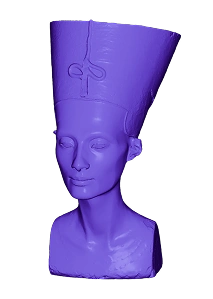
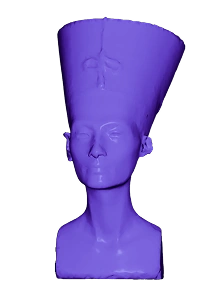
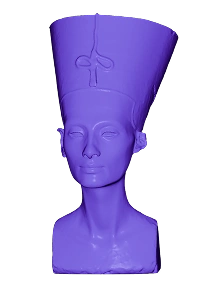
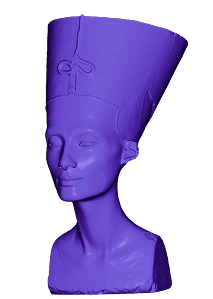
Prepare Nefertiti mesh
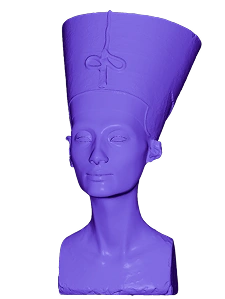
Use a consistent, high-complexity benchmark model (2M triangles) across all runs.
Run simplification
Execute heavy and moderate reduction scenarios with consistent parameters.
Measure quality
Evaluate output fidelity, structural integrity, and rendering compatibility.
Compare results
Normalize findings into a comparable matrix for developer decision-making.
- 11 libraries
- C / C++
- Python support
- Open-source & commercial
Libraries evaluated
Mesh Simplification Option | GitHub / Website | Primary Language(s) | Python Support | Notes |
|---|---|---|---|---|
MeshLib (ST and MT) | Download on GitHub
| C++ | Yes | Provides a robust API for Python. |
CGAL | Download on GitHub
| C++ | Yes | Python bindings available via SWIG. |
LibIGL | Download on GitHub
| C++ | Yes | Offers Python bindings. |
MeshLab | Download on GitHub
| C++, JS | Yes | Python support through PyMeshLab. |
Rhino 3D | Explore the website
| C++ | Yes | Supports Python via Rhino.Python. |
Fusion 360 (Adaptive and Uniform) | Explore the website
| C++ | Yes | Unified API accessible from both Python and C++. |
3DCoat | Explore the website
| C++ | Yes | Offers both a C++ Core API and a Python API. |
Fast Quadric Mesh Simplification | Download on GitHub
| C++ | Yes | Designed for C++; Python bindings can be created through wrapping techniques. |
MeshOptimizer | Download on GitHub
| C++ | Yes | Provides Python bindings. |
VTK | Download on GitHub
| C++ | Yes | Offers Python wrappers for its functionalities. |
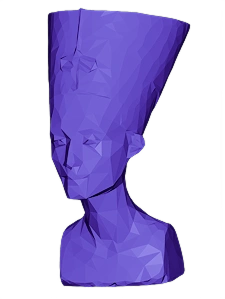
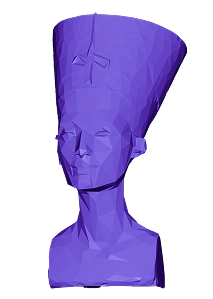
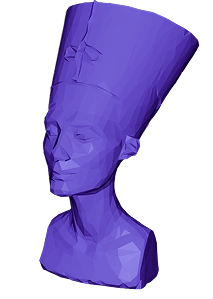
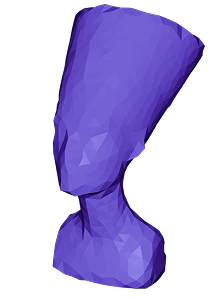
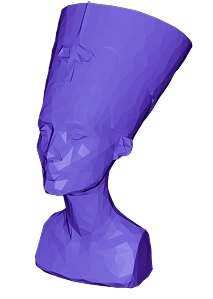
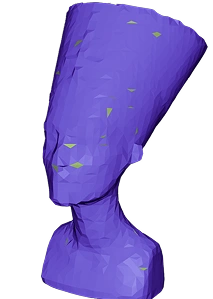
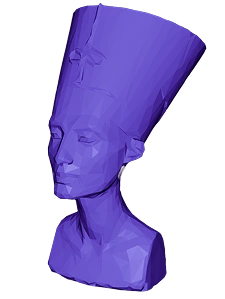
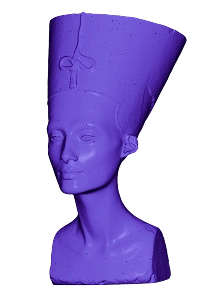
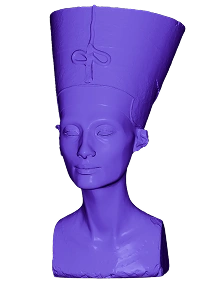
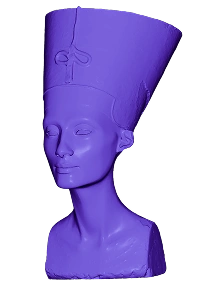
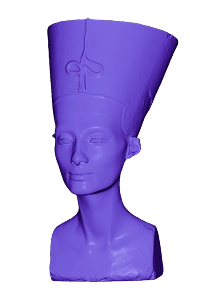
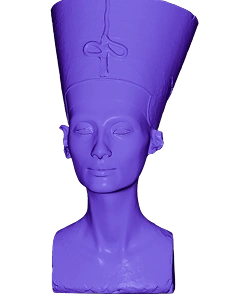
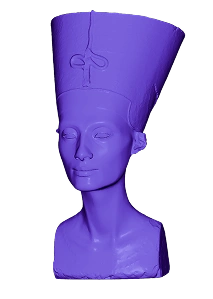
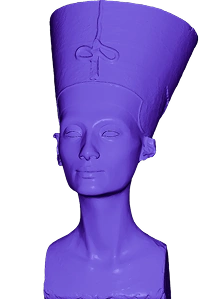
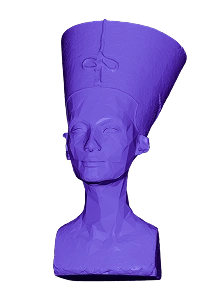
As for our object to run a test on, we opted for the iconic Nefertiti mesh (2M triangles) as the benchmark notable for its complexity and relevance in 3D modeling flows.
All tests were conducted on a consistent hardware basis to ensure reliable comparisons:
- Windows 11
- Intel Core i7-12700H
- 32GB RAM
- NVIDIA RTX 3060m (6GB VRAM)
Heavy Mesh Simplification Case
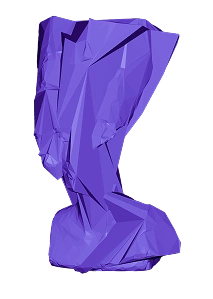
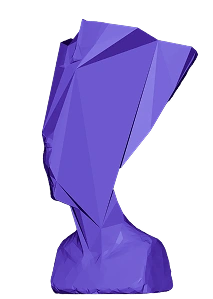
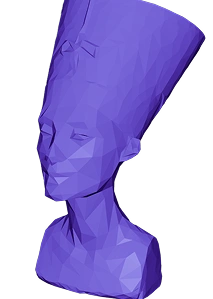
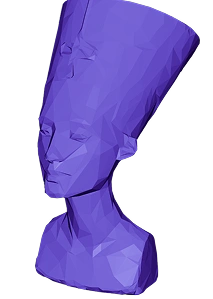
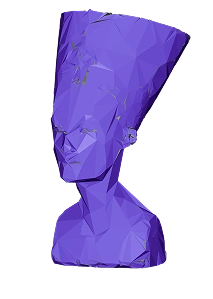
Again, for this test, our Nefertiti mesh (2 million triangles) was used. A reduction factor of 1000x was applied, resulting in a final mesh of 2000 triangles.
MeshLib ST
MeshLib MT
CGAL
LibIGL
MeshLab: Quadric Edge Collapse
MeshLab: Clustering
Rhino 3D
Fusion Uniform
3DCoat
Fast Quadric Mesh Simplification
MeshOptimizer
VTK
Moderate Mesh Simplification Case
For this test, our Nefertiti mesh (2 million triangles) was reduced by a factor of 10x, resulting in a final mesh of 200,000 triangles. This scenario evaluates how well libraries balance speed and quality while maintaining geometric fidelity in a less extreme reduction scenario.
MeshLib ST
MeshLib MT
CGAL
LibIGL
MeshLab: Quadric Edge Collapse
MeshLab: Clustering Decimation
Rhino3D
Fusion Adaptive
Fusion Uniform
3DCoat
Fast Quadric Mesh Simplification
MeshOptimizer
VTK
Notes on Verification Sources
In case you want to verify this research, dive deeper into it, or just feel curious, you can find all the files and code samples by following this link.
Try MeshLib now
Booleans, mesh repair, decimation and ICP — in your browser, as JavaScript and WebAssembly. No install, no sign-up.
Open live demoOr install the SDK — free to evaluate