Mesh Healing
Mesh healing is a critical process to prepare mesh for further use in the 3D pipeline, ensuring that mesh models are watertight, error-free, and suitable for applications such as s...
Discover moreMesh healing is a critical process to prepare mesh for further use in the 3D pipeline, ensuring that mesh models are watertight, error-free, and suitable for applications such as s...
Discover moreMesh offsetting enables the precise expansion or contraction of a 3D mesh surface, crucial for applications requiring exact wall thickness and custom surface control, like 3D print...
Discover moreCollision detection serves as a fundamental concept in computational geometry. In this capacity, it focuses on determining whether two or more objects intersect. Understandably, be...
Discover moreWith MeshLib’s flexible file format support, users can seamlessly integrate 3D models into various workflows for further processing and analysis.
Discover more3D boolean operations are essential for creating complex shapes and forms that would be difficult or time-consuming to model from scratch using traditional modeling techniques.
Discover moreThe term ‘Mesh Boolean operations’ refers to a particular set of manipulations that professionals apply to pairs of versatile 3D objects for the purpose of reshaping their geometri...
Discover morePoint cloud triangulation is the process of triangulating a point cloud— a set of 3D points captured by LiDAR or other scanning technologies—into a continuous triangular mesh.
Discover moreMesh simplification (aka mesh decimation) is, for all intents and purposes, a technique aimed at reducing the number of triangles in 3D models.
Discover moreMesh triangulation is a technique that swiftly converts point clouds into triangle meshes. In many cases, this process relies on pre-existing vertex normals to guide processes.
Discover moreCT 3D reconstruction is the process of converting a series of 2D CT scans captured from different angles into 3D volumes. In practice, it suggests combining multiple X-ray images t...
Discover moreIterative Closest Point (ICP) is, effectively, an algorithm that aligns two given 3D datasets. It takes a source object, i.e., a point cloud or a mesh, and estimates a rigid transf...
Discover more3D Viewer SDK is MeshLib’s plug-in rendering and UI layer. Written entirely in modern C++, this compact Viewer engine opens a window, draws your geometry, and presents a ribbon-sty...
Discover moreMesh smoothing refers to a group of algorithms, some iterative and some none-iterative, designed to reposition vertices in a 3D model to reduce noise and improve surface quality. W...
Discover moreVolume rendering is a potent technique for visualizing volumetric data—that obtained from scanning—by mapping each voxel’s density to specific colors and opacities. In this fashion...
Discover moreSigned Distance Fields (SDFs or distance volumes) are scalar fields most often stored as 3D voxel grids. Each voxel here records the shortest or unsigned or signed distance to a ta...
Discover moreMesh intersection computes the exact common volume shared by two polygonal models. Its potential, is applied to 3D data processing, computational geometry, and computer graphics. N...
Discover moreFilling holes in a mesh is a function that lets you correct topological defects, predictably known as holes. These defects are essentially missing regions where a continuous surfac...
Discover moreNo matching articles.
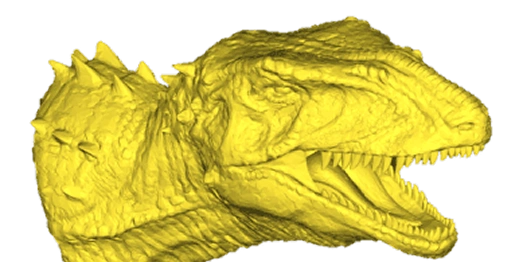
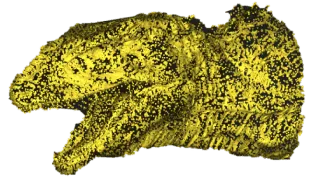
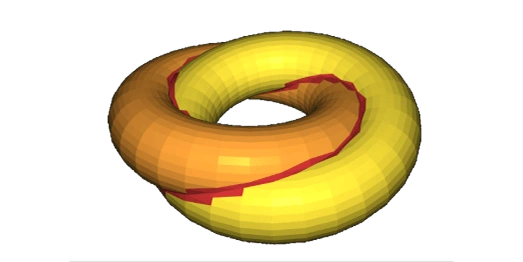
Finds colliding faces of two meshes in realtime.
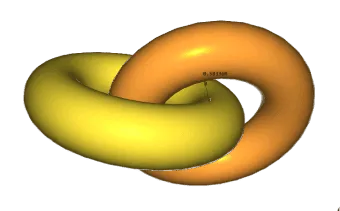
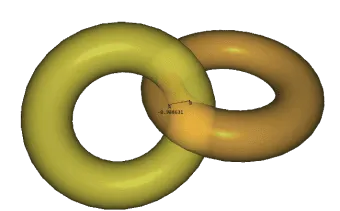
Finds minimal signed/unsigned distance between two meshes in realtime.
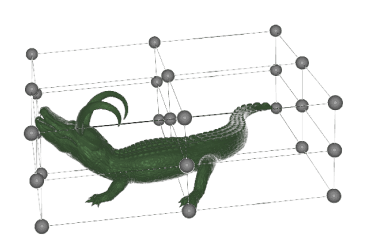
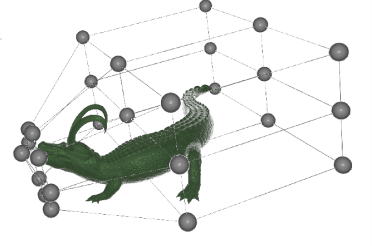
Applies free form transformation to mesh or finds best free form transformation to fit given points. Grey points – reference grid of free form transform (resolution is customizable)
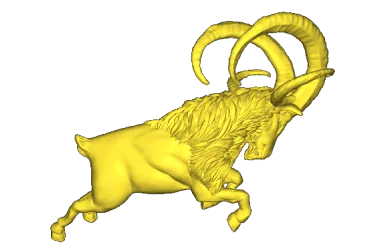
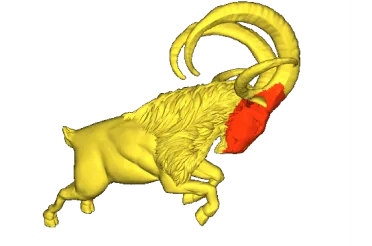
It modifies a surface region following the movement of some fixed points in this region, and preserving curvature in other points Read area – deformed area (a few points were fixed on forehead)
Triangulates a hole in mesh, or stitch two holes with a tunnel. Different metrics could be used for triangulation.
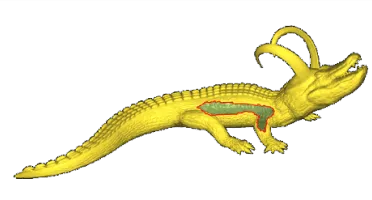
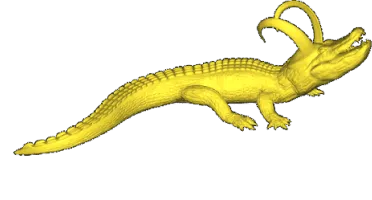
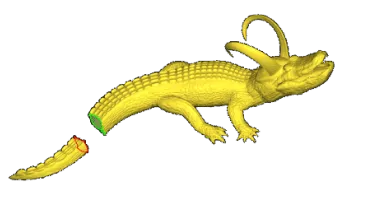
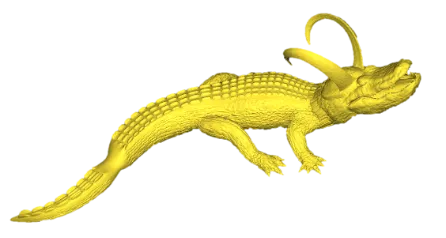
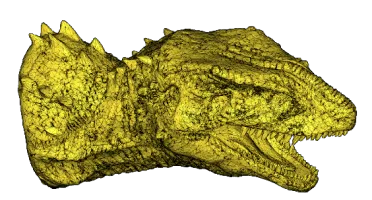
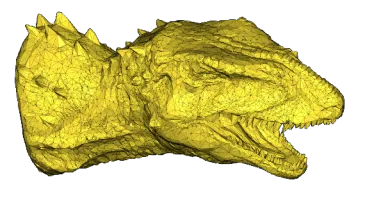
Decimation or simplification is reached by reducing the number of triangles, while preserving the overall initial shape and most prominent features.
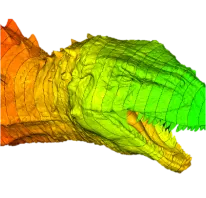
The task is to find the shortest path between two points along the surface. The implementation is very fast and robust allowing its application in real-time editing:
ICP is for finding the best aligning transformation (from some transformation group, e.g. the group of all rigid transformations) for two meshes.
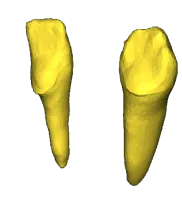
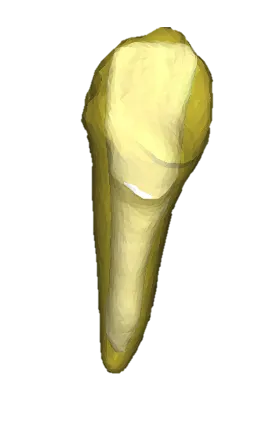
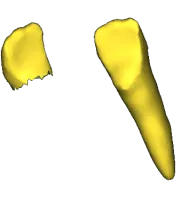
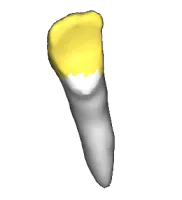
MeshLib can detect and fix tunnels on surface. Here on the left a thin tunnel is detected, a cut is made, each side of which is filled with a disc-like patch to get a topological sphere on the right:
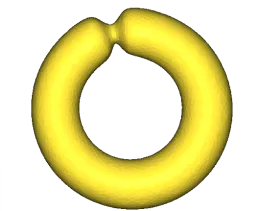
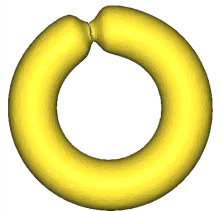
MeshInspector contains two implementations of 3D Boolean operations :
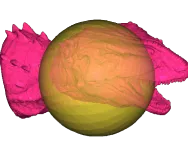
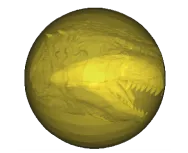
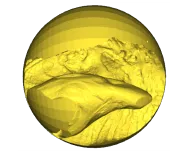
Offset selected part of mesh only and produce single component mesh as result.
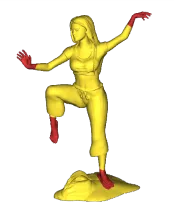
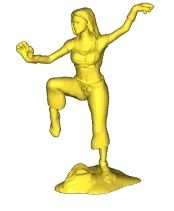
The task is to select a mesh region, separated from other mesh parts by a high curvature boundary (or some other metrics, including custom ones), given 2-3 points on the boundary.
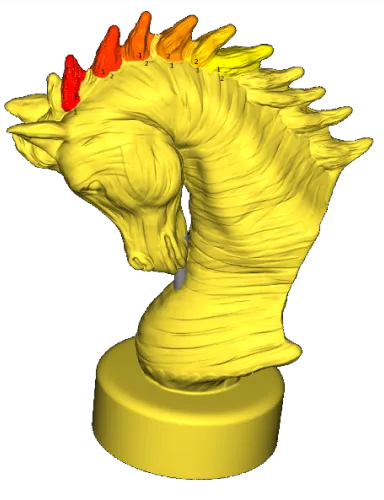
The picture demonstrates segmentation of crests.
Each one is segmented by two points picked on its base
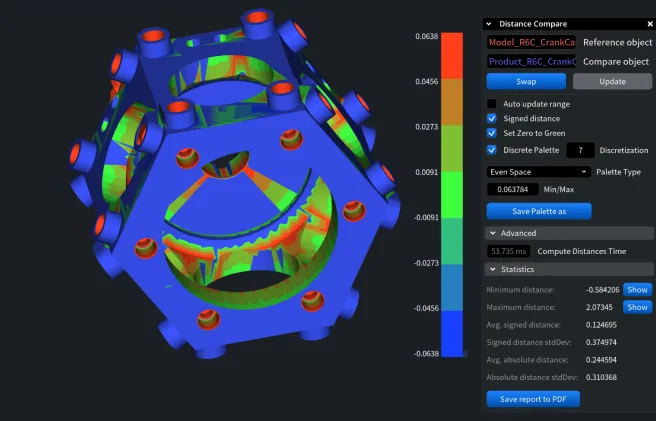
Effortlessly compare two models side by side, meticulously examining the surface distances. This innovative feature allows you to inspect the quality of your printed 3D model against the original CAD design. Identify even the slightest deviations and ensure your project meets the most stringent standards.
Depth map from some plane to mesh.Could be visualized in grey-scale image:– Black pixels of distance map – farthest– White pixels – closest
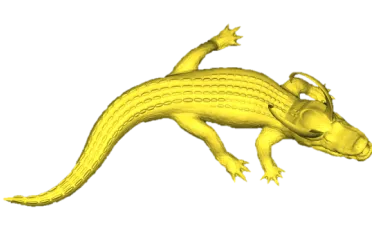
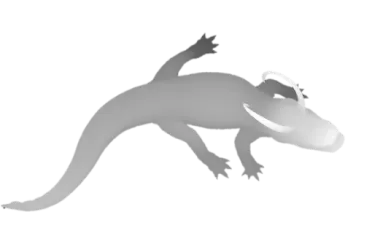
It presents field of distances in contours plane from each pixel, to contours closest point.Can be signed or unsigned. Zero value corresponds to input contour points
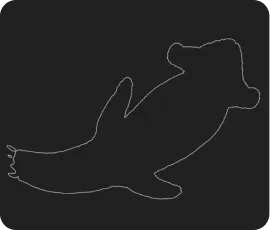
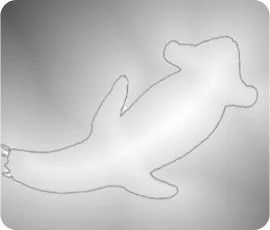
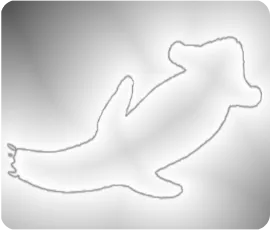
Finds iso-line contour on distance map of any kind.
Mesh – distance map visualization
Red line – input contour
Blue lines – iso-lines
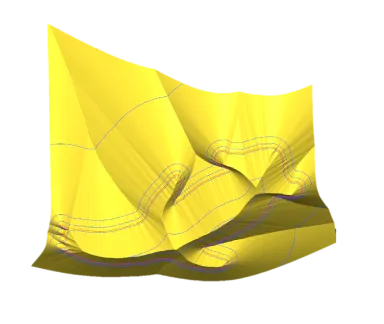
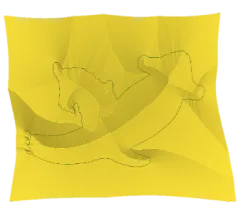
Merge min, max or subtraction of distance maps
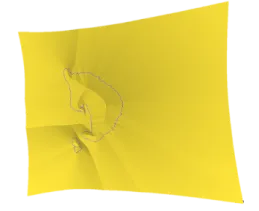
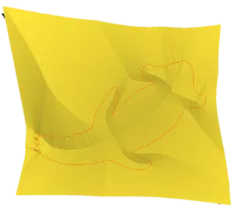
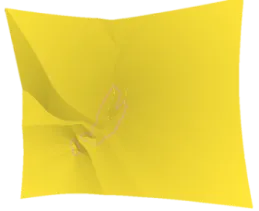
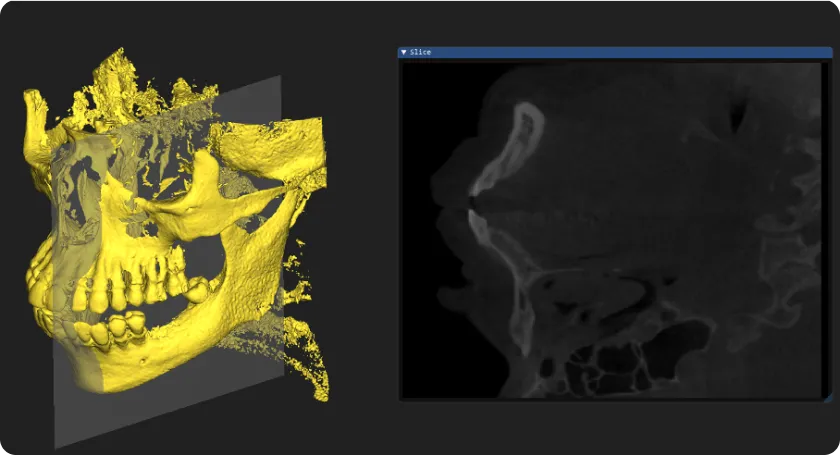
Voxel object presents 3D grid in space (visualized via Iso surface). The Picture demonstrates dense voxels and its slice.
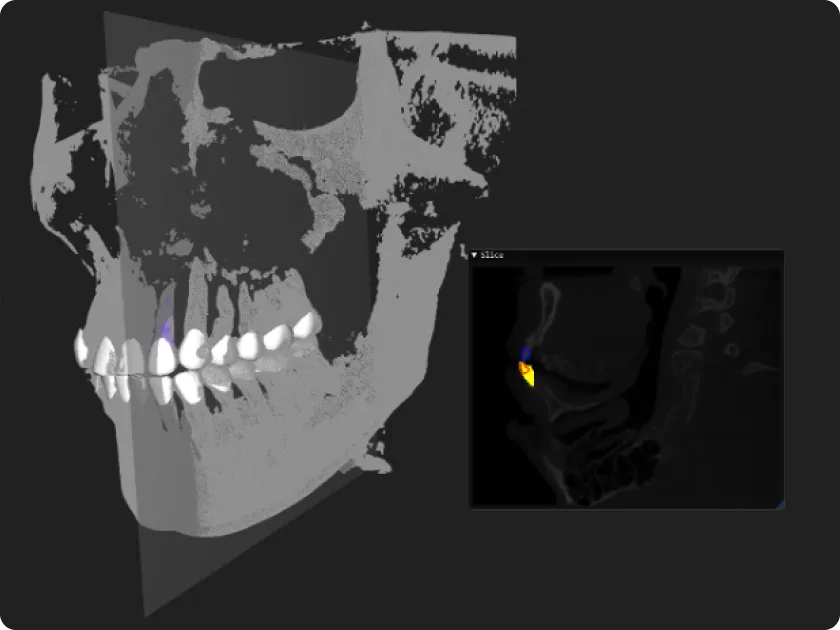
The picture demonstrates separation of tooth from the skull voxels.
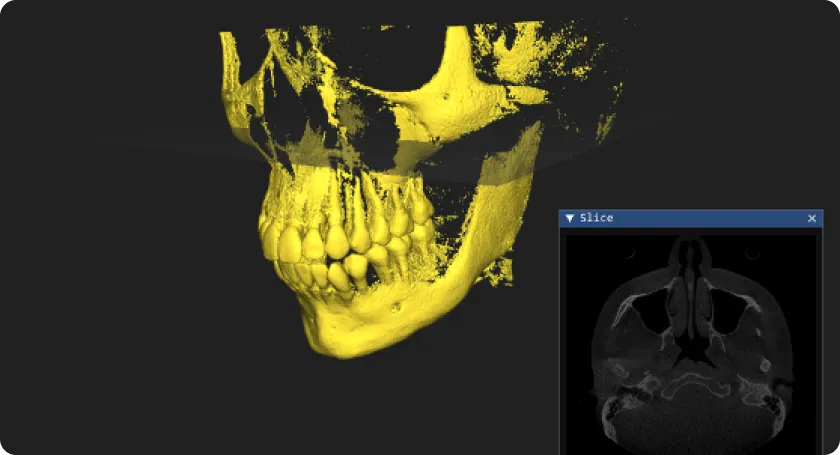
CT-Reconstruction algorithm implementation allows you to obtain dense volumes (voxel data) from a number of radiograph images. Voxel data generated by CT-Reconstruction
Sampling – algorithm for taking representative subset of points. Uniform and grid sampling are implemented.
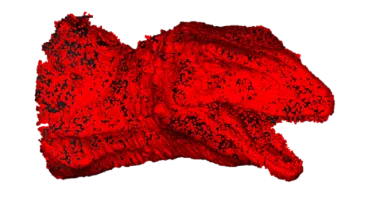
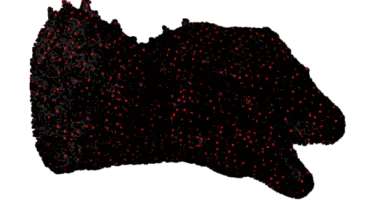
Creating mesh from point cloud
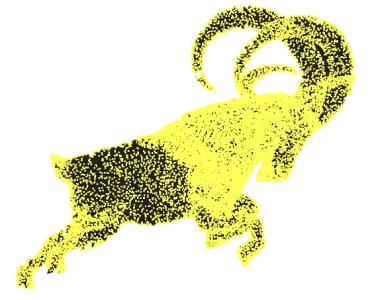
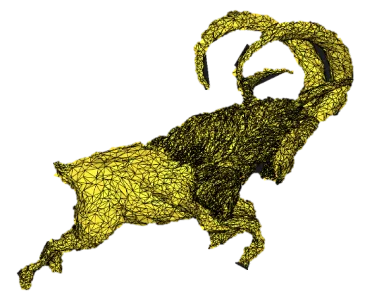
We use cookies to help you navigate efficiently and perform certain functions. You will find detailed information about all cookies under each consent category below.
The cookies that are categorized as "Necessary" are stored on your browser as they are essential for enabling the basic functionalities of the site.
We also use third-party cookies that help us analyze how you use this website, store your preferences, and provide the content and advertisements that are relevant to you. These cookies will only be stored in your browser with your prior consent.
You can choose to enable or disable some or all of these cookies but disabling some of them may affect your browsing experience.
Your browser is sending a Global Privacy Control signal, so we treat it as an opt-out of advertising: “Accept All” leaves the Advertisement category off. You can still turn it on yourself under Customize.
To learn more about how Google processes personal information, visit: Google privacy policy
Necessary cookies are required to enable the basic features of this site, such as providing secure log-in or adjusting your consent preferences. These cookies do not store any personally identifiable data.
Functional cookies help perform certain functionalities like sharing the content of the website on social media platforms, collecting feedback, and other third-party features.
Analytical cookies are used to understand how visitors interact with the website. These cookies help provide information on metrics such as the number of visitors, bounce rate, traffic source, etc.
Performance cookies are used to understand and analyze the key performance indexes of the website which helps in delivering a better user experience for the visitors.
Advertisement cookies are used to provide visitors with customized advertisements based on the pages you visited previously and to analyze the effectiveness of the ad campaigns.
Other cookies are those that are being identified and have not been classified into any category as yet.