MeshLib vs MCut: 3D Boolean Operations Benchmark
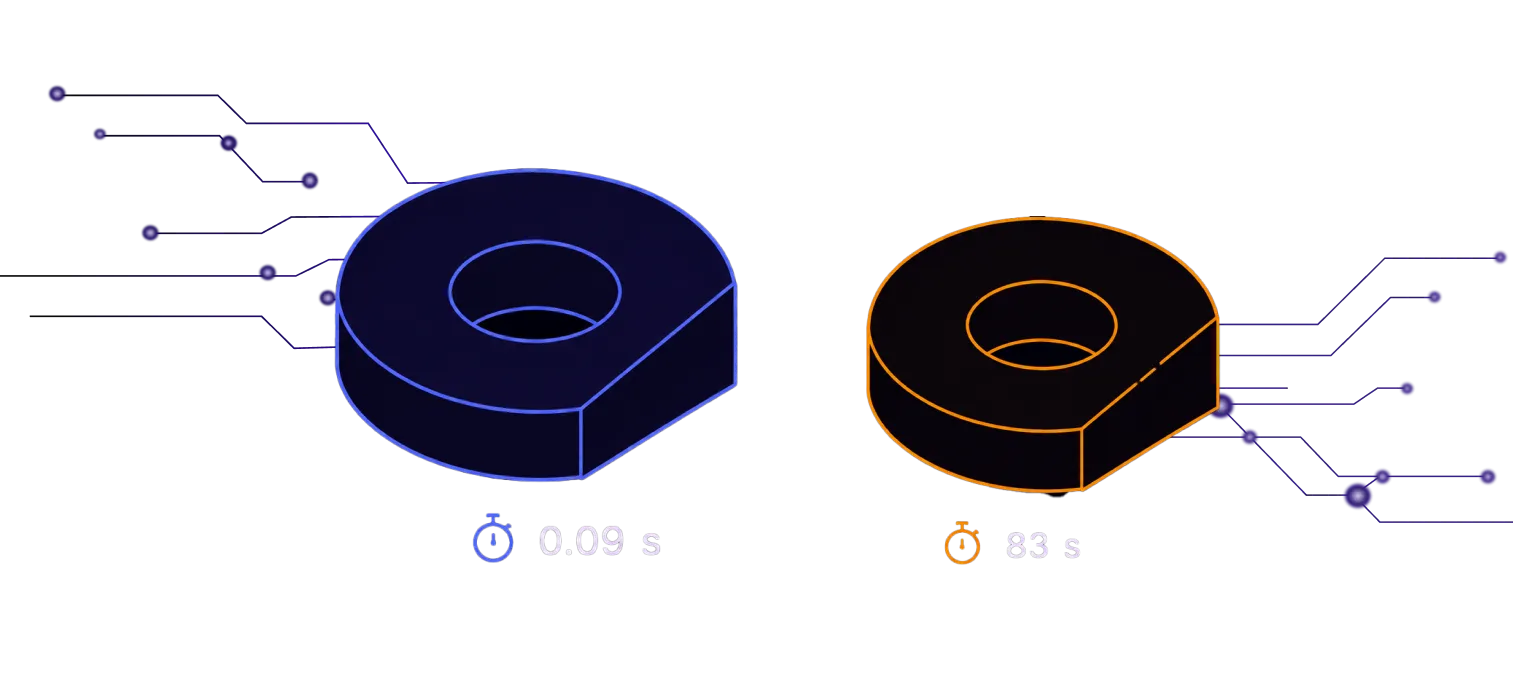
MCut takes an unusual angle on booleans: it is first and foremost an exact mesh-cutting library, and union, intersection, and difference come as applications of its cutting machinery. That design promises precision — but what does it cost on real production meshes? We benchmarked MCut against MeshLib on our 2026 test set: large scans, a degenerate dental model, and three qualitative edge cases.
What is MeshLib?
MeshLib is an open-source 3D geometry SDK whose boolean engine was built for real-world workloads from day one. The high-performance C++ core comes with bindings for Python, C#, C, and JavaScript, and the library is designed to digest the meshes scanners actually produce — non-manifold patches are converted automatically into a form the algorithms can process at full speed.
What is MCut?
MCut is an open-source C++ library for cutting and slicing meshes, developed from computer-graphics research on exact mesh arithmetic. Boolean operations are exposed as one application of its general cutting API, which also targets scenarios classic CSG kernels avoid, such as sectioning open meshes. MCut is distributed under LGPL-3, with a commercial licensing option available.
MeshLib vs MCut comparison results
Testing setup — Apple M5 MacBook Air (10-core CPU, 32 GB unified memory), macOS 26. We report the minimum over 10 iterations per operation; mesh I/O is excluded from the timings. To access the input and result meshes used in our tests, visit this link.
Nefertiti Case
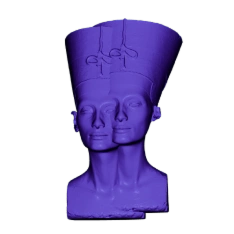
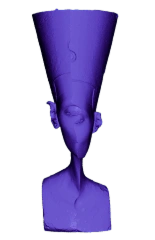
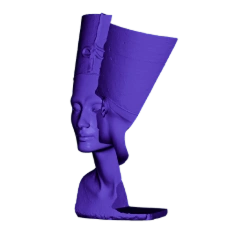
This scenario involves large meshes (2M Triangles each) with complex topology, representing a common challenge in 3D boolean operations.
| Operation | MeshLib 3.1.3.249 | MCut |
|---|---|---|
| Nefertity — Union | 0.09 (0.26) | 83 |
| Nefertity — Intersection | 0.08 (0.23) | 83 |
| Nefertity — Difference | 0.08 (0.23) | 83 |
Comments
The large-scan case is hard on MCut: every operation takes about 83 seconds, and in our runs the union output additionally contained defects, so it did not pass the correctness check. MeshLib completes the same operations in 0.08–0.09 seconds — roughly a thousand times faster — with correct output for all three operations. Numbers in braces are MeshLib’s one-time geometric precomputations.
Dental Case
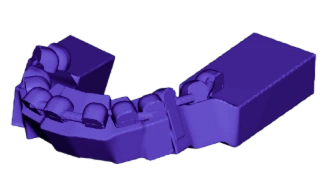
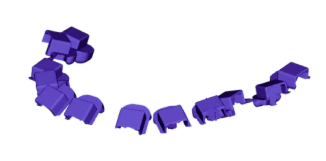
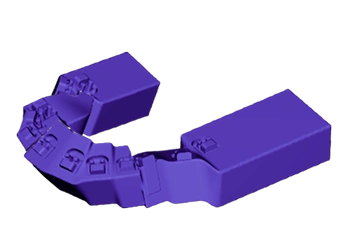
In this case, we simulate dental models (≈500K Triangles) with degeneracies and coinciding surfaces, reflecting real-world scenarios encountered in medical applications.
| Operation | MeshLib 3.1.3.249 | MCut |
|---|---|---|
| Dental — Union | 0.04 (0.06) | Fail |
| Dental — Intersection | 0.05 (0.08) | Fail |
| Dental — Difference A-B | 0.05 (0.07) | Fail |
Comments
The dental scan, with its degenerate triangles and coinciding surfaces, is the robustness stress test of this benchmark — and MCut fails all three operations on it outright. MeshLib processes the same model in 0.04–0.05 seconds per operation and returns correct results.
Simple Objects Case
In this case, we compare how algorithms behave when handling complex geometries.
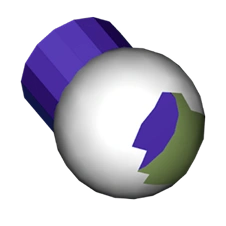
Boolean Union of meshes, one with a hole aside from the intersection part.
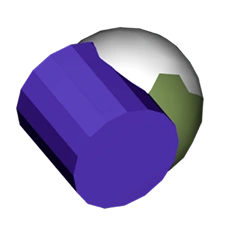
Boolean Union of meshes, one with a hole into the intersection part.
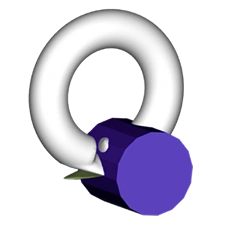
Boolean Union of meshes, one with self-intersections into meshes’ intersection part.
| Operation | MeshLib 3.1.3.249 | MCut |
|---|---|---|
| Holed, Not Intersected | Yes | Yes |
| Holed Intersected | No* | No |
| Self- Intersections | No** | No |
Comments
The qualitative cases show MCut’s cutting heritage: like MeshLib, it successfully processes the mesh whose hole stays clear of the intersection zone. Neither engine accepts a hole inside the intersection area, and both decline self-intersecting input — an operation MeshLib deliberately treats as ill-defined.
* MeshLib does not support the representation of non-manifold meshes and automatically converts them to a manifold form. ** The results of such operations are not well-defined, leading to a mesh with numerous inconsistencies, such as self-intersections and degeneracies. See why 3D Boolean operations may fail.
Why choose MeshLib SDK for 3D boolean operations over MCut?
MCut is a specialized instrument: if your task is literally cutting meshes, it serves a niche few libraries address. As a general boolean engine, the 2026 numbers are hard to argue with: MeshLib is orders of magnitude faster on large scans, survives the degenerate dental case that MCut fails, and ships as a commercially supported SDK with bindings for C++, Python, C#, C, and JavaScript. For production booleans, MeshLib is the safer default.
What our customers say
Massimo Ivani
CEO, Medialab

Read full review«Our application is a medical device, so we have to be able to trust the SDK behind it. We built a lot of internal tests before switching, and MeshLib gave us the precision we had before at twice the speed…»
Ruedger Rubbert
Chief Technology Officer, Brius Technologies Inc

Read full reviewWith MeshInspector MeshLib we were able to automate many of our workflow processes, thanks to its advanced, modern, and efficient dental and geometry oriented algorithms, covering many of our orthodontic-related tasks: CT and intraoral scan segmentation, voxel and Boolean operations, editing, aligning, visualization, inspection, and import/export of mesh objects. We use the versatile MeshInspector MeshLib API, both in production and R&D for fast prototyping and testing of our ideas.
Mariusz Hermansdorfer
Head of Computational Design at Henning Larsen Architechts

Read full reviewOver the past year, MeshLib has transformed my approach to design and analysis in landscape architecture and architecture projects. This powerful library excels in critical areas, such as geometry processing, interactive booleans, point cloud manipulation, and curve offsetting. These features enhance design workflows, allowing for dynamic modifications, efficient terrain modeling, stormwater flow analysis, and advanced wind flow visualiiza…
Gal Cohen
CTO, customed.ai

Read full reviewMeshLib has been a game-changer for our company, providing all the essential operations we need to handle meshes and create highly accurate personal surgical instruments (PSIs), which are our primary products. After extensive research and comparison, MeshLib stands out as the best solution on the market. Their team is exceptionally professional and knowledgeable. Collaborating with them has been an absolute pleasure—they respond to any issues we encounter promptly and always deliver effective solutions. Their commitment to customer support and technical excellence is truly unmatched.
HeonJae Cho, DDS, MSD, PhD
Chief Executive Officer, 3DONS INC

Read full reviewMeshLib SDK helped us achieve faster and more accurate calculation results and outperformed any other Mesh Processing library that we evaluated. For us in digital dentistry, it was a game-changer. Mesh processing operations, such as inspecting and editing the mesh to create dental devices for the treatment plan, are crucial. MeshInspector support liberated our team from technical constraints so we concentrated on creating exactly what we wanted. I highly recommend incorporating the MeshLib into your software arsenal.
Thomas Tong
Founder, Polyga

Read full reviewWhen we set out to develop our new PointKit scanning platform, we chose MeshInspector’s MeshLib as the foundation. That partnership let us accelerate development, ship new features faster, and get to market months sooner than we could have on our own. The MeshInspector team has been outstanding — quick answers, deep technical know-how, and genuine enthusiasm for our success. We simply wouldn’t be where we are today without their support.
Try MeshLib now
Booleans, mesh repair, decimation and ICP — in your browser, as JavaScript and WebAssembly. No install, no sign-up.
Open live demoOr install the SDK — free to evaluate